
Recovering nearly $2 billion from job quitters who cheated the Canada Emergency Response Benefit program would create an “undue burden” for investigators, says a federal memo. More than 190,000 claimants quit work to take a “CERB vacation.”
E.I. Premiums To Rise Again
Employment Insurance premiums are at a “historical low” and must rise again to cover pandemic cost overruns, says the Department of Employment. New premium rates are due to be detailed by month’s end: “Rates are expected to continue to increase in 2024.”
Halt Emergency Aid For Vote
The Prime Minister’s snap 2021 election call disrupted a crucial Covid relief program, says a federal audit. Justin Trudeau left no one to approve payments for mercy flights carrying essential food and medicine to 140 remote hamlets: “That did not happen.”
Follow Money On Food Aid
Only a “small portion” of millions in federal grants to a foreign aid group went to “critical nutrition needs,” say auditors. Taxpayers are the largest single donors to the Canadian Foodgrains Bank Program: “There were shortcomings.”
$215M Reactors Just A Starter
Cabinet says it must continue to subsidize development of small modular nuclear reactors though none are in use to date. “The federal government acknowledges it has a role to play,” said Energy Minister Jonathan Wilkinson: “Canada will need to act boldly.”
Air Complaints Past 55,000
The number of air passenger complaints at the Canadian Transportation Agency has grown to more than 55,000, by official estimate. The Agency responsible for handling complaints of poor service typically manages 10,000 a year: “Customers? Always dead last.”
Gov’t Ranks Pets’ Popularity
In-house research by a federal agency settles longstanding disagreements over the most popular pets. The Canadian Food Inspection Agency was conducting surveys on animal diseases when it compiled new data on who owns which pets, from turtles to livestock.
“Lead by Example”: A Poem
A psychologist
on TV
says this generation
needs more
person-to-person contact.
His words struck a chord with me.
I would like to respond,
express my agreement.
Where do I find his email?
By Shai Ben-Shalom

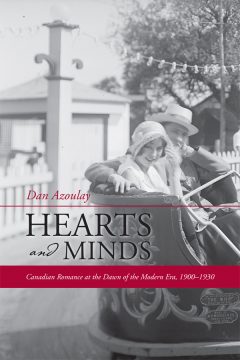
Book Review: Sex & The Model T
“Old maid” once defined a single woman of 23. In rural Canada bachelors outnumbered ladies by 46 percent. With those kinds of pressures, how could an average Canadian get a decent date a hundred years ago?
The answers are unearthed in an unusual archaeological dig. Historian Dan Azoulay of McMaster University picked through some 20,000 lonely-hearts columns published in Western Home Monthly and Family Herald from 1904 to 1929 to document the dating game in the words of those who played it. “I believe I could live with almost anyone who could cook a good meal, wash the dishes and not grumble,” as one Alberta farmer put it.
Women were prized for prowess in making pie, playing the piano and appearing “delicate” but “not too proud.” Conversely eligible men were required to sober up, bathe and have cash: “To a good many bachelors, in other words, size mattered – the size of their land, their homes, and their bank accounts,” Azoulay writes in Hearts and Minds.
Rules of dating were excruciating: No touching, no wisecracking, no colourful language. Even gifts were prescribed: a book for her, a pencil holder for him.
“Two weeks before the start of World War I an Ontario bachelor had submitted a poem to the Family Herald called ‘Wanted: A Wife.’ The last verse went as follows: ‘A commonsense creature, but still with a mind to teach and to guide, exalted, refined – A sort of angel and housemaid combined.’”
“This was what most men wanted in 1914. After the war, they wanted something different.” In an instant all this Victorian ritual was swept away. Azoulay captures the moment with the Model T Ford.
Four cylinders, with no heater and a crank starter that could break your arm on recoil, the first mass-produced auto put sex on wheels. “There is much truth in the complaint of the young man that no girl wants him unless he owns a car!” the Herald reported in 1920. “There is nothing I like better than to see a woman who likes to…drive,” wrote one bachelor.
By the end of the decade – the Model T went out of production in 1927 – the number of births out of wedlock in Canada rose from 2 to 3.2 percent. “Some historians have said that, because men were now paying more for such outings, they expected physical affection in return,” notes Azoulay. “Possibly, but women seem to have been more than willing.”
By Tom Korski
Hearts and Minds by Dan Azoulay, University of Calgary Press; 300 pages; ISBN 978155238-5203; $35.95
Asked If They’d Spy For Feds
The Canada Revenue Agency asked accountants if they’d report small businesses that don’t pay their taxes, records show. “Very few were interested,” said in-house research: “Some felt it would be unlikely that Canadians would report on one another.”
Freeland Friend Is Appointee
The Department of Finance hired a friend of Minister Chrystia Freeland as a senior advisor, records show. Freeland said she played no role in the appointment: ‘I want to avoid any appearance of preferential treatment or any opportunity to further the private interest of a friend.’
Air Challenge In High Court
The Supreme Court yesterday agreed to hear airlines’ challenge of passenger compensation rules on international flights. A lower court dismissed airlines’ claim that Canadian regulators had no jurisdiction on flights that originated or ended outside the country: “Canada requires an effective air passenger rights regime.”
Must Triple Electricity Power
Canada must double or triple its electricity output to meet 2050 climate targets, says a Newfoundland and Labrador submission to the Senate energy committee. Meeting targets is “likely not possible” without more federal subsidies, it said: “That is the equivalent of four Churchill Falls.”
Electric Subsidies Now $32B
Federal subsidies for electric car makers yesterday reached $32 billion, twice the annual output of the entire Canadian auto sector. “It’s pretty remarkable,” Industry Minister François-Philippe Champagne said in awarding another subsidy to Ford Motor Company: “I think it is a big accomplishment.”
Agency Won’t Host Riff-Raff
Canadians must focus on “high value guests” in tourism, says a federal agency. Wealthy foreigners are “naturally curious,” “seek culture” and spend more than working people, it said: “In other words, value and values over volume.”