Ottawa Lost: A Forgotten PM

The political heart of Ottawa spans a ten-square block area of the old city stretching from Wellington to Somerset Streets. Here on Somerset lived Prime Minister John Thompson, a workaholic who wrote Canada’s first Criminal Code, created Labour Day in 1893 and was an early supporter of votes for women.

“The days are not long enough for all the work I have to do,” wrote Thompson. “About all the exercise I can get is the walk from my house up to the Hill and back.”

Thompson was a brilliant young lawyer whose career was meteoric. At 15 he was a Halifax law clerk, at 26 a city alderman. By 37 he had become attorney general of Nova Scotia and a high court judge. “The best thing I ever invented is Thompson,” said John A. Macdonald, who recruited him as federal justice minister in 1885.

For three years Thompson lived in Ottawa boarding houses, lonely and miserable while his wife and children remained in Halifax. In order to forget his solitude, he would work late into the night at his office on the Hill.

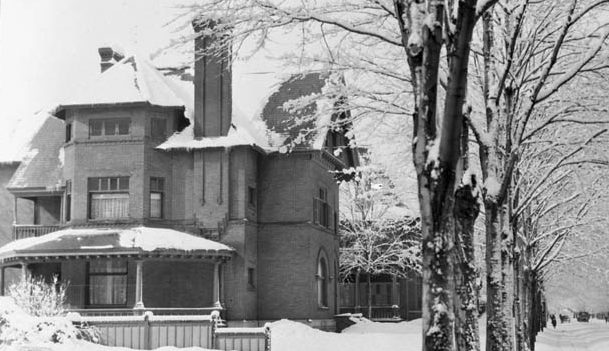
When re-united with his family Thompson resumed a joyous home life. He and his wife Annie had nine children. He was devoted to them. For years they led a rambling existence, moving from one rental house to another. On becoming prime minister in 1892 Thompson moved to a grand home at 276 Somerset Street. It was a splendid, over-the-top Queen Anne Revival affair.

Here Thompson read Treasure Island to his children and left love notes for his wife. He called her “baby dear.” She nicknamed him “grunty.” Biographer Peter Waite recounted: “He always remembered birthdays and gifts for the children. He was a wonderful family man.”

Thompson had vices too. He smoked and ate too much. His favourite lunch was a fistful of coconut caramels. At 5’ 7” his weight ballooned past 200 pounds. In September 1894 he was diagnosed with heart trouble and advised by doctors to lose weight and stop drinking rye.

“You have to give your best and your worst,” Thompson said. Tragically, the prime minister who gave his best did not have long to live.

Seven weeks after seeing his doctor, Thompson left the capital on an Italian holiday. In Rome he proposed to climb the 404 steps to the top of St. Peter’s Dome. Left panting by the exertion, Thompson took to his bed for two days. Shortly afterward he was summoned to London to receive an honour from Queen Victoria.

On Dec. 12, 1894, at a luncheon with the Queen, Thompson dropped dead of a heart attack. He was 49. Back in Ottawa a newspaper reporter ran to the house on Somerset Street to break the news to Thompson’s widow. “If it were not for children,” she wrote, “I should long to creep away in some corner and die.”

Thompson died so poor Parliament paid the cost of the funeral. His estate totaled $9,727. Today he is forgotten. While most of the grand houses at Somerset and Metcalfe Streets survive, Thompson’s home was demolished, replaced with a dreary 1960s apartment building. No monument commemorates his life in Ottawa.

By Andrew Elliott

Review: Dreams Of Boiling Water

Explorer Vilhjalmur Stefansson said the Arctic was at the very centre of national life though southerners thought of it as the edge of the frontier. The unforgiving land and its rugged people are instantly recognizable worldwide as uniquely Canadian. Say “Canada” from Germany to Japan and foreigners see Inuit art, Northern lights and merciless winters.

Johnny Neyelle, a Dene Elder with the Bear Lake people, from the 1980s made cassette recordings of ancient lore and his life experience. Neyelle had a stark purpose. As his son Morris puts it, “I realized that storytelling was changing and that kids weren’t coming to listen to the Elders’ stories anymore.”

“Elders were the greatest teachers we had,” Neyelle explained. “Think of rolling together all the professional experts like lawyers, doctors, teachers, priests, scientists, whatever, all rolled into one. That’s what they were. If you had a problem, they were the ones to ask for help.”

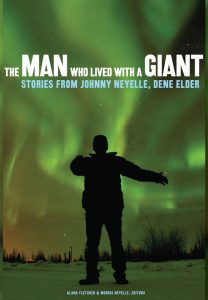
Neyelle died in 2002 at 87. The University of Alberta Press transcribed Neyelle’s recordings into The Man Who Lived With A Giant, an oral history from the centre of the world. It is a haunting and beautiful book, a documentary of life as it was for millennia with tales of prophetic dreams and reincarnation, survival and starvation, inter-tribal warfare and a “crowded land of the dead.”

“A lot of people would starve during the winter,” said Neyelle: “They had to hunt enough to put up food for the coming winter, since winters were always severe.”

The stories are appreciable to modern readers. Neyelle tells of a medicine man who could summon the power of the sun to bring lake water to a boil. It was “passed on to us during the cold winter nights,” a pleasing thought in the sunless cold.

There is an account of cannibalism. The origins of the legend require little imagination: “There was a man who was a very strong medicine man. In those times, people would often curse each other and put hexes on each other if they got really angry. There was one such man who was a jealous type, and he would make his enemies dream he was a giant who ate people. After a while he started to believe the dream himself, and then he started hunting people and eating them. He ate all his children and his whole family except for his mother, who also turned to cannibalism. Everyone around was afraid.”

Neyelle recalls the code of the Bear Lake people as eloquent as the Ten Commandments. “Talk wisely and truthfully, because if you don’t, misadventure will befall you,” he told his cassette recorder. In a dream from his 30s, he recalled a vision of the afterlife with old people and small children awaiting judgment in the clouds.

“Those are the people you need to help most while you’re on earth, the old people and the orphans,” a Guardian tells Neyelle. “That pleases God the most, since those people often have nobody to help them though they need it most.”

The Man Who Lived With A Giant is unforgettable.

By Holly Doan

The Man Who Lived with a Giant: Stories from Johnny Neyelle, Dene Elder; University of Alberta Press; 160 pages; ISBN 9781-77212-4088; $24.99

MPs Question $218 Breakfasts

MPs yesterday demanded to see actual menus for costly in-flight meals for Governor General Mary Simon. Food expenses on a junket to Dubai were the equivalent of $218 per plate for breakfast, lunch and supper servings for Simon and 45 others: “We’d like to know whether we are dealing with caviar and champagne.”

This content is for Blacklock’s Reporter members only. Please login to view this content. (Register here.)

Bracing For Painful Recession

Canada is headed for recession and it is “not going to feel so good,” David Dodge, retired Bank of Canada governor, yesterday testified at the Senate banking committee. Dodge faulted his successors at the Bank for incorrect forecasts that were “not very helpful.”

This content is for Blacklock’s Reporter members only. Please login to view this content. (Register here.)

“Shoot Them” Draws Protests

A reporter for the Canadian Bar Association National Magazine faces a Commons review after posting a Twitter comment about shooting a Conservative MP. Protests yesterday coincided with a parliamentary report that complained of online abuse targeting public office holders: “This is not normal political discourse.”

This content is for Blacklock’s Reporter members only. Please login to view this content. (Register here.)

Too Late To Avert Pot Losses

A statutory review of marijuana legalization comes too late to save dozens of federally licensed wholesalers and retailers that have filed for bankruptcy, a cannabis trade group said yesterday. A total 34 marijuana corporations have become insolvent since 2020: ‘We cannot wait for changes.’

This content is for Blacklock’s Reporter members only. Please login to view this content. (Register here.)

Lobbyists Got RCMP Blacklist

A police blacklist of bank account holders named as Freedom Convoy sympathizers was emailed to lobbyists, records disclose. The RCMP distributed names, birth dates, phone numbers and other personal information by unencrypted email, contradicting public claims by cabinet: “Haphazard would be an understatement.”

This content is for Blacklock’s Reporter members only. Please login to view this content. (Register here.)

Gov’t Admits $3 Billion Error

Nearly $3 billion in pandemic relief was paid to undeserving claimants, records show. Less than a billion has been recovered to date, cabinet disclosed in an Inquiry Of Ministry tabled in the Commons: “The intended total recovery amount cannot be predicted with accuracy.”

This content is for Blacklock’s Reporter members only. Please login to view this content. (Register here.)

Took Years At Passport Office

The passport office took more than two years to restore in-person staffing levels despite warnings of increased demand for travel documents. Newly-disclosed records also confirmed as late as this past summer more than a tenth of staff continued to work from home: “We are doing everything we can.”

This content is for Blacklock’s Reporter members only. Please login to view this content. (Register here.)

Sorry For Misguided Dealers

Criminal law should not punish misguided drug dealers who just want to “put bread on the table,” Attorney General David Lametti said yesterday. Lametti made the comment in defending a cabinet bill to repeal mandatory minimum sentences for cocaine traffickers: “Did you talk to victims’ groups?”

This content is for Blacklock’s Reporter members only. Please login to view this content. (Register here.)

Expect Two More Years: Bank

Inflation and interest rates will remain above pre-pandemic rates for about two years, a deputy governor of the Bank of Canada said yesterday. Paul Beaudry told University of Waterloo students it was “too early” to say if interest rate hikes will choke the economy into recession: “You get worried.”

This content is for Blacklock’s Reporter members only. Please login to view this content. (Register here.)

Court Okays Curb On Rights

Pandemic restrictions on the size of outdoor gatherings were justified, Saskatchewan Court of King’s Bench ruled yesterday. The decision came in the case of protesters fined $2,800 apiece for breaching a public health order limiting outdoor gatherings to ten people: “We can all see things which we would wish had been done differently or not at all.”

This content is for Blacklock’s Reporter members only. Please login to view this content. (Register here.)