
The immigration department is keeping a Conservative “barbaric practices” law on the books “to find out if this is actually happening,” says a senior manager. Then-Immigration Minister Chris Alexander sponsored the contentious 2015 bill targeting polygamy and forced marriage in the immigrant community: “This brings back memories.”
Reject 23% Fee Hike For Now
Federal regulators have deferred a proposed 23 percent hike in subscription fees for CPAC, broadcaster of parliamentary proceedings since 1992. The Cable Public Affairs Channel said it faces ruinous losses despite a multi-million dollar bailout in 2024: “We cannot continue to provide our core services.”
Fear Wine Drinking ‘Stigma’
A Senate bill mandating health warnings on liquor labels would “stigmatize” wine drinkers, says a petition by the Wine Growers of Canada. The Senate social affairs committee recommended the bill for Third Reading after concluding drinkers should be cautioned on their risks of disease: “It does ruin lives and kills people.”
Higher Stamp Rates In 2026
Canada Post is signaling more stamp rate hikes in 2026 amid ongoing pre-tax losses approaching $1 billion to date this year. The price of mailing a domestic letter has increased 35 percent in the past 18 months, from 92¢ to $1.24: “Rates are underpriced.”
A Poem: ‘Cautionary Advice’
Due to the associated
smell,
skunks are strongly advised
to stay away
from politics.
(Editor’s note: the author, an Israeli-born biologist, writes for Blacklock’s each and every Sunday)

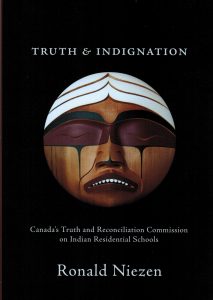
Review: The Truth
It was an unnerving moment at a Victoria hearing of the Truth and Reconciliation Commission on Indian Residential Schools. An aging priest was to testify. There were no abuses at his school, he explained. Frankly the care was excellent, he recalled. There were Indigenous staff, and parents could visit anytime.
“Tell the truth!” voices shouted from the back. “Shame on you!” “Tell the truth!”
It was a significant moment, writes Professor Ronald Niezen. The old man’s testimony set off the audience. “He interrupted the boundary that separated the oppressed as a collectivity from those who have moral responsibility for their suffering,” writes Niezen. “He questioned the foundational historical premise of the Commission itself, captured succinctly in the title of an interim historical report, They Came For The Children.”
Niezen is an anthropologist at McGill University. His book is as unnerving as the priest’s testimony. The Truth and Reconciliation Commission, created from a class-action lawsuit, was neither a forensic audit nor a criminal investigation nor a fact-finding exercise. There was little reconciliation, and even truth was subjective. At one hearing a commissioner patiently explained the difference between “factual truths” and “relative truths,” Niezen writes.
“More than in any other truth commission, the Truth and Reconciliation Commission on Indian Residential Schools is concerned with mental illness,” the author writes. As a result, testimony from former students was “complicated by the permissiveness of the hearings, and by the fact that there are no explicit limits to what one may or may not say into the microphone and before the cameras.”
No one disputes that abuses occurred. Niezen documents these outrages: The child forced to eat vomit, or the abused boy who froze to death while trying to walk home. The result was multiple apologies drafted by liability lawyers, and flat payments of $10,000 to all former students for the first year spent at school, with $3,000 for each year thereafter.
He interviews former priests and nuns, too, who express bafflement that they were as a class depicted as sadists. “In my school in five years I never heard of physical abuse and sexual abuse,” one priest tells Niezen. “Years later this comes and all of a sudden you find out you are a criminal. That makes me mad. I’ve lost hours and hours of sleep over that business.”
The author goes further, noting the absence of any focus on the prominent role of the Government of Canada as the architect of the program. Truth & Indignation is an attempt by an eloquent observer to document what became of the Truth and Reconciliation process. Oddly, the Commission almost resembles the Indian Residential Schools themselves, a cruel, ambiguous, institutional response to conflict and failure.
In the end readers are left with the words of the shaken priest, Brother Tom Cavanaugh, attempting to tell his story in Victoria:
- Witness: “There didn’t seem to be any other viable alternative in providing a good education for so many children who lived in relatively small, isolated communities.”
- Audience Members (sobbing): “Truth!” “Tell the truth!” “You’re not telling the truth!”
- Witness: “The Native staff who were related to a number of the children along with the other staff, I felt, provided a good education, as well as excellent care and guidance.”
- Audience: “Tell the truth! Shame on you! We never sent our children to a Residential School.”
- Witness: “Parents were encouraged to visit the school and rooms were available, if they wished to stay overnight with their children.”
- Audience: “Tell the truth!”
By Holly Doan
Truth & Indignation: Canada’s Truth and Reconciliation Commission on Indian Residential Schools, by Ronald Niezen; 192 pages; ISBN 9781-44260-6302; $24.95
PM Very Ethical, Says Staffer
Prime Minister Mark Carney has the highest ethics and should be commended for accumulating a large stock portfolio, his chief of staff yesterday told the Commons ethics committee. MPs questioned why Carney did not simply sell millions in stock he held in companies including federal contractors: “Mr. Carney imposes the highest standards on himself.”
Vote 5-4 To Send In Auditors
The Commons health committee by a 5-4 vote yesterday requested a special audit of a half-billion dollar fund covering medical claims by illegal immigrants and refugee claimants. The vote came as MPs dismissed testimony by Assistant Deputy Immigration Minister Soyoung Park that foreigners received no better health coverage than taxpayers: “I am not sure what point you are trying to make there.”
Mismanagement ‘Despicable’
Members of the Commons heritage committee are demanding an inventory of 132 works that vanished from a $14.4 million federal Indigenous Art Collection, largest of its kind in Canada. Conservative MP Rachael Thomas (Lethbridge, Alta.) said mismanagement by the Department of Crown-Indigenous Relations was “despicable.”
MPs Pre-empt Appointment
The Commons government operations committee yesterday by 5-4 vote asked to interview future candidates for appointment as Budget Officer. Cabinet seeks to replace Interim Officer Jason Jacques after he criticized federal spending as reckless: “You know something is going to break.”
New Citizenship Law Signed
A cabinet bill granting Canadian status to the grandchildren of citizens abroad yesterday was signed into law. Parliament passed the bill in time for an original November 20 deadline set by an Ontario court: “Canada cannot have different classes of citizen.”
Clerk Sold Brookfield Shares
Privy Council Clerk Michael Sabia yesterday confirmed he sold his own shares in Brookfield Corporation but could not say why Prime Minister Mark Carney did not do the same. MPs on the Commons ethics committee said Carney stood to make millions through a Brookfield investment fund registered in the Cayman Islands: “Given the role that the Prime Minister played in Brookfield, it was clear Brookfield would be an important part of my activities.”
Waives Mandatory Medical
Immigration Minister Lena Diab yesterday permanently ended a requirement that refugees in Canada undergo a medical exam when applying for permanent residency, effective immediately. It followed questioning over rising costs of a half-billion dollar program that covers medical expenses for refugee claimants and illegal immigrants: ‘It covers all sorts of things seniors do not get.’
Hired Million-Dollar Lawyers
The Ontario government hired $1 million-a month American trade lawyers for help on cross-border disputes even as Premier Doug Ford publicly expressed confidence in the Prime Minister’s negotiating skills, records show. The costly retainer was signed October 25: “We need to work as Team Canada right now.”
Still Recovering CERB Debts
Cabinet is extending debt collections until 2028 on Canadians who falsely claimed $2,000 pandemic relief cheques. Auditors have complained of slow recovery of billions in wrongful payments: “It’s a lot of money.”