
Six cities saw house price gains averaging at or near six figures last year, Canadian Real Estate Association data showed yesterday. Members of the Commons finance committee reviewed the figures with Canada’s chief statistician: “Housing inflation is homegrown.”
Million Afghans Ask To Settle
More than a million Afghans have asked to settle in Canada, Immigration Minister Sean Fraser yesterday told reporters. Canada has accepted 6750 to date, said Fraser: “I use the point to illustrate the pressures the system is facing.”
Covid Is Real Rules Fed Judge
Covid is real, a federal judge has ruled. The Federal Court dismissed out of hand a claim by a Montréal stock trader who likened himself to Galileo in questioning conventional wisdom: “The comparison is unfair to the great Italian scholar.”
Bank Confirms Enemies List: “Oh, Is This On The Record?”
Bank of Canada Governor Tiff Macklem’s staff disclosed the agency runs a press enemies’ list in contravention of cabinet orders. Macklem’s director of communications said blacklisted media outlets like Blacklock’s were prohibited from questioning bankers while friendly reporters may call for tips on how to cover the news.
“Oh, is this on the record?” Paul Badertscher, the Bank spokesperson, said when asked for an explanation. “I have no comment.”
Badertscher made the remarks Friday while preparing for a Bank videoconference. Unaware of an open microphone, Badertscher explained to federal regulators that certain reporters were blacklisted from asking questions.
“There’s a couple here who I absolutely – I’ll check the list to make sure he’s not listening – absolutely not keen to give questions to,” said Badertscher. “I do not want to be in a situation where we are allowing Blacklock’s to be asking us. So, yes, that’s where we’re at.”
Badertscher did not name the other news organization banned from asking questions. A total 23 media organizations attended the videoconference.
The remarks were made to Deputy Bank Governor Toni Gravelle and Ben Gully, assistant superintendent of banks. Neither commented.
“We have our usual suspects and then we have a lot of other folks like The Narwhal, the National Observer, and on the other side Investment Executive asked to come in as well,” said Badertscher. “So we will have a lot of people.”
Badertscher explained other media were given preferential treatment. One Bloomberg News reporter, Theophilos Argitis, called to ask how to cover the Bank’s announcement, he said.
“So, couple of quick updates,” said Badertscher. “There have been not a lot in terms of questions, in fact very little. I’ve got – Theo Argitis gave me a call, just to sort of do the, ‘Hey, what’s my lede here?’ You know, as a former colleague of mine – ”
“And I basically just told him, you know, look, you know, all we’re doing here – you know, there may not be the kind of news that you are expecting or that a wire’s expecting here, but what we are doing here is just trying to – it’s our way of underlining the importance of the issue for the financial sector, and it’s us giving financial institutions the tools to move forward,” said Badertscher.
“So that’s what I told him,” Badertscher continued. “He hadn’t gone through the scenarios yet. I suspect he’ll head there. I just had a reporter from The Logic looking for the raw data for the scenarios and I don’t know if that’s possible – “
An unidentified voice interrupted: “Paul, I think we have a journalist on the line with us right now.”
“We do,” replied Badertscher. “I have got to get you to drop. Don’t admit people, please.”
Cabinet in a December 16 Ministerial Mandate letter cautioned federal employees had a duty to act professionally in dealing with reporters and the public. “Canadians continue to rely on journalists and journalism for accurate and timely news,” said the Prime Minister’s letter. “I expect you to maintain professional and respectful relationships with journalists to ensure Canadians are well informed.”
Cabinet went further in a 2015 Mandate letter that pledged to “set a higher bar for openness and transparency in government,” including taking questions. “Members of the Parliamentary Press Gallery, indeed all journalists in Canada and abroad, are professionals who by asking necessary questions contribute in an important way to the democratic process,” it read. “Your professionalism and engagement with them is essential.”
By Staff 
Pandemic Plans Were Wrong
Covid infection rates nationwide are much higher than the Public Health Agency expected, admits Dr. Theresa Tam, chief public health officer. The Agency for the first time acknowledged the entire basis of its pandemic planning, that fewer than one in ten Canadians would become infected, was wrong: “That’s a fact.”
Canadians “Going Nuts”: MP
People are “going nuts” over Covid, exasperated MPs told the Commons health committee. Legislators summoned Health Minister Jean-Yves Duclos for questioning this week on pandemic relief, lockdowns and quarantine measures: “It goes on and on.”
Carbon Tax To Slow Growth
Carbon taxes may slow economic growth for decades, says a Bank of Canada report. The outlook follows a Budget Office forecast that taxing fuel to lower emissions would cut workers’ net income: ‘Canada has unique needs as a vast northern country for heating and transportation.’
Labour Loses On Vax Privacy
Teamsters Canada has lost a challenge of a workplace vaccination order. The union appealed on behalf of an employee at the Toronto Maple Leafs’ home arena who was suspended without pay after declining to reveal his medical status: ‘Personal medical information should not be the subject of disclosure.’
“In Case Of Emergency”
Inside the building,
signs in English and French
direct me to First Aid stations,
fire extinguishers,
defibrillators.
By the boardroom,
bilingual copies of
Evacuation Plan
on display.
In each floor,
emergency exits and
fire safety doors
clearly marked.
English and French.
It’s been a long day.
I’m last to leave.
On my way out,
the cleaners.
They smile, greeting me
in Spanish.
I smile back.
(Editor’s note: poet Shai Ben-Shalom, an Israeli-born biologist, writes for Blacklock’s each and every Sunday)
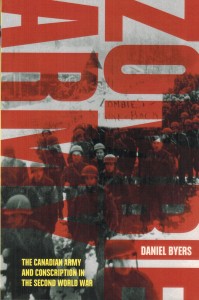
Review: Zombies
Canada’s last military conscription was popular. Resisters were scorned as weaklings who failed the tests of manhood and citizenship. Perceptions of the draft today are coloured by unpopular American wars – even deserters are treated as heroes – but facts are facts. Our conscription experience is a uniquely Canadian story, and Professor Daniel Byers of Laurentian University tells it well.
“The impacts of conscription and the National Resources Mobilization Act were largely forgotten in almost every way after the Second World War,” writes Byers. “For almost five full years the country had been mobilized to an extent that Canadians had not experienced before, nor have they since. Dozens of training centres and military camps stretched across the country. More than a million men and women served in the armed forces, over 150,000 of them as conscripts.”
Canadians voted for conscription in a 1942 plebiscite; 64 percent supported it outside Québec while opposition ran to 85 percent of Québec francophones. The conflict was more nuanced than the votes imply.
Volunteers from the Gaspé suffered alongside Winnipeg Grenadiers in the first combat action of Canada’s war, at the disastrous 1941 Battle of Hong Kong. Professor Byers notes some French districts in Québec actually topped their enlistment quotas, while a few English districts in Ontario and British Columbia did not. Well into the 1950s, Québec populists like Social Credit MP Réal Caouette articulated the anti-conscription argument in terms any family could grasp: “You think your children belong to you, but not in wartime,” he said. “In war your children belong to the government.”
Yet the contempt was real. Conscripts were scorned, and the Prime Minister who waited till 1944 to send them overseas was personally unpopular. The soldier vote cost Mackenzie King his Commons seat in a 1945 election. “His refusal to take a stand frustrated not only some of his fellow Canadians but also British leaders who were looking for some sign of the Dominion’s intentions,” write Prof. Byers.
Zombie Army recounts this whole vivid clash through a crisp narrative and meticulous research. “Zombies” was among the more polite terms for conscripts. Prof. Byers quotes one commander of B.C.’s 13th Infantry Brigade who recalled the “taunts and jibes” against draftees: “westypoofs,” “women’s home companions,” “pantywaists,” “poltroons,” “lily livered” and “other unmentionables.”
Who were the Zombies? Byers examines newly-released archival records in compiling a statistical profile of the typical conscript: under 25, single, a farmer or factory worker, Roman Catholic – boys, really. Four thousand of them ran away rather than fight overseas, and remained unaccounted for when cabinet declared a deserters’ amnesty in 1946.
Zombie Army tells the whole arresting story with an even hand and smart commentary. It is as compelling as the subject.
By Holly Doan
Zombie Army: The Canadian Army and Conscription in the Second World War, by Daniel Byers; University of British Columbia Press; 344 pages; ISBN 9780-7748-30522; $34.95
Mandate Climate Insurance On Canadians: Gov’t Report
Canadians homeowners could be forced to buy climate change insurance, says a federal report to Emergency Preparedness Minister Bill Blair. “We welcome and support the core findings,” Blair said yesterday in a statement: “There’s important work to be done.”
House Probes Phone Tracking
The Commons ethics committee yesterday voted 10-0 to examine federal monitoring of 33 million Canadian cellphone users in the name of lockdown enforcement. Conservative MP John Brassard (Barrie-Innisfil, Ont.) accused cabinet of using Covid as cover for “massive overreach.”
Firefighters Oppose Vax Rule
A British Columbia labour adjudicator has rejected firefighters’ appeal to suspend a mandatory vaccination order. A firefighters’ union local in Richmond, B.C. challenged the program as intrusive and heavy-handed: ‘They must choose between getting a vaccine they do not want or giving up on their careers as firefighters.’
Bible No Documentary: Judge
The Bible is no documentary, Ontario Superior Court has ruled. A judge rejected a filmmakers’ claim for an 85 percent “documentary” tax credit for a TV series depicting readings of Scripture with images of the Rocky Mountains: ‘This is just a Christian thing.’
Want First Nations At Capital
Most Canadians surveyed want more representation of Indigenous cultures on Parliament Hill, says a Department of Public Works survey. It follows a cabinet proposal to address “colonialism, patriarchy and racism” in historical commemorations: ‘Parliament Hill should reflect the values and aspirations of all Canadians.’