
Cabinet considered seizing factory production and imposing a cap on corporate profits in early days of the pandemic, according to internal emails. “What are next steps to advance this?” wrote one political aide in discussing extraordinary measures under the Emergencies Act: “Is there another Act where we could make these amendments?”
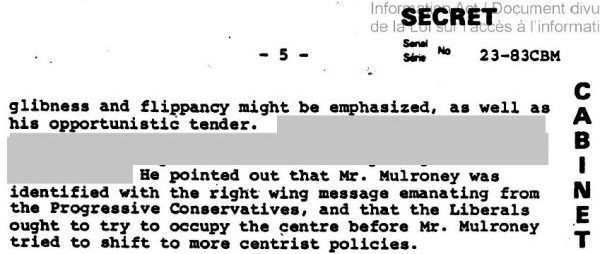
Mulroney A Glib “New Boy”
Then-Prime Minister Pierre Trudeau’s cabinet in secret 1983 meetings dismissed Brian Mulroney as a “new boy” easily ridiculed for “glibness and flippancy,” according to declassified records obtained by Blacklock’s. The Liberal cabinet expressed confidence it would beat Mulroney in a 1984 election: ‘Ministers should be seen to be giving the ‘new boy’ a chance.”
PM To Cabinet: “Appear To Listen,” Look “Sympathetic”
Then-Prime Minister Pierre Trudeau planned to combat 1981 recession protests with pro-Liberal federal advertising and tips for cabinet on how to “appear to listen,” say declassified records. Trudeau cautioned: “Nothing would be more harmful than to communicate a sense of not knowing what we are doing.”
Few Trust CRA To Do Right
Fewer than a third of small business owners, 32 percent, say they get respect from the Canada Revenue Agency, according to in-house research. Just 28 percent said they think the Agency treats taxpayers fairly: “Answers vary according to their experience.”
Sale For Freeland Farms Inc.
Finance Minister Chrystia Freeland’s family farm is auctioning all equipment in a retirement sale organized by Freeland’s father Donald, 76. The finance minister, a millionaire Rhodes Scholar, frequently invoked the farm as proof her family was not part of the “Upper Canada elite.”
Review – Strangest Territory On Earth
When Nunavut became a territory they put the Motor Vehicle Division in a village called Gjoa Haven. Nobody can drive there; Gjoa Haven is on an island. All of Nunavut has no highways and only 5,000 registered vehicles anyway.
Nunavut’s creation was not merely the world’s largest Indigenous land claim but an experiment in community-based government. “There was a sense at the Nunavut Implementation Commission that we were creating a big, new beautiful world,” one official tells the authors of Made in Nunavut.
Did it work? “More than one person interviewed used the word ‘mindless’ to describe some of the moves made to accommodate job targets,” authors write.
Made in Nunavut is meticulous and beautifully researched. It recounts an experiment in governance in the strangest place on earth, a territory of 1.9 million square kilometres flung across three time zones inhabited by a string of hamlets where “even basic phone service was often problematic,” authors write.
The territory has fabulous reserves of oil and gas, diamonds and minerals in a land so unforgiving its main revenue source remains a $1.6 billion annual grant from the Government of Canada. If Nunavut is very lucky it will someday have the population of Red Deer. As one former Indian Affairs minister put it, “Why are we doing this for 25,000 people?”
“Here was a small, marginalized Indigenous people who had succeeded against long odds and through entirely peaceful means in establishing a government they controlled within the Canadian state in order to gain control over their lives, their land, and their resources – and ultimately their destiny,” write authors Jack Hicks and Graham White.
Hicks is a former research director for the Nunavut Implementation Commission. White is professor emeritus at the University of Toronto’s political science faculty. Made in Nunavut is the definitive analysis of the nation’s most ambitious trial in home rule.
“Decentralization in Nunavut was to be fundamentally different,” authors note. “Not only were a substantial number of government jobs to be located in small communities throughout the territory, but many of the government functions to be spread across the territory were ‘headquarters’ activities that, in most governments, are located in the capital.”
So, they put the Motor Vehicle office with a director and two clerks in Gjoa Haven. Eight other employees are assigned to Iqaluit, Rankin Inlet and Cambridge Bay. When the Wildlife Management Division was moved to Igloolik, only 11 of 22 positions were filled. An attempt to relocate the Workers’ Compensation Board to Pangnirtung saw managers complain they’d “risk losing highly-trained, dedicated staff.”
Nunavut as a new territory had few Inuit lawyers, accountants and engineers, and saw crippling attrition in hiring outsiders. In the first year 31 percent of employees quit. “Some adventurous Southerners were attracted by the prospect of being involved in an exciting new venture in governance, though many had more enthusiasm than experience in any government context let alone in northern Canada,” authors note.
Turnover still runs at about 20 percent a year, a serious problem in any organization. As one Nunavut manager explains, “We have a whole bunch of empty positions because no one wants to come here.”
By Holly Doan
Made in Nunavut: An Experiment in Decentralized Government, by Jack Hicks & Graham White; University of British Columbia Press; 392 pages; ISBN 9780-7748-31048; $34.95

PM Feared Recession Would Spell Death Of Liberal Party
Then-Prime Minister Pierre Trudeau privately feared the severe 1981 recession would spell destruction of the Liberal Party, according to declassified records. Cabinet ministers were urged to combat public protests by planting pro-Liberal statements in the press: ‘In the Prime Minister’s view the mood of Liberal Party members which was developing across the country was potentially very destructive.’
Seeks 56% Debt Ceiling Hike
Finance Minister Chrystia Freeland yesterday said a record 56 percent increase in the debt ceiling is necessary, but would not detail what cabinet will do with the money. “We are being extremely transparent,” Freeland told the Commons finance committee.
CERB Audit Due March 25
The first audit of the costly Canada Emergency Recovery Benefit program will be complete by March 25, Auditor General Karen Hogan yesterday told the Commons public accounts committee. MPs have asked why the program went 240 percent over budget to eclipse spending on national defence: “It is actually meant to identify what is going on now.”
Calls Daily On China Agents
RCMP receive more than a hundred calls a day from tipsters alleging clandestine activities by agents of the Communist Party of China. Commissioner Brenda Lucki yesterday told a Commons committee she could not divulge the nature of complaints: “We get an average 120 tips per day.”
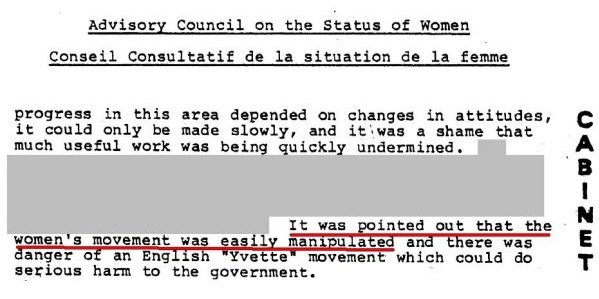
Feminists Easily Manipulated
The feminist movement is “easily manipulated,” the federal cabinet concluded at a confidential 1981 meeting. Declassified records show ministers schemed to co-opt women’s groups to avert public criticism of cabinet: “There was a need for a well-planned counteroffensive to prevent the situation from snowballing.”
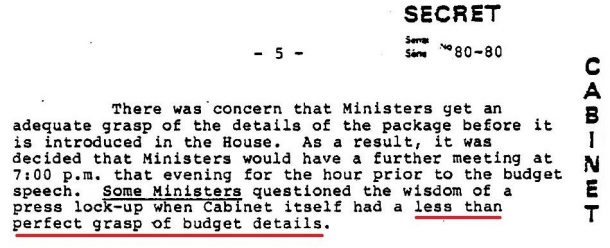
Cabinet Given Scant Minutes To Read Tax Plan: Secret Files
Then-Prime Minister Pierre Trudeau gave his own cabinet scant minutes to hurriedly review the National Energy Program the very day it was introduced in Parliament, say declassified secret records obtained by Blacklock’s. Cabinet members complained they could not “get an adequate grasp of the details” of the landmark tax plan: “Ministers were generally surprised.”
MPs Order Covid Disclosure
The Commons government operations committee last evening voted 6-5 to compel disclosure of actual Covid-19 spending by month’s end, and every month after that. Cabinet has not reported expenses since borrowing more than a half-trillion in the first 120 days of the pandemic: “What I’m not getting is what you’re trying to hide.”
Trudeau Sought Lib Lottery
Then-Prime Minister Pierre Trudeau proposed to introduce a permanent federal lottery “in support of the Liberal party” but vowed to keep planning low-key, say declassified records. The secret 1980 plan was stymied by an agreement signed by a previous Conservative cabinet: “There did not seem to be a reason for the federal government to avoid acting in this area as a trade-off.”
Elections Act Hangs By Typo
A cabinet bill to set new rules for a 2021 pandemic election hangs by a typo. Conservative MP Brad Vis (Mission-Matsqui, B.C.) yesterday stunned the Commons by announcing he’d uncovered a major discrepancy in the legal text of the bill: “Oh, no.”



