Shortage Contradicted Claims

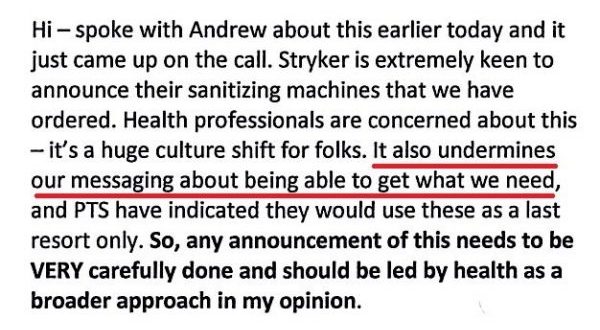
Internal emails disclose federal agencies shipped expired medical supplies to provinces within days of the pandemic’s outbreak, but fretted it “undermines our messaging about being able to get what we need.” Political aides feared angry premiers would pressure cabinet over failures to stockpile goods: “I don’t think we can hold them back with the shortage.”

This content is for Blacklock’s Reporter members only. Please login to view this content. (Register here.)

Confused By MPs’ Questions

A $216,000-a year federal corporate ethics ombudsman last night said two years after her appointment her office has yet to answer any complaint or conduct any investigation. Ombudsman Sheri Meyerhoffer in testimony before a Commons subcommittee appeared confused by questions: “Did you not hear the question?”

This content is for Blacklock’s Reporter members only. Please login to view this content. (Register here.)

MPs Wary Of Match Fixing

MPs are wary of match fixing under a bill to repeal an 1892 ban on bookmaking. At least one Canadian sports league is on record against legalizing single event sports betting: “I can’t sit here today and tell you it won’t happen. I just can’t.”

This content is for Blacklock’s Reporter members only. Please login to view this content. (Register here.)

Friends Sought Party Favours

Friends of cabinet attempted to pull strings with Public Works Minister Anita Anand for lucrative pandemic contracts, internal emails show. Lobbyists included a former aide to a Liberal MP, and the ex-president of a Liberal Party riding association who sought millions in contracts: “We’ve been seeing a lot of people who ‘know a guy’ in China.”

This content is for Blacklock’s Reporter members only. Please login to view this content. (Register here.)

PM Skips China Vote, 266-0

Prime Minister Justin Trudeau yesterday skipped a Commons vote condemning China for crimes against humanity. MPs including 87 Liberals voted 266-0 to cite the People’s Republic for genocide, and petition the International Olympic Committee to relocate the 2022 Winter Games from Beijing: “This is an issue that matters deeply to me.”

This content is for Blacklock’s Reporter members only. Please login to view this content. (Register here.)

Find Good News, Staff Told

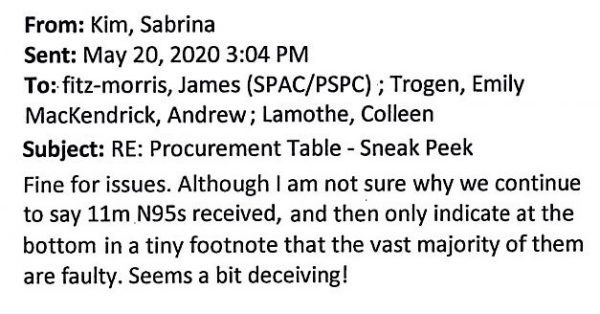
Staff in the Prime Minister’s Office struggled to find positive news in early weeks of the pandemic, according to internal emails. Sabrina Kim, then-director of communications, urged coworkers to find “positive updates” at the same time the Public Health Agency complained it was short of body bags for pandemic victims: “We love good news!”

This content is for Blacklock’s Reporter members only. Please login to view this content. (Register here.)

Covid ‘Deceptions’ By Email

Internal emails show cabinet-level political aides knowingly released misleading figures on medical supplies to cover chronic shortages of pandemic masks. Figures were inflated to ‘present the truth’ regardless of whether goods were defective. “Seems a bit deceiving!”

This content is for Blacklock’s Reporter members only. Please login to view this content. (Register here.)

CBC Conflicts OK: Producer

CBC pundits may have undisclosed federal contracts, says a senior network producer. The comment followed Blacklock’s report the network failed to disclose one pundit was invited to praise cabinet on TV while working as a government contractor: “Do these connections render Amanda Alvaro’s opinion less valid?”

This content is for Blacklock’s Reporter members only. Please login to view this content. (Register here.)

See 85% Coverage To Reopen

About 85 percent of Canadians must either get vaccinated or develop natural resistance to Covid-19 before the pandemic runs its course, a federal advisor told the Commons health committee. Currently fewer than three percent of people have been immunized: “It is a concern, absolutely.”

This content is for Blacklock’s Reporter members only. Please login to view this content. (Register here.)

$50M For Free Covid Hotels

Health Minister Patricia Hajdu budgeted $50 million to provide free rooms, meals and medical care to travelers at quarantine hotels, records show. New rules that took effect at midnight last night compel travelers to pay their own way in self-isolation: “I want to take a moment to thank the number of hotels.”

This content is for Blacklock’s Reporter members only. Please login to view this content. (Register here.)

Book Review — Canals Or Clinics?

When they wrote the Constitution in 1867 life expectancy was 42, few cures for disease were known, and a physician’s practice was comprised mainly of delivering babies and amputating limbs. Health care was so cheap and uncomplicated the Fathers of Confederation left it to the provinces, and assigned the really heavy lifting to Parliament – like regulation of railways and canals.

“The provisions of the Constitution were based on the realities of life in 1867,” writes Prof. Raisa Deber; “Things were designated as national responsibilities because they were expensive or because they were important to nation building.”

“Although few realized it at the time, these provisions have proven critical in determining who would have responsibility for health care in Canada,” writes Deber. Here we are, 154 years later, with a medicare system many Canadians rate as mediocre outside of treating babies and broken limbs. “We still look very good compared with the United States, but so does everyone else,” notes Deber, of the University of Toronto’s Institute of Health Policy.

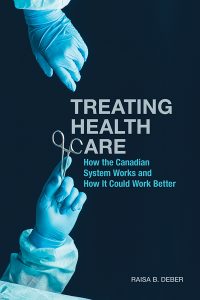
Treating Health Care: How the Canadian System Works and How It Could Work Better is frankly excellent. Prof. Deber has a crisp, engaging writing style that strips away the adjectives and political hyperbole that muddles so much of the medicare debate. “As an experienced teacher of health policy, my philosophy has always been that it is not my job to tell you what you should want, but it is my job to tell you whether a particular approach is likely to take you where you want to go,” writes Deber.

Parliament since 1957 has transferred grants to provinces to run the hospitals. Federal funding used to cover 50¢ on the medicare dollar. The original Hospital Insurance And Diagnostics Services Act allowed health taxes or user fees; Saskatchewan charged patients $35, the equivalent of $260 today. “If you give people a card from Santa Claus entitling them to free hospital services, it’s not good psychology,” as then-Premier Tommy Douglas put it. “But the amount should be sufficiently small that it doesn’t impose financial burdens on anybody.”

Today Ottawa pays about 23¢ of every pre-pandemic health care dollar, and there is no proof a $260 user fee would make any difference whatsoever. “The evidence is clear that user fees indeed discourage people from seeking care, but this effect is not very sensitive to whether that care is necessary,” writes Deber. Treating Health Care notes one in five Canadians cannot afford necessary prescription drugs, with resulting costs borne by ratepayers when patients are rushed to hospital with strokes or other emergencies made worse by their inability to buy medication.

“People need the right care, at the right time, at the right place, at the right price,” writes Deber. “Fortunately, most of the time, that is what we get, particularly when we are really sick. But that depends heavily on who we are, where we live, what health problems we have, and which providers we are seeing. This implies that most reforms will tend to be incremental.”

Treating Health Care is a good start.

By Holly Doan

Treating Health Care: How the Canadian System Works and How It Could Work Better, by Raisa B. Deber; University of Toronto Press; 224 pages; ISBN 9781-4875-21493; $24.95