
Book Review — Canals Or Clinics?

When they wrote the Constitution in 1867 life expectancy was 42, few cures for disease were known, and a physician’s practice was comprised mainly of delivering babies and amputating limbs. Health care was so cheap and uncomplicated the Fathers of Confederation left it to the provinces, and assigned the really heavy lifting to Parliament – like regulation of railways and canals.

“The provisions of the Constitution were based on the realities of life in 1867,” writes Prof. Raisa Deber; “Things were designated as national responsibilities because they were expensive or because they were important to nation building.”

“Although few realized it at the time, these provisions have proven critical in determining who would have responsibility for health care in Canada,” writes Deber. Here we are, 154 years later, with a medicare system many Canadians rate as mediocre outside of treating babies and broken limbs. “We still look very good compared with the United States, but so does everyone else,” notes Deber, of the University of Toronto’s Institute of Health Policy.

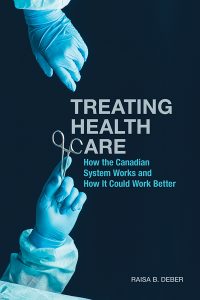
Treating Health Care: How the Canadian System Works and How It Could Work Better is frankly excellent. Prof. Deber has a crisp, engaging writing style that strips away the adjectives and political hyperbole that muddles so much of the medicare debate. “As an experienced teacher of health policy, my philosophy has always been that it is not my job to tell you what you should want, but it is my job to tell you whether a particular approach is likely to take you where you want to go,” writes Deber.

Parliament since 1957 has transferred grants to provinces to run the hospitals. Federal funding used to cover 50¢ on the medicare dollar. The original Hospital Insurance And Diagnostics Services Act allowed health taxes or user fees; Saskatchewan charged patients $35, the equivalent of $260 today. “If you give people a card from Santa Claus entitling them to free hospital services, it’s not good psychology,” as then-Premier Tommy Douglas put it. “But the amount should be sufficiently small that it doesn’t impose financial burdens on anybody.”

Today Ottawa pays about 23¢ of every pre-pandemic health care dollar, and there is no proof a $260 user fee would make any difference whatsoever. “The evidence is clear that user fees indeed discourage people from seeking care, but this effect is not very sensitive to whether that care is necessary,” writes Deber. Treating Health Care notes one in five Canadians cannot afford necessary prescription drugs, with resulting costs borne by ratepayers when patients are rushed to hospital with strokes or other emergencies made worse by their inability to buy medication.

“People need the right care, at the right time, at the right place, at the right price,” writes Deber. “Fortunately, most of the time, that is what we get, particularly when we are really sick. But that depends heavily on who we are, where we live, what health problems we have, and which providers we are seeing. This implies that most reforms will tend to be incremental.”

Treating Health Care is a good start.

By Holly Doan

Treating Health Care: How the Canadian System Works and How It Could Work Better, by Raisa B. Deber; University of Toronto Press; 224 pages; ISBN 9781-4875-21493; $24.95


Name China A Gangster State

Canada’s relations with China yesterday fell to their lowest ebb since the 1989 Tiananmen Square massacre as MPs from all parties prepared to condemn the People’s Republic for genocide. Even legislators wary of reprisal called China a gangster state complicit in murder, slavery and other atrocities. A formal vote is due next week on a Conservative motion censuring China for crimes against humanity: “I am thinking of the million people detained in camps.”

This content is for Blacklock’s Reporter members only. Please login to view this content. (Register here.)

Space Exhibit Quietly Shelved

Rideau Hall has quietly shelved a museum display chronicling Julie Payette’s life in space. The Dare To Dream exhibit was scheduled until 2022: “Personal items on loan from Payette will be returned as well as several items on loan from the Canadian Space Agency.”

This content is for Blacklock’s Reporter members only. Please login to view this content. (Register here.)

No Quick Fix On Air Bailout

Transport Minister Omar Alghabra yesterday said he saw no quick conclusion to talks with airlines on a $7 billion pandemic bailout. “I’m not able to prejudge the outcome yet,” Alghabra told the Commons transport committee: “I’m not able to give a specific date.”

This content is for Blacklock’s Reporter members only. Please login to view this content. (Register here.)

Repeal Little-Used Drug Law

Cabinet yesterday introduced a bill to repeal mandatory minimum penalties for cocaine traffickers. Officials acknowledged they knew of no case in which a drug dealer was sentenced to the lightest jail term, one year: “We will continue to watch how this plays out.”

This content is for Blacklock’s Reporter members only. Please login to view this content. (Register here.)

Equity Policy Is ‘Confusing’

Workplace equity in the military is weak despite two committees and eight programs mandated to promote diversity and inclusion, says an audit. The report complained of “confusion,” “lack of clarity,” “lack of cohesiveness” and no “common understanding of clearly defined concepts.”

This content is for Blacklock’s Reporter members only. Please login to view this content. (Register here.)

Loan Write-Offs Increase 15%

Canada Student Loan write-offs are up fifteen percent from pre-pandemic levels, according to budget documents. The Department of Employment that manages the program yesterday declined comment on its resumption of debt collections following a brief reprieve: “Repayment continues to be one of the priorities.”

This content is for Blacklock’s Reporter members only. Please login to view this content. (Register here.)

Disclosure Is “On The Brink”

A federal system promising Canadians access to government secrets is “on the brink,” Information Commissioner Caroline Maynard last night told the Commons government operations committee. Maynard contradicted claims by the Prime Minister that Access To Information is better than ever: “It is on the brink of being unable to be fixed.”

This content is for Blacklock’s Reporter members only. Please login to view this content. (Register here.)

MPs Veto Property Rights Bill

The Commons by a 202-115 vote yesterday rejected a private bill to outlaw “green” expropriations of private land without a public hearing. “My goal is to protect the property rights of average Canadians,” said Conservative MP Cheryl Gallant (Renfrew-Nipissing, Ont.), sponsor of the bill.

This content is for Blacklock’s Reporter members only. Please login to view this content. (Register here.)

NHLer Cited For Metaphor

A national broadcast ombudsman yesterday cited the NHL’s Brian Burke for breach of an ethics code. Burke was accused of using a violent metaphor while commenting on a playoff game: “Commentators can still use colourful expressions to make their point.”

This content is for Blacklock’s Reporter members only. Please login to view this content. (Register here.)

Gallery To Stand By Xinhua

Directors of the Parliamentary Press Gallery yesterday rewrote new ethics rules that shield China’s Xinhua state news agency from expulsion. A proposed code of conduct applies only to new applicants seeking membership. Xinhua has been a member for 57 years: “This is particularly important when it comes to the very halls of power.”

This content is for Blacklock’s Reporter members only. Please login to view this content. (Register here.)

“Failure” On Covid Supplies

Federal failures to properly stock medical supplies prior to the pandemic were a “significant error,” the Canadian Public Health Association said yesterday. Managers of the national stockpile were so short of goods they recommended nurses wear aprons due to lack of medical gowns: “We are facing a real crunch.”

This content is for Blacklock’s Reporter members only. Please login to view this content. (Register here.)

Must Cross T’s On Genocide

Canada must ensure “all the I’s are dotted and the T’s are crossed” before citing China for genocide, Prime Minister Justin Trudeau yesterday told reporters. His remarks followed a Conservative protest against having Canadian athletes attend the 2022 Winter Olympics in Beijing: “There is no question there have been tremendous human rights abuses.”

This content is for Blacklock’s Reporter members only. Please login to view this content. (Register here.)