
There are few environmental benefits to show for a quarter billion dollars spent on green technology subsidies, say federal auditors. More taxpayer aid is needed, concluded a Department of Natural Resources report: “Demand for clean energy is not sufficient.”
Agency Bets $141M On Coal
A federal agency has spent more than $100 million in the Chinese coal industry even as cabinet’s climate change plan proposes to eliminate Canadian coal-fired power plants. The Canada Pension Plan Investment Board yesterday did not comment: “The whole world needs to phase out coal.”
Kilt Ban Not Discriminatory
Workplace bans on kilts are not discriminatory, says a human rights tribunal. The judgment came on appeal by a Scottish-Canadian transit bus driver censured for wearing a kilt on casual Friday: “Wearing a kilt is not intimately connected to his Scottish ancestry.”
No Deal On 1967 Aid Rewrite
Finance Minister Bill Morneau yesterday would not commit to rewriting terms of a 1967 program intended to compensate provinces for catastrophic revenue shocks. “We are not at the stage where we have a conclusion,” Morneau told reporters.
We Can ‘Learn’ From China
Canadians could “learn” from China, say three senators and an ex-New Democrat MP. The parliamentary friendship group met overseas with Communist Party officials even as police used tear gas against pro-democracy protestors in Hong Kong: “Both countries have a long relationship that has been productive in many respects.”
Feds See Impact Of Pot Law
A majority of teenage marijuana users, 51 percent, tell the Department of Health they “have cannabis in or around the home” since Parliament legalized marijuana. Federal research showed the typical Canadian now considers marijuana more socially acceptable than tobacco: “Can cannabis smoke be harmful?”
Gov’t Cited For Toxic Fire
A federal agency has been found guilty of breaching air pollution regulations even as MPs prepared to declare a climate emergency. British Columbia’s Prince Rupert Port Authority started a slow-burning garbage fire so toxic, nearby residents complained of sore throats, burning eyes and asthma attacks: “Climate change is increasingly a climate emergency.”
Deficit 34% Higher: Morneau
The federal deficit is 34 percent higher than disclosed prior to the election, Finance Minister Bill Morneau said yesterday. This year’s deficit will be the highest since 2013 and will rise again in 2020: “Nobody said it was going to be easy.”
Plan To Police Facebook Posts
Parliament will police what Canadians put on Facebook, YouTube and Twitter, reversing a decades-old policy against internet regulation. Cabinet in a document said content must be controlled in the name of public safety: ‘This is deeply disturbing.’
Offer More Electric Rebates
Cabinet is expanding rebates for electric car buyers though it has no data on whether existing $300 million subsidies have met climate change targets. Rebates will now be offered to buyers of used zero-emission vehicles: “Why do we need this?”
Feds Take Pharma To Court
A drug company with a costly treatment for kidney patients is under federal investigation. The Competition Bureau alleges Otsuka Canada Pharmaceutical Inc. of Saint-Laurent, Que. acted to “prevent or delay generic versions of this product from coming to market”.
Question Vape Endorsement
The Department of Health is declining comment on why it placed newspaper stories claiming health benefits of vaping. The promotions contradict decades of anti-smoking campaigns, said an MP: “You can’t tell people for years that smoking tobacco is bad, and then start encouraging people to smoke something else.”
Zoning Bylaw Covers Airbnb
A Québec City judge has upheld municipal zoning against Airbnb. A property owner was fined $1,000 for breach of regulations forbidding the hotel trade in a residential neighbourhood: “The owner chose to make this property a tourist residence.”
A Sunday Poem: “Sitcom”
Don’t miss!
All-new episodes!
Canada is kicking off
another season of The Premiers.
Can Horgan and Kenney
see eye to eye on pipelines?
Would Pallister follow Savikataaq
on carbon tax?
Will Ford and Trudeau
keep their smiles
when the cameras are gone?
This season
will reveal the biggest mystery:
Can the Premiers
agree on anything
other than more money
and less intervention
from the federal government?
(Editor’s note: poet Shai Ben-Shalom, an Israeli-born biologist, examines current events in the Blacklock’s tradition each and every Sunday)

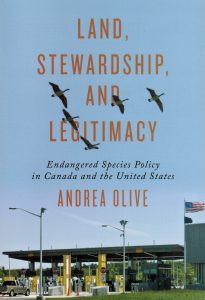
Review: My Land
The Lake Erie water snake can dive ten feet and swallow its prey head first. The snake is also endangered. Its favoured habitat is private lakefront property where landowners don’t enjoy snakes. “I see no reason why it should be protected,” one Pelee Island landowner told an interviewer. “If it were to go away, I don’t think anyone would miss it.”
This is the most vexing part of endangered species. Rare birds, fish and wildlife belong to all humanity, but the lakefronts and marshlands belong to ratepayers. As the Canadian Cattleman’s Association once told a Commons committee, “Number one: if a species at risk is viewed as a liability to a land manager, it will always be at risk.”
Prof. Andrea Olive of the University of Toronto examines this conflict in Land, Stewardship and Legitimacy. The results are intriguing. Olive discovers Canadians have a generally positive opinion of saving threatened species, but aren’t quite sure what to do about it; 61 percent of Saskatchewan residents agreed it would be unfair to ask landowners to pay the cost of protecting species that happen to nest, stalk or swim on their property.
“In Canada most land is privately managed,” writes Olive; “This is the consequence of history – of pioneers who were encouraged by government to settle two vast countries. The result today is that most biodiversity relies on private property, and on the people who own and manage it, for survival.”
Land, Stewardship and Legitimacy seeks solutions. Should we pay landowners not to kill water snakes? “Expensive,” Olive notes. Might shaming work? Maybe; the author recounts a 1982 study on the impact of anti-littering ads in Oklahoma City. Residents were twice as likely to feel guilty about littering, especially if the neighbours saw them doing it: “If outreach and education are able to inform enough people about the importance of biodiversity,” writes Olive, “then shaming people into conservation efforts might be a method to achieve changes in desired public behaviour.”
Land, Stewardship and Legitimacy recounts the fate of select endangered species including the Lake Erie snake; the Indiana brown bat; and Utah desert tortoise. Canada was an early signatory to the U.N. Convention On Biological Diversity in 1993, but Olive writes there’s no particular reason to feel superior.
More than 90 percent of southern Ontario’s Carolinian forests have been converted to farms or suburbs; British Columbia is home to almost two thousand threatened or endangered species; Alberta, Saskatchewan and Prince Edward Island have no actual, legally binding endangered species legislation.
So, if it is too much to offer tax breaks to save water snakes, and too mean to punish landowners who are indifferent, Prof. Oliver proposes something in the middle. Canadians must first be shown that species are at risk, and very simple steps might save creatures that thrived for generations: “That will take some work.”
By Holly Doan
Land, Stewardship and Legitimacy: Endangered Species Policy in Canada and the United States, by Andrea Olive; University of Toronto Press; ISBN 9781-4426-15748; 304 pages; $32.95