
Transport Canada has no estimate of the climate change impact of its $300 million electric car rebate program. The department credited rebates with increasing the market share of electrics by one percent this year, but could not calculate actual reductions in tailpipe emissions: “The objective is not to sell the cars; the objective is to reduce greenhouse gas emissions, right?”
Vegas Sports Bet Bill Is Back
New Democrats yesterday said they will reintroduce a Vegas-style sports betting bill in the Commons. MPs passed the measure in 2012 but saw it lapse in the Senate following protests from the Toronto Blue Jays: ‘It would open a Pandora’s box of match fixing.’
Dep’t Split Costing Billions
Parliament is spending billions more on Indigenous services since creating two new departments out of one, the Senate national finance committee was told yesterday. A total 8,315 federal employees now work at the two departments compared to 4,627 at the previous Department of Indian Affairs: “That’s a lot of extra money.”
Media Grants No “Panacea”
Taxpayers’ subsidies are no panacea for failing media, the Department of Canadian Heritage said yesterday. Grants under a program first announced two years ago should be paid in 2020: “I can’t comment on whether it’s sufficient.”
Payroll Costs $44M More
The Treasury Board has budgeted $44 million in early compensation awards to federal employees affected by the failed Phoenix Pay System. It is only the beginning, managers told the Senate national finance committee: “Who is tracking the cost?”
VW Charged With 60 Counts
The Department of Environment yesterday said it formally charged Volkswagen AG with sixty breaches of federal law over faked emission data for its “green” diesels. It follows multiple lawsuits by environmental groups: “Laws would be respected.”
Senator Hired Media Coach
A new Liberal appointee to the Senate billed taxpayers $3,250 for a single day’s coaching on how to speak to media. Senator Margaret Anderson (Independent-NWT) did not take media questions about the expense: “What will I receive? Practical, hands-on training from leading practitioners.”
Could Win A Free Muffin
The Privy Council Office offered employees free muffins to curb security breaches involving classified records, according to Access To Information files. Memos detail numerous breaches including lost BlackBerrys, stolen laptops and unlocked filing cabinets: “Be rewarded with a muffin break.”
Would Mandate Home Refits
New Democrats are asking the Commons to endorse a “green new deal” mandating energy refits to every building in the country. The motion also proposed to eliminate all tailpipe emissions from cars and trucks where possible: “We want to fight the climate crisis like we want to win it.”
Cite Justice Dep’t Bullying
The Department of Justice has been cited for abuse of process in bullying witnesses in a contract dispute. Federal lawyers ordered witnesses to appear for questioning on four days’ notice with “all relevant documentation” in what Ontario Superior Court called a fishing expedition: ‘They constitute an abuse of process.’
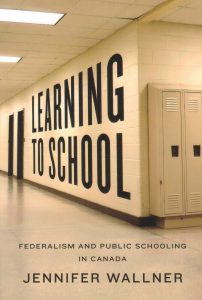
Review: Schooling
Canada, unlike Zimbabwe, has no federal department of education, to which Professor Jennifer Wallner of the University of Ottawa comments: And your point is – ?
Parliament regulates the minutiae of labels on fertilizer bags; the price of mozzarella; the CDs they play at Radio CJLR in Meadow Lake, Sask. Yet in 152 years legislators have never set any federal standards on basic elementary and secondary education. Critics lament the fact. Professor Wallner argues this does not mean standards don’t exist.
“Provinces can work together,” Wallner writes; “When we compare the provincial education systems to one another, all ten show remarkably strong similarities in investments, achievements and substantive policies.”
Learning To School delves into the genius of the federation through the prism of schooling. The conclusion is plain: Canadian education standards do just fine in Parliament’s absence, and provinces have been leaders in the classroom since the 19th century.
Learning To School does not varnish the knotholes in the system. True, Canada spends less on education as a percentage of GDP than Finland, Belgium or New Zealand. True, the ratio of teachers to students is lower here than in just about every industrialized country except Korea, Mexico and Turkey. Yes, the provincial ratio of spending per student varies as much as 35 percent, from a low of $6,200 a year in Prince Edward Island to a high of $8,400 in Manitoba – though Wallner notes this is improving all the time. In 1945 the gap was more than 200 percent; in 1900 it was twice as bad, when British Columbia outspent Québec by a ratio of 5 to 1.
For all these flaws Learning To School concludes Canadians do not fare too badly: “While Canada seems to invest slightly less in education than other advanced industrial nations, its educational attainments are strong, with high marks on international tests and elevated completion rates in secondary and tertiary education. Without a central authority, moreover, the Canadian provinces support their respective elementary and secondary systems with similar levels of investment.”
How is this possible? Simple, says Wallner: teachers and parents. “Teachers, for example, have similar interests with regards to salaries, benefits and professional working conditions regardless of where they live,” resulting in de facto standards on curricula, class sizes and other factors. And parents from coast to coast “consistently demand and expect high-quality education programming from their respective provincial governments,” Learning To School concludes.
Just as provinces have pretty much the same minimum wage, the same highway speed limits, the same regulations on landfilling, so provinces have adopted comparable standards on elementary and secondary schooling. Their record is impressive.
Nova Scotia created the first effective department of education in 1864 with all others following, though Québec took nearly a century. Public school curricula have been standardized since 1910; British Columbia created the first funding pool between rich and poor districts in 1933; Alberta established the first three-year university degree program in education in 1942.
Learning To School turns conventional wisdom on its head. Without any federal leadership or Act of Parliament, Canadians built a modern, effective school system – even without a Zimbabwean Ministry of Education.
By Holly Doan
Learning To School: Federalism And Public Schooling In Canada, by Jennifer Wallner; University of Toronto Press; 432 pages; ISBN 9781-4426-15892; $37.95

Powerless To Stop Scammers
The patent office in Access To Information memos says it is powerless to halt scammers targeting Canadians who file records with the agency. Authorities counted hundreds of cases of trademark owners targeted with fake demands for exorbitant fees on official-looking invoices: “It should not be the entire responsibility of taxpayers to expose these scams.”
Feds To Hike Minimum Pay
Cabinet yesterday said it will increase the federal minimum wage for the first time in twenty-three years. The labour department has acknowledged employer resistance to a $15 hourly minimum in federally-regulated workplaces: “Employer organizations cited negative economic consequences for small and medium-sized businesses.”
Feds Vow “Climate Action”
Cabinet yesterday said it will take “ambitious climate action” but did not commit to maintaining a current 12¢ per litre cap on the carbon tax. The Throne Speech opening the 43rd Parliament mentioned “climate change” and “climate action” seven times: “We are inextricably bound to the same space-time continuum and on board the same planetary spaceship.”
Wireless Health Claim Nixed
An Ontario tribunal has rejected a complaint that electronic Smart Meters make people sick. A private Conservative bill mandating health warnings on wireless devices lapsed in Parliament in 2015: “When it comes to cancers, I’m not a physician so I can’t comment.”