
Most Canadians want portraits of prime ministers removed from banknotes, according to in-house research by the Bank of Canada. The bank has issued bills depicting dead prime ministers for eighty-four years: ‘Great Canadians from other fields should be featured.’
Rail Service Resumed At 6 am
Canadian National Railway Co. today resumed regular freight service at 6 am local time in cities nationwide following an eight-day national rail strike. It was the first shutdown of its kind in seven years. Transport Minister Marc Garneau said Parliament would not be compensating shippers for losses: “It’s part of life.”

Memo’s Hateful: U.S. Scholar
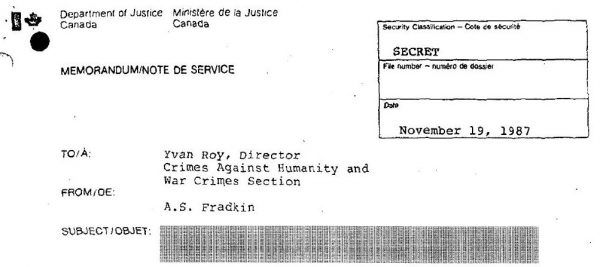
A declassified Department of Justice memo claiming to explain root causes of anti-Semitism cites language never used by postwar German prosecutors, says a Brown University scholar. Staff declined comment on the secret 1987 memo by the department’s war crimes unit that pointed to Jewish “financial power” and “the image of the ‘Jew-Communist’.”
Gov’t To Go Easy On Fines
Federal regulators in Access To Information memos say they will “use discretion” in enforcing contentious new animal welfare rules that take effect February 20, 2020. Farmers and truckers are liable for up to $50,000 in fines for harm to livestock and poultry in transport: “It is a contentious topic.”
Uphold Sticky Note Citation
A federal labour board has upheld the one-day suspension of a Statistics Canada analyst upset over a sticky note. “The employer had the burden of proving that the incident took place,” wrote an adjudicator: “Come and see me right away.”
$26.6M In Legal Fees OK’d
A federal judge yesterday approved a billion-dollar settlement of sexual harassment claims by ex-military that will see assault victims receive a maximum $150,000 in compensation. Fees for five law firms that handled the case total $26,560,000: ‘The legal fees are fair and reasonable.’
Jarring Memo On Holocaust
The Department of Justice in a jarring memo claimed European anti-Semitism was fueled in part by “incontrovertible” evidence of Jewish “financial power”. The 1987 memo marked secret was released by the national archives through Access To Information. The department had no comment: “We knew even in 1987 those are loaded terms.”
Post Office Conceals Payout
Canada Post will not disclose the cost of a decades-old pay equity claim for fear it “could be prejudicial” to the Crown corporation. Management settled last May 12 with the Canadian Postmasters and Assistants Association in a dispute dating from 1992: “Information will not be provided.”
$114K For Drug Suspension
Alberta’s Human Rights Tribunal has awarded a Calgary millwright more than $100,000 in damages and back pay after he was suspended for failing a drug test. “Human rights damages are on the rise,” said the Tribunal.
Press Endorsements Okay
A national press ombudsman has rejected complaints over newspaper editors’ campaign endorsements, calling it an old election tradition. One federal study found few voters recall endorsements: “About two-thirds of the voters interviewed had no idea.”
Quiet On Back-To-Work Bill
Transport Minister Marc Garneau yesterday would not confirm cabinet is drafting back-to-work legislation to end a national rail strike. Parliament forced an end to six previous rail shutdowns dating from 1950: “We are convinced there is a solution.”
Energy Bills Stay As Is: Feds
Cabinet yesterday said it will not rewrite two contentious energy bills passed by Parliament last June 20. One measure is currently the target of a constitutional challenge in the Alberta Court of Appeal: “Look, the legislation is now in force.”
Complaint Took Ten Years
Federal judges have sharply criticized the Office of the Information Commissioner for a ten-year delay in processing an Access To Information complaint. “The administrative procedure in question constitutes a gross and outrageous abuse,” said the Federal Court of Appeal.
“It is undeniable the file should have been resolved in a much shorter time,” Justice Marc Nadon wrote on behalf of the Court. “I can only conclude the lack of diligence on the part of the Commissioner has resulted in the Access To Information regime being brought into disrepute.”
The Court cited extraordinary time spent managing a request for safety audits at Air Transat Inc. An unidentified applicant sought the data from regulators in 2005, and complained to the Commissioner in 2006 when records were withheld by Transport Canada. The Office of the Commissioner completed its investigation in 2016. Staff told the Court the case was complex.
“Complexity of the case cannot justify the ten-year delay,” wrote Justice Nadon: “The interest of the company in the pursuit of the case does not override the negative effects suffered by Air Transat and the Access seeker.”
Federal agencies do not comment on litigation. The Court noted three Information Commissioners came and went as the Air Transat case lingered with investigators.
“Delays are endemic across the Access system,” Commissioner Caroline Maynard said in 2018 testimony at the Senate legal and constitutional affairs committee. Maynard took office after the Air Transat report was completed. “I receive 2,400 complaints per year on different interpretations of the law, and in half of those cases I conclude the exclusions and exemptions mean the institution has not complied with the legislation,” said Maynard.
The Air Transat case involved auditors’ findings of a 2003 pilot project that saw the airline become the first to introduce a so-called Safety Management System. All major commercial airlines are now required to draft risk management plans under Canadian Aviation Regulations.
The original request was for 653 pages of records. Air Transat and the Department of Transportation sought to block the release of all data, claiming commercial confidentiality. The Federal Court of Appeal rejected the argument.
“I am unable to understand how and why its disclosure would likely cause alleged harm to Air Transat,” wrote Justice Nadon: “It is difficult to accept that a report more than fifteen years old” – it was written in 2003 – “can be of serious interest to the competitors of Air Transat.”
Justice Nadon said the decade spent on the Air Transat complaint caused airline lawyers to “repeat the work already done many years ago”, including tracking down former employees.
By Staff 
VIA Rail Redefines “Late”
VIA Rail in Access To Information records indicates one commuter train ran late 173 business days in a row though management claims on-time performance of seventy to eighty percent. The Crown railway yesterday did not comment on its definition of punctuality: “Passengers want to be on time.”
Supreme Court Is Too Drafty
The Department of Public Works yesterday placed a rush order for new windows at the Supreme Court of Canada, though the building will undergo a billion-dollar refit in 2023. The Court did not comment: “We like working here.”