
A federal judge has faulted the Canadian Human Rights Commission for a slipshod review of a discrimination complaint. Investigators “only heard one side of the story” and quickly closed the case, wrote Federal Court Justice Susan Elliott: “That failure is inexplicable.”
House Bans Whale Capture
MPs yesterday passed into law a bill to ban the capture of live whales for profit. No federal license has been issued for whale capture in Canadian waters since 1992: “This bill does not help one single marine mammal that is currently living in captivity.”
Fake News Cops Too Slow
Promised federal monitoring of fake election news appears weak and slow, New Democrat leader Jagmeet Singh yesterday told reporters. Singh is the subject of a first-ever Elections Canada probe of fake news targeting a candidate: “We’ve got to do better.”
Feds Eye Higher Farm Debt
The Department of Agriculture will consider expanding taxpayer-guaranteed farm loans in 2020, says a report. Researchers noted farm debt in Canada has grown 56 percent since 2009 to more than $98 billion: “I remember the 1980s.”
Postmedia Awarded $5.5M
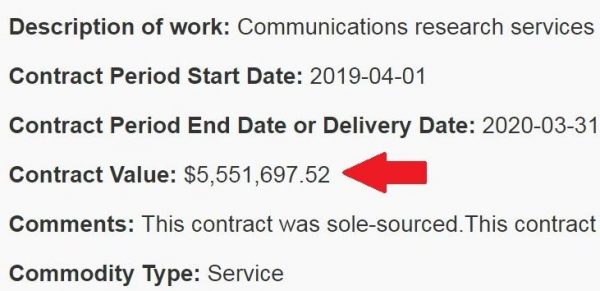
The Department of Public Works quietly awarded millions in untendered contract fees to the nation’s largest newspaper chain twelve days after announcing a media bailout, records show. The sole-sourced contract to Postmedia Network Inc. was the largest of its kind approved for “communications research services”.
Neither Postmedia nor the department commented on the contract worth $5,551,698. It was awarded April 1, only days after cabinet’s March 19 budget proposed a $595 million bailout for federally-approved media in a bill that has yet to pass Parliament.
Postmedia’s flagship daily National Post in news coverage of the bailout wrote: “The federal government’s plan to invest $595 million in local journalism should assist Postmedia in continuing to make its transition from relying on print revenue streams to those in the digital realm.”
Records did not explain why Postmedia was paid for “communications research”, or what justified the $5.55 million fee on a contract to expire in a year. The department on the same day awarded a similar untendered communications research contract to the rival Torstar Corporation’s iPolitics division worth $266,545, one-twentieth the value.
The newspaper chain has reported a total $962.23 million in net losses in the past six years. No Postmedia executive has testified at parliamentary hearings on the bailout detailed in Bill C-97 the Budget Implementation Act.
Then-CEO Paul Godfrey in his last appearance at parliamentary hearings in 2016, at the Commons heritage committee, told MPs dailies would die without taxpayers’ aid. “We’re asking the government to be an ally,” said Godfrey: “We know that a free press isn’t really free.”
“There have been no fiercer critics of subsidies to the media than the Toronto Sun and the National Post; how do you square your editorial position with your corporate position?” asked Liberal MP Adam Vaughan (Spadina-Fort York, Ont.). “You realize that columnists have the right to say what they want,” replied Godfrey.
The Department of Canadian Heritage in earlier 2016 Access To Information memos questioned whether Postmedia could “keep the wolf from the door” amid annual, multi-million dollar losses. Postmedia that year announced it would cut its payroll 20 percent and stop hiring freelancers. “Postmedia’s valiant efforts to keep the wolf from the door do not mean the chain can survive in its current form,” wrote Ramzi Saad, then-deputy director general of cultural industries.
“What is happening to Postmedia papers will now happen to the Globe & Mail and the Toronto Star in five years,” wrote Ben Schnitzer, then-senior policy analyst with Heritage Canada’s periodical publishing policy division.
Collapse of the Postmedia chain would leave 28 cities without a daily newspaper. The heritage department as late as 2017 opposed any attempt to “bail out industry models that are no longer viable”, said then-Minister Mélanie Joly.
By Staff 
Bill Costs Advertisers $1B
A bill to ban junk food advertising to children will cost industry at least $956 million, according to lobbyists’ submissions to Health Canada obtained through Access To Information. The bill is one Senate vote away from becoming law: “A blunt instrument is being applied here.”
Interns Win An 8-Hour Day
Banks, radio stations and other federally-regulated employers cannot work unpaid student interns more than 40 hours a week under proposed Canada Labour Code regulations. The rules mirror a 2015 New Democrat bill prompted by student deaths: “It’s something they have been asking for, for a very long time.”
Claim Lobbyists Rewrote Bill
Senate amendments to an oil and gas bill appear ghostwritten by lobbyists, say Liberal MPs. The Commons will reject revisions that fail to restore “trust in the process”, officials said: “Some of those amendments in the package come directly from oil lobbyists.”
Tight Eco Regs On Shippers
Transport Canada proposes the strictest regulations yet on oceangoing vessels to curb the spread of invasive water species. Zebra mussels, sea lampreys and other pests have cost millions, said the department: “They were the ones who created the loopholes in the first place.”
A Poem: “The View Within”
Premier Ford
may be immortalized
with a monument
built of flexible, six-feet long tube,
bearing a tiny camera
at its tip.
In memory of his willingness
to stop funding sedation
during colonoscopy.
At the base,
high-definition LED monitors
would transmit live streams
from area hospitals
as the invasive probes
push their way
up and away.
Visitors would enjoy a snapshot
into the mind of a leader
who could see a little further.
(Editor’s note: poet Shai Ben-Shalom, an Israeli-born biologist, examines current events in the Blacklock’s tradition each and every Sunday)
Fake News Manhunt Detailed
Elections Canada investigators have waged a four-month manhunt for sponsors of a fake news item targeting New Democrat leader Jagmeet Singh. Access To Information records indicate the hoax was traced to a company registered in Israel.
“The identity of the purchaser of the electoral advertising is unknown,” wrote Nicholas Alexander, lead investigator for the Commissioner of Elections: “I believe it is necessary to determine the identity of the purchaser.”
Singh was campaigning in a February 25 byelection in Burnaby South, B.C. when the online Vancouver Courier published a February 4 website ad depicting the NDP leader alongside a $5.5 million home. “Jagmeet Singh shows off his new mansion”, read the caption.
Singh does not own a mansion. The falsehood also appeared in ad banners at The History Channel and other websites.
The content was removed February 6 after it was exposed by The Tyee. New Democrats filed a federal complaint citing a breach of the Elections Act section 91 that states: “No person shall with the intention of affecting the results of an election, knowingly make or publish false statements of fact in relation to the personal conduct of a candidate or prospective candidate.”
Investigator Alexander in a report said he sought a judicial order to compel release of records from an ad broker that would identify the source. “I determined section 91 does not apply to the circumstances, given the image and accompanying caption does not constitute a false statement of fact in relation to the personal character or conduct of Mr. Singh,” wrote Alexander, former staff sergeant with the RCMP commercial crimes unit. “However, other sections of the Act pertaining to election advertising did apply.”
Alexander wrote the fake news item appeared to breach section 319 that requires disclosure of sponsors of campaign ads under federal spending limits. “I believe the advertisement featuring an image of Jagmeet Singh constitutes election advertising, specifically because (it) depicts an image of Jagmeet Singh and states he possesses a mansion; (it) depicts another image of Jagmeet Singh beside two images of a large mansion, with a headline insinuating that he owns a $5.5 million mansion; the NDP policy book at paragraph three states the NDP believes in ‘implementing a national strategy to ensure secure, adequate, accessible and affordable housing for Canadians,’” wrote Alexander.
The report continued: “The advertisement implies that Jagmeet Singh owns a $5.5 million mansion which conflicts with stated policy of the NDP with respect to accessible, affordable housing. The advertisement clearly opposes his candidature as it calls into question his bona fides as leader of the NDP. It implies his lifestyle is not conducive to the stated policy provisions of the NDP with respect to affordable housing.”
First Fake News Probe
The ad was posted through a broker, Taboola Canada Inc. of Toronto, that was cleared of any wrongdoing. Taboola told the Commissioner of Elections it “did not produce any of the content”, but could not identify who did without a court order.
Investigator Alexander obtained the order March 27. Evidence suggested the ad was purchased through a firm listed in the Israeli corporate registry, according to Access To Information records.
The Commissioner of Elections yesterday would not comment on the ongoing probe. “The duration of these investigations can vary greatly,” said Michelle Laliberté, spokesperson for the Commissioner. The Singh mansion hoax is the first to fall under federal investigation since cabinet on January 30 announced a $7 million program to monitor online news coverage in the October 21 general election campaign.
“Ultimately it’s not our job to tell Canadians what is good or bad information, but to provide them the tools and the resources to, when something comes to them, to make a choice on their own and to say where this information is coming from, who is behind it, and what their objective is,” Minister of Democratic Institutions Karina Gould earlier told reporters.
“When you open up a newspaper, you have a sense this is coming from a journalist who’s professional, who has done their research, who has worked at it, and whose information is coming from a reliable source,” said Gould. “Of course, depending on which newspaper that is, you have a sense of where that information is coming from. When you go onto a social media platform and you see a meme or you see a story, if it’s being shared by a friend or a cousin or someone trusted, you may implicitly share that information because it’s coming from a trusted source.”
New Democrats expressed frustration with the pace and scope of the investigation. “It spread through Twitter and Facebook who themselves have no responsibilities,” MP Nathan Cullen (Skeena-Bulkley Valley, B.C.) told a February 7 hearing of the House affairs committee. “What happens then?”
“It’s a completely made up story to try to discredit the NDP leader in the byelection,” said Cullen. “It is utterly untrue.”
“What we have now is fake news which is akin to a match,” said Cullen: “Social media is like the wind. These lies can be weaponized now unlike ever before, and weaponized in that they’re targeting particular voters on their motivated issues. Is that a fair analogy in terms of what the threat is?”
“Certainly that is a significant threat,” replied Chief Electoral Officer Stéphane Perrault.
By Staff
Pay Equity Win Took 27 Yrs
The nation’s postmasters yesterday said they reached final settlement in a 27-year pay equity dispute with Canada Post. A federal judge in 2016 called the delay proof of a failed pay equity system: “It has been a struggle to have their rights recognized.”
Senate Passes Fisheries Act
The Senate by an 86 to 3 vote yesterday passed a bill to rewrite the Fisheries Act. Senators approved amendments sought by industry lobbyists to narrow the definition of protected habitat: “I know there continues to be some questions over the need for higher standards.”

Tweet Prompts Senate Pause
A tweet by a Manitoba senator yesterday prompted members of the Senate budget committee to propose a review of social media practices. All senators’ Twitter accounts should be examined, the committee was told: “Senators must be held to a higher standard.”
Slim Chance Of Audit Funds
MPs on the Commons public accounts committee yesterday said there is little chance cabinet will increase funding for the Auditor General’s office. Auditors will abandon audits of cybersecurity, employee travel and other issues after they were denied an extra $10.8 million: “We have money for everything, except this.”