
A federal farmers’ bank predicts credit losses will increase by a third this year. Farm Credit Canada said it uses “sound business practices” to limit shortfalls: “The government is on the hook to cover that.”
Tobacco Libel Suit Proceeds
A First Nations cigarette maker has won Court approval to press a $27 million libel suit over allegations it’s involved in tobacco smuggling. The makers of Putter’s-brand cigarettes sued over 2016 articles in Frontline Safety & Security Magazine: “Those articles were not fact-checked in any manner that has been shown in the record.”

Saw Sweetheart Lavalin Deal
Attorney General David Lametti sought to quash a criminal prosecution of SNC-Lavalin Group Inc., MP Jody Wilson-Raybould hints in a March 26 letter released by the Commons justice committee. Lametti has refused comment on the claim he was prepared to issue an unprecedented order to save the company from trial on fraud and bribery charges: “I simply won’t go there.”
Sees Carbon Tax Doubling
The $50 per tonne federal carbon tax would have to double to meet emissions targets without new regulatory curbs on polluters, says an environmental group. The current tax to take effect today nationwide will add an extra 12¢ to the cost of a litre of gasoline by 2022, as well 14¢ more for diesel, 13¢ for aviation fuel, 10¢ per cubic metre of natural gas and 8¢ a litre for propane: “The federal government may change the pricing system.”
Fees Went Up At Midnight
More than $40 million in federal fee increases on industry took effect at midnight under a 2017 Act mandating perpetual hikes. The cost of charges for everything from patents to marijuana licenses went up 2.2 percent: “There will be no incentive to try to keep the costs down.”
Feds Scrub Douglas Record
A federal review of controversial views by historic figures will exempt Tommy Douglas, founding leader of the New Democratic Party. Douglas was an early supporter of eugenics, and in the 1930s advocated the sterilization of women he deemed subnormal: “He later changed his views on this topic.”
Drilldown In WestJet Probe
Federal investigators are drilling down into WestJet Airlines Inc. practices in a probe of alleged predatory pricing, according to Court documents. The Competition Bureau seeks to question a second WestJet executive: ‘The Commissioner seeks information on the intent behind ticket pricing.’
MPs Worried By China Feud
The Commons agriculture committee tomorrow opens hearings on a growing billion-dollar trade dispute with China. MPs feared a Beijing boycott of canola seed will spill over to other sectors: “All of them are scared.”
A Poem: “Musical Chairs”
Prime Minister Andrew Scheer
pulls no punches
persuading his Attorney General
to drop charges against SNC-Lavalin.
He knows the importance
of keeping the company going.
Across the aisle,
Leader of the Opposition Justin Trudeau
speaks highly about the rule of law,
blames the Prime Minister for
bullying and threatening the Attorney General,
condemns a behaviour he declares
is harassment.
He knows the importance
of keeping the story running.
(Editor’s note: poet Shai Ben-Shalom, an Israeli-born biologist, examines current events in the Blacklock’s tradition each and every Sunday)

Review: Monkeys & Organ Grinders
On March 22, 2013 hours before that year’s budget was tabled in Parliament, two newspapers reported the Department of Finance was about to cut tariffs on hockey equipment. “Cheaper Hockey Gear An Assist To Parents”, read the Globe & Mail headline. “This Year’s Shiny Object: Cheaper Hockey Gear”, read the National Post.
Readers could only conclude both newspapers in a simultaneous burst of enterprise reporting had uncovered a budget secret through fearless digging. In fact, both were fed the line by department staff. This was not news-gathering; it was propaganda.
The dailies did not mention cabinet attempted to raise tariffs on hockey equipment three months before the budget, and Bauer Hockey Corp. replied with a confidential letter threatening to move all production out of Canada. Blacklock’s had that story all to itself.
Here in a nutshell was the cynical interplay between officialdom and media. Both insist they have a “relationship”, like organ grinder and monkey, though neither can agree on who is which.
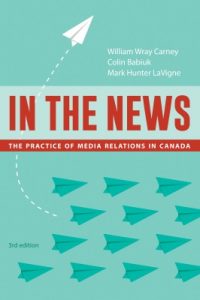
With public distrust of government and media at an ever-ascending high, the University of Alberta Press has the timely release of the third edition of In The News: The Practice Of Media Relations In Canada. The book is co-written by communications professionals, for communications professionals, but it’s instructive for any member of the audience coveted by officialdom and press: the general public, you.
“Media relations is the art and science of reaching your target audience with key messages through the news media,” authors explain. “Media relations is one of public relations’ main practice areas and, arguably, one of the most difficult. It is one of the only communications disciplines that goes through a gatekeeper – news media – to reach the end audience.”
In The News is entertaining and refreshingly frank. “Reporters are not inherently blessed with brains, civility or ethics,” write authors. “Neither are communicators. Both can be wrong-headed, uncivil or simply obtuse.”
Authors recommend that clients avoid news conferences (“the pack might tear you or your spokesperson to pieces”); try not to be clever (“spin can blow back on its practitioners”); prepare for surprises (“you cannot manage the media”); and understand that journalism is a completely unregulated trade, meaning literally anyone can join. True fact: Cement truck drivers are subject to more regulatory oversight than reporters.
“Given that neither journalism nor communications is likely to become regulated, they must police themselves,” write authors: “Today’s media consider themselves objective and non-partisan – a far cry from media coverage in the nineteenth and early twentieth century, when political parties owned newspapers and provide the party line to loyal readers. Like others who deal frequently with media, politicians see the media’s mistakes and shortcomings more than most people do; this knowledge adds to their skepticism about dealing with reporters.”
By Holly Doan
In The News: The Practice of Media Relations in Canada, 3rd Edition, by William Wray Carney, Colin Babiuk and Mark Hunter LaVigne; University of Alberta Press; 320 pages; ISBN 9781-7721-24118; $39.99

Tax Billions For 0.6% Return
Environment Canada in Access To Information memos calculates its national carbon tax to take effect April 1 will cost billions, with a marginal impact on greenhouse gas emissions in at least one province studied. The department calculated impacts on Saskatchewan, the first province to defy the Greenhouse Gas Pollution Pricing Act: ‘Emissions would be reduced by about 0.6 percent.’
MPs Compile Facebook Slurs
The Commons justice committee is asking every MP and Senator for input including copies of Facebook attacks for a national study on hate speech. The committee also proposes cross-country hearings in a pre-election probe of “enticement of hate” online: ‘It’s to stem the propagation of hateful acts.’
French-Only Breached Act
The Commissioner of Official Languages has cited Parks Canada for breach of the Official Languages Act. The agency issued polling data tables in French only. It earlier failed a 2012 audit for “shortcomings in the bilingual delivery” of service: “There was a technical glitch.”
Claim Lineups Run For Miles
Canadians typically face miles-long delays at border crossings, says a former Canadian ambassador to Ireland. The claim is contradicted by data from the Canada Border Services Agency and its U.S. counterpart. The remarks were made to an Irish newspaper: “You could be there for hours.”

Paid U.S. Publicist $320/Hr
The Canadian Tourism Commission is paying U.S. publicists up to $320 an hour to pitch travel-friendly features to American media, accounts show. The total budget surpassed the $100,000 spent by VIA Rail in 2014 to offer free train trips to U.S. travel writers: “We will be speaking to our lawyer.”