
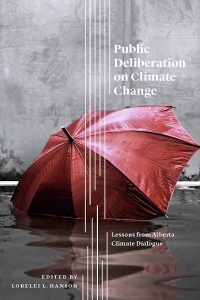
Review: All Wrong On Climate Change

Cabinet’s climate change program is a demonstrable fiasco swallowed in acrimony, evasion and costly litigation. Authors of Public Deliberation on Climate Change ask, is it possible Parliament is incapable of getting the big jobs done?

The Commons finance committee was in session May 1. MPs noted the finance department had a 2015 memo detailing the cost of a carbon tax to Canadian households, but censored all the numbers. How much would it cost? “I would prefer not to expand,” replied Gervais Coulombe, a department tax director.

On March 22, the Commons environment committee met. MPs asked, what’s the impact of the carbon tax on emissions? “I don’t have that number offhand,” replied Deputy Environment Minister Stephen Lucas. He coughed up the data five weeks later. It’s 55 percent short of the emissions target.

Here is Parliament’s climate change debate in a nutshell, a hodgepodge of secret math, evasive testimony and exasperated MPs. In the absence of coherent leadership it’s become “a proxy for political battles”, as Public Deliberation puts it.

Authors recount the experience of a series of research projects and workshops called Alberta Climate Dialogue to a) identify the problem and b) ponder solutions. Public Deliberation is not a scientific paper; it’s a compelling, human explanation of how the whole climate debate has gone wrong.

In Parliament this is a clash of competing narratives, where one side asks, “Why should Grandma pay 14 percent more for home heating oil?” and the other side replies, “Okay, what’s your climate plan?”

“People tell stories to get a handle on a complex and uncertain world,” writes contributor Gwendolyn Blue, a Climate Dialogue researcher. “The language we use and the stories we tell do not innocently reflect reality. Rather, our stories actively shape the ways in which we perceive, understand, discuss and act in the world.”

Public Deliberation identifies a natural tension in the climate change debate. It is real. “Deliberations focused on wicked issues present an additional layer of complexity,” note authors. “Intractable problems that involve competing values and tensions – where time is not costless and those most responsible for the problem have the least immediate incentive to do something about  it – challenge existing public policy engagement processes at many levels.”

That’s a damning indictment of a multi-billion dollar question. Two contributors to Public Deliberation, Tom Prugh of the Worldwatch Institute and Public Agenda’s Matt Leighninger, warn there is more at stake here than a 14 percent hike in home heating oil. “There are signs that twenty-first century public institutions are not up to the challenge of dealing with wicked problems like climate change,” they write. “For this failing, and a host of other reasons, the trust and confidence citizens once had in their public institutions is in very sharp decline.”

Incompetence is not inevitable. Skillful leaders can address complex issues with time and care. Proponents of free trade systematically dismantled a century of industrial tariffs by appointing a 1982 Royal Commission with cross-country hearings, opening negotiations in 1986, putting the question to voters in 1988 and bringing free trade into force in 1989. It was so methodical even free trade critics were left to say, “Okay, if that’s the way you want it – ”.

On climate change, cabinet opted for the shotgun approach instead. They should have read Public Deliberation.

By Holly Doan

Public Deliberation on Climate Change: Lessons from Alberta Climate Dialogue, edited by Lorelei L. Hanson; Athabasca University Press; 242 pages; ISBN 9781-77199-2152; $34.95


Cites Post Office Bullying

Public Works Minister Carla Qualtrough yesterday cited Canada Post for an unacceptable culture of harassing employees. Qualtrough told the Commons government operations committee she personally interviewed postal workers who complained of workplace bullying: “There are tensions.”

This content is for Blacklock’s Reporter members only. Please login to view this content. (Register here.)

1,559 Cut For Refusing Oath

More than 1,500 community groups have been denied federal funding for failing to sign a government oath, according to Department of Employment Records. The new Canada Summer Jobs policy is the target of a federal lawsuit: “It’s deeply concerning.”

This content is for Blacklock’s Reporter members only. Please login to view this content. (Register here.)

MP Would Revive The C.C.F.

The long-disbanded Cooperative Commonwealth Federation party would return to the Commons for the first time since 1961 by a legislator’s request. Independent MP Erin Weir (Regina-Lewvan) yesterday said he is petitioning the Speaker to sit as a Saskatchewan CCFer.

“I represent that political heritage,” said Weir. “My great-grandfather was a CCF candidate for Parliament in 1957 in Prince Albert, John Diefenbaker’s riding. There is a history and a heritage that I and a lot of other Saskatchewan people are tremendously proud of.”

The CCF, founded in 1932 as a farmer-labour party, disbanded 57 years ago with the establishment of the New Democratic Party. Saskatchewan’s provincial CCF carried the name until 1967 when delegates at a Saskatoon convention voted to rebrand themselves as New Democrats.

“This is the party I represent,” said Weir. “This is a tradition that is worth carrying on. The heart and soul of this movement was in Saskatchewan.”

Weir said he submitted a request to the Speaker of the Commons to be formally identified as a CCF Member of Parliament. “I’m going to defer to the Speaker,” he said. “MPs can make submissions to the Speaker about how they choose to be designated. The decision rests with the Speaker.”

The party elected its first government at the Saskatchewan legislature in 1944. CCF initiatives included the nation’s first Annual Holiday Act in 1944 mandating two weeks’ paid leave for private sector employees; introduction of the 40-hour week; passage of Canada’s first Bill Of Rights, a 1946 law prohibiting discrimination on the basis of race, colour or religion; and the first public hospital insurance program, in 1947.

The Saskatchewan party under then-Premier Tommy Douglas was also the first to rename jails as “correctional institutions”, and the first to introduce no-fault auto insurance. The national party at its peak in 1945 elected MPs in British Columbia, Saskatchewan, Manitoba, New Brunswick and Nova Scotia.

The federal party’s longest-serving leader, Major Coldwell, a former secretary-treasurer of the Canadian Teachers Federation, died in 1974. “He wanted to call it the Social Democratic Party,” Coldwell’s daughter Margaret Carman said in a 2009 interview. “He’d known poverty. His father was a butcher, and we lived in Saskatchewan in the Depression years.”

“He thought all people were entitled to a decent life, that no one should suffer from poor housing and poor health,” said Carman. “His whole life was devoted to improving conditions for the common man.”

By Tom Korski

‘My Income Is $12,000…’

A bestselling children’s author has told the Commons industry committee she took a 90 percent pay cut due to free photocopying under the Copyright Act. MPs are conducting a statutory review of the Act for the first time since 2012.

“The world watches as Canadian schools download and copy curated content in a government-sanctioned theft,” said Sylvia McNicoll of Burlington, Ont. “I’m trying to make a living. It’s impossible. I must tell my student the same.”

“I am drawing my pension and cashing in my registered retirement funds,” said McNicoll. “After that, I will sell my house. What does that mean for future writers and cultural workers? Your job must become your hobby. You do it on your lunch break.”

The current Act includes a “fair dealing” provision that permits free photocopying of works for private study or personal research. The Supreme Court in a 2012 decision Alberta v. Access Copyright expanded private study to include photocopying of textbooks and literature for classroom use. A federal judge in 2017 faulted York University for using free photocopies in millions of student course packs.

McNicoll told the committee she has seen her novels photocopied wholesale by public institutions. “My grandson recently brought home a photocopied story in a duo-tang folder, a Canadian-authored retelling of an Indigenous tale – Canadian illustrated, Canadian published, edited. The photocopied story was 100 percent complete.”

McNicoll, whose bestselling children’s novels have been republished overseas, said in 2012 her income was more than $46,000 including $2,579 in royalties. “I just finished preparing my income tax for 2017,” said McNicoll. “My income is down 90 percent to $12,000,” she said.

Royalties totaled less than $400. The author said she published two novels last year. “It’s down from two mortgage payments and three weeks of groceries, to one week of grocery money,” said McNicoll. “Groceries have gone up.”

“This photocopying, of course, negatively impacts the publishing industry and the cultural workers involved,” said McNicoll. The Association of Canadian Publishers in earlier April 26 testimony said licensing fees fell 89 percent under the photocopying provision of the Act.

“We are suffering real time damage triggered by this Act,” said Glen Rollans, Association president; “The rights you protect for me are not taken away from anyone. They are protected for everyone.”

Eight provincial education departments – all but Ontario and Québec – on February 20 filed a Federal Court lawsuit for the right to continue waiving fees on photocopied textbooks. The lawsuit covers copying by 92 school boards in the eight provinces.

By Staff

Joly Ups Facebook Ads 689%

Federal agencies tripled their spending on Facebook ads last year even as Heritage Minister Mélanie Joly lamented the state of local Canadian media. Joly’s own department increased its Facebook spending seven-fold. Newspaper publishers have cited cuts to federal advertising as a threat to newsroom jobs: “The aim of our government is to improve the fate of the industry.”

This content is for Blacklock’s Reporter members only. Please login to view this content. (Register here.)

Gov’t Insures Foreign Cash

Cabinet is extending federal deposit insurance to foreign currency accounts for the first time, but will not raise its $100,000 limit on protected savings in case of bank failure. Canada has the lowest deposit insurance rates of any G7 country: “I have no idea of why that makes sense.”

This content is for Blacklock’s Reporter members only. Please login to view this content. (Register here.)

Senators Block Railway Bill

The Senate yesterday blocked passage of a rail bill with demands that cabinet heed shippers’ rights. The close vote marked only the fifth time since 1960 that senators insisted the Commons rewrite legislation.

“Our role as Maritime senators is firstly to look out for the interests of our provinces,” said Senator Diane Griffin (Independent-P.E.I), chair of the Senate agriculture committee; “There is no reason that just because we’re the little ones at the end of the country that we should be treated like the little kid and bullied.”

The Senate transport committee on March 27 amended Bill C-49 An Act To Amend The Canada Transportation Act to compel railways to disclose confidential cost data in arbitration, and allow for competitive Atlantic freight rates by permitting shippers to gain interswitching rights east of Québec City to the Port of Saint John. The Canadian National Railway Co. monopolizes Atlantic freight lines.

The Commons dismissed the Senate amendments May 3. However, in a surprise motion, Senator David Tkachuk (Conservative-Sask.) yesterday urged senators to reject the Commons veto. “The railroads have no competition,” said Tkachuk. Senators passed the motion by a vote of 43 to 39 amid warnings the amendments would upset railway managers.

“Everybody knows Canadian National is the only Class One railway serving destinations in the Maritimes,” said Senator Peter Harder (Ont.), Government Representative in the Senate. “Providing access to long-haul interswitching to shippers in the Maritimes must be balanced against the potential risks of the future viability of CN services in Eastern Canada, which are critical.”

“Why should Maritimers have to pay more?” said Senator Griffin; “This is fundamentally a question of respect. Why is the Maritime region the only region where the economic interests of a private company outweigh the interests of the provinces?”

On only four other occasions since 1960 has the Senate blocked passage of a Commons bill by insisting on its amendments: a 1961 tariff bill; a 1969 Pest Control Products Act; a 2003 Criminal Code amendment on cruelty to animals; and the 2006 Federal Accountability Act. Each time, cabinet either accepted the Senate amendments as final, or prorogued Parliament to kill the bill.

‘Embarrasses The Government’

“Why insist?” said Senator André Pratte (Independent-Que.). “Is it just to embarrass the government for a couple of days? I don’t think it’s worth it, really.”

“If you are willing to fight on it, then let’s fight until there’s a constitutional crisis,” said Pratte. “The regional rights, as important as they are – I don’t think they reach the threshold of creating a constitutional crisis.”

Atlantic senators including Conservatives, Liberals and Independents yesterday protested Maritime shippers were disadvantaged in being unable to contract alternative rail service east of Québec, and that all shippers were entitled to greater disclosure of railways’ actual costs.

“For as long as I can remember, Atlantic Canada has been fighting for equal treatment,” said Senator Michael Duffy (Independent-P.E.I.). “The railways want to keep the status quo.”

Shippers in testimony last February 6 appealed to the Senate transport committee to compel greater disclosure of rail costs and rates in arbitration hearings. “We are totally at their mercy when it comes to rates and it makes it difficult for our shippers to compete,” said Perry Pellerin, president of the Western Canadian Shortline Railway Association.

Senator Rosa Galvez (Independent-Que.), sponsor of the amendment to force railways to disclose costing, said the provision was crucial. “Arbitrators should have access to all relevant rail costing information that is necessary to due proper diligence,” said Galvez; “This will reassure everybody that transparency will become a reality.”

Transport Minister Marc Garneau did not comment on the Senate vote. Garneau had demanded senators pass the legislation five months ago without any revision. “We’ll never get anything accomplished,” said Garneau.

By Tom Korski

Broke Rules, Hid Contracts

Federal agencies have failed to report millions in spending in breach of a Treasury Board directive, says an Inquiry Of Ministry tabled in the Commons. The 2004 order requiring prompt disclosure of contract spending was made after the sponsorship scandal: “That’s real money.”

This content is for Blacklock’s Reporter members only. Please login to view this content. (Register here.)

Fear Pot Tax Fuels Crime

A federal tax on legal cannabis is so onerous it could drive 270,000 medical patients to buy from unlicensed drug dealers, the Commons finance committee was told yesterday. Cabinet would tax cannabis at about 15 percent: “Ethically it’s wrong.”

This content is for Blacklock’s Reporter members only. Please login to view this content. (Register here.)

Can’t Legalize Pot Too Soon

One of Canada’s poorest provinces yesterday appealed to the Senate social affairs committee to speed the legalization of marijuana. New Brunswick is counting on $7.2 million in revenue from cannabis sales this year: “It’s an opportunity, for sure.”

This content is for Blacklock’s Reporter members only. Please login to view this content. (Register here.)

Blame Staffer For Flag Snafu

Rideau Hall blames a hapless staffer for displaying a German flag to welcome the King of Belgium on a state visit. The Office of the Secretary of the Governor General formally apologized for the gaffe, according to an Inquiry Of Ministry tabled in the Commons: “There was a mistake.”

This content is for Blacklock’s Reporter members only. Please login to view this content. (Register here.)

Says $50 Carbon Tax Is Short

Environment Canada yesterday acknowledged a $50 national carbon tax will not meet its 2030 greenhouse gas emission targets. John Moffet, associate assistant deputy minister, told the Commons finance committee the future tax rate is undetermined: “The federal government may change the pricing system.”

This content is for Blacklock’s Reporter members only. Please login to view this content. (Register here.)

Transport Co’s Weigh Tax On Carbon: ‘We Lose Customers’

The national carbon tax will see more border city Canadians go to the U.S. for cheaper air fares, the National Airlines Council yesterday told the Senate energy committee. The Council estimated five million Canadians a year already drive to the U.S. to catch discount flights: “That’s huge.”

This content is for Blacklock’s Reporter members only. Please login to view this content. (Register here.)

Protest Precedent On Privacy

Senators yesterday protested a railway bill as an “egregious” precedent on privacy rights, but said they will not defeat the measure. The Transport Canada bill exempts rail workers from protections under federal privacy law: “This fight isn’t over.”

This content is for Blacklock’s Reporter members only. Please login to view this content. (Register here.)



