
Canadians are proud of their rights and freedoms, the military and hockey, says in-house research by the Department of Canadian Heritage. The findings contradicted attempts by federal managers to emphasize Indigenous reconciliation and “equity and diversity.”
376,630 New Citizens In 2025
Nearly 380,000 new Canadians gained citizenship last year, according to Department of Immigration figures. The department would not say how many more applications were expected under revisions to the Citizenship Act: “Given the complexity of some Bill C-3 cases, we expect greater pressure.”
Carney Avoids Election Talk
Prime Minister Mark Carney yesterday would not say whether he’ll lead the Liberal Party into another general election. Asked twice by reporters, Carney, 61, replied: “I am blessed.”
Dairy Quotas Win In Québec
A former president of Dairy Farmers of Québec, Daniel Gobeil, last night claimed an upset Liberal win in Chicoutimi on unusually high turnout in a federal byelection, 41.5 percent. Liberals easily held two other safe seats to retain a narrow majority in the Commons: ‘We produce less milk than the state of Wisconsin and without supply management, dairy producers would see their farm gate price drop.’
Say Fire Evacuees Mistreated
Indigenous Canadians under forest fire evacuation orders have been mistreated by federal and local authorities, says Federal Housing Advocate Marie-Josée Houle. Complaints ranged from being denied access to hotel swimming pools to falling prey to local gangs: ‘Some of them were leaving their communities for the first time experienced trauma and uncertainty.’
Public Wary Of Costs: Report
Canadians are divided over billions in new military spending, says in-house Privy Council research. “Reactions were mixed,” said a federal focus group report: “A number expressed concern about the scale of the investment, $81.8 billion.”
Man From McKinsey Is Back
Dominic Barton, former managing director of the consulting firm McKinsey & Company, yesterday was named chair of the federal agency Invest in Canada. The appointment came two years after investigators said McKinsey benefited from favouritism in winning $200 million worth of federal contracts: “I have no interest in making money.”
School Year Will Cost $31,700
The typical postsecondary student in Canada will spend $31,700 getting an education this school year including tuition and expenses, the nation’s Chief Actuary said yesterday. Student loans this year will average $8,285: “More students have a need that exceeds the loan limit.”
“Strategy” Followed Bad Poll
Prime Minister Mark Carney’s abrupt reversal on electric car mandates followed in-house federal polling that showed only a third of Canadians supported sales quotas, according to records. Opposition ran hottest west of Ontario including a majority of drivers in British Columbia, where Liberals held 20 seats: “We are making strategic decisions.”
Need Tariff Hearings: Senator
The Senate must open special committee hearings to hear from business, labour and local authorities on impacts of rolling tariffs, says the Opposition Leader in the Senate. Existing trade committees in the Senate and Commons have not met in months: ‘Thousands of Canadian jobs hang in the balance.’
CBC Reversal Took Half Hour
CBC News publicly cancelled an editorial order 30 minutes after learning of cabinet’s disapproval, records show. The TV network has repeatedly denied following Liberal “political winds or influences,” according to former CEO Catherine Tait: “Independence is critical to the trust Canadians place in us.”
Took Away ‘Street Furniture’
Canada Post has removed 600 city sidewalk mailboxes this year as a cost-cutting measure. Removal of what management called “street furniture” came as the corporation ran up $482 million in pre-tax losses for the first six months of the year: “Changes are critical.”
$20K Rights Limit Holds Firm
Federal judges have upheld a $20,000 cap on compensation for pain and suffering under the Canadian Human Rights Act. Legal commentators including now-Governor General Louise Arbour had criticized the limit set a generation ago by Parliament: “Removing the cap on damages would go a long way to increase access to justice.”
A Sunday Poem: “Imagine”
You envision a world
of perfect harmony.
Show me two individuals
able to be in one room
without a conflict –
and I’ll show you
two liars.
By Shai Ben-Shalom

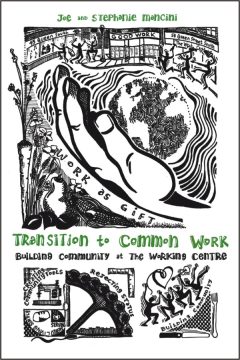
Book Review — The Welfare State
Poverty is called a trap, though millions of Canadians have escaped it using subtle methods. The Department of Employment, an anti-poverty agency, is not good at this. “The welfare state, which imposes order from above and requires specific outcomes, fails on many levels,” write Joe and Stephanie Mancini. “Access to basic necessities of life is often denied because someone does not fit into bureaucratic categories, or because they cannot navigate complex rule-based systems.”
The Mancinis’ Transition To Common Work is a crisp critique of the welfare state written by a devoutly Catholic husband and wife committed to aiding the poor. This is not a rant about the dole. It is an eloquent account of the subtle, human remedies for despair.
At the Working Centre in downtown Kitchener, Ont., founded by the Mancinis in 1982, “we became known as the place to go where there were few other options,” they explain. What do visitors say? “‘My brother died in Hamilton and I am trying to find bus fare and clothing so I can go to the funeral.’ ‘My daughter is in a hospital just outside London and I would like to visit her. Is there someone I could pay to drive me there two times a week?’ ‘I am new to Canada and I am trying to find work as an engineer.’ ‘I am living in my car but I have a dog, so I have to find a job quickly so I can find a place to live.’”
This is where the Mancini method works and Employment Canada fails. No check-off bureaucracy can resolve the small, immediate crises that are the burden of the workaday poor.
At one point the couple attend an Employment Canada workshop where managers provide a fixed answer for the jobless: “Unemployment could be beaten by an organized and meticulous job search,” Transition recounts. “The jobs are out there, the system works, and it’s up to the unemployed to work hard to find them. What else could the government say? This was the same service that was paying out Unemployment Insurance claims. The Canada Employment Centre was designed with carrots and sticks. Part of its mandate was to help the unemployed find work, but it could also suspend benefits if the job search was not up to undisclosed standards.”
Later the Mancinis count the job listings at the Kitchener unemployment office. There were 560 with nearly a quarter of the postings part-time: “The bulk of the jobs paid low wages for unskilled labour. When we published these details in our newsletter, we received a letter from the Canada Employment Centre manager demanding that we never count the jobs board again.”
Instead they created the Working Centre. It runs a thrift store and bicycle repair shop, market garden and café. It serves a no-charge lunch and rents apartments at sub-market rates. It issues a quarterly newsletter Good Work News, and draws funding from an annual Mayor’s Dinner and a golf tournament where unions sponsor foursomes and a big prize table. It is “a non-judgmental place that offered hospitality and support for the unemployed,” without bureaucracy.
Transition To Common Work is fresh and candid. It concedes failure. The Mancinis opened a recycling depot that bundled paper and metal for scrap dealers. At its peak it employed 12 and generated $20,000 a month in revenue till it collapsed in the teeth of the 1991 recession: “We started with altruistic notions about recycling and sought companies and individuals eager to recycle their waste,” they write. “We learned that paper mills had no loyalty and treated us like second-class citizens, and that equipment salespeople had their own agenda.”
“The initiative had no value in itself,” Transition concludes, a lesson lost in so many anti-poverty programs. “We concluded that private and public bureaucracies expend vast sums of money administering systems that are often second rate or unimaginative and that governments tie up tax money in highly unproductive activities.”
Transition details the subtle, human methods a Kitchener couple used to better their city. It works. They proved it. In 2014 the Mancinis received the Benemerenti Medal from the Pope for outstanding service to society.
Transition to Common Work: Building Community at The Working Centre, by Joe & Stephanie Mancini; Wilfrid Laurier University Press; 232 pages; ISBN 9781-7711-21606; $14.99



