
Canada’s police and courts remains inherently racist, Senator Murray Sinclair (Independent-Man.) yesterday told the Commons heritage committee. The former Court of Queen’s Bench justice cited recruitment tools previously used by police as evidence of bias: “There are many such rules in the justice system.”
CBSA Sorry For Data Error
The Canada Border Services Agency yesterday said it made a paperwork error in claiming Customs officers seized more than half a billion dollars from travelers last year. The Agency said the actual figure was $31.3 million: “Apologies for the confusion.”
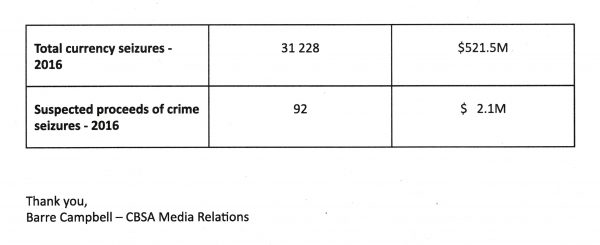
$522M In Secret Cash Seizures
The Canada Border Services Agency last year confiscated more than half a billion dollars from travelers, the equivalent of nearly a third of the Agency’s entire budget. The figure is 100 times greater than seizures claimed in an earlier audit: “It does not mean that funds are the proceeds of crime.”
Carbon Tax Under The Radar
Few Canadians know a national carbon tax will be introduced in 2018, says in-house research by the Privy Council Office. Most respondents told pollsters they are “already doing everything they can” to cut greenhouse gas emissions: ‘Few recognize how taxing consumers would result in effective change.’
Random Tests Back In Court
Unifor says it will ask the Supreme Court to again rule on the legality of random workplace drug and alcohol testing. The appeal follows an Alberta decision on random Suncor Energy Inc. testing of oil sands workers: “Impairment is the issue.”
Silent On Whistleblower Act
Cabinet says it still has no response to a Commons committee report critical of a failed whistleblower law. Treasury Board President Scott Brison said there’s “no specific timeline” for answering MPs’ calls for reform.
Animal Test Bill Sees Rewrite
The Senate sponsor of a bill to ban animal testing by cosmetics makers will amend the proposal amid industry protests. “I am not an animal rights activist,” said Senator Carolyn Stewart Olsen (Conservative-N.B.): “If we try to push too much, in all seriousness, we’ll lose the bill.”
Say Migrants Suppress Wages
MPs yesterday said the Temporary Foreign Worker Program must not lower wages or deny jobs to Canadians. The comments came as the Commons human resources committee examined an audit critical of the program: “We can’t have this as part of a business plan to keep wages low.”
“One Step To Pharmacare”
MPs say they’re encouraged by a Parliamentary Office Budget study that puts the federal cost of a national pharmacare program at $19.3 billion a year. Cabinet earlier rejected a proposal to enact pharmacare this term: “It’s an important step.”
Senate Passes Kids’ Ad Ban
Senators yesterday passed a Conservative-sponsored bill to ban kids’ junk food advertising. One Senator said he was “horrified” by industry marketing practices: “People will pay, and they do pay because sugar is addictive.”
Wants $1,500 French Fines
A French rights advocate who took Air Canada to the Supreme Court yesterday told the Commons language committee that critics must be vigilant. Breaches of bilingualism law should be punishable by a $1,500 fine, he said: “As a francophone citizen, I have to read a sign that says ‘exit’.”
No Gov’t Bailout For Dailies
The Department of Canadian Heritage has vetoed a bailout of money-losing daily newspapers. Staff earlier noted any bankruptcy of the nation’s largest daily publisher, Postmedia Network Canada Corp. and its Sun tabloid subsidiary, would leave 28 cities without a daily newspaper.
“Our approach will not be to bail out industry models that are no longer viable,” said Heritage Minister Mélanie Joly. “Rather, we will focus our efforts in supporting innovation, experimentation and transition to digital.”
Postmedia has reported annual losses as high as $263.4 million. Joly’s department in memos earlier obtained through Access To Information said subsidies should target “the next generation of Canadian publishers”. Joly yesterday said the department would consider “start-up funding” for new digital media.
No regulations were detailed. Digital start-ups are currently eligible to apply for modest grants, typically under $50,000, through a “business innovation” program. The fund is part of a larger $79 million-a year Canada Periodical Fund that mainly subsidizes weeklies and periodicals. Blacklock’s has neither solicited nor accepted taxpayers’ subsidies.
“As more publications add mobile versions or move fully online, what’s important to Canadians is that they continue to publish original Canadian content, and that our programs provide the support they need to innovate,” said Joly. The Minister noted current eligibility for grant applicants “is still based upon dwindling numbers of print subscribers.”
Some thirty-seven print dailies have folded in Canada since 2008 including the Guelph Mercury, Halifax Daily News, Kamloops Daily News, Nanaimo Daily News and Prince Rupert Daily News.
Joly’s department in a report Research Study On The Impact Of Digital On The Magazine Industry noted paid circulation for periodicals had fallen sharply. Circulation of Reader’s Digest in Canada has declined from 1.5 million to an average 327,000 since 1970. Reader’s Digest continues to receive $1.5 million a year through the Periodical Fund.
Maclean’s has seen paid circulation fall from 294,000 to 226,000 in the period from 2014 to 2016. Maclean’s also receives $1.5 million in annual aid. Rogers Media, Maclean’s publisher, last January restricted its print run from weekly to monthly.
“The publishing industry is in flux at the moment,” said Magazine Industry. “No publishing operator has found the ‘right’ business model.”
Statistics Canada in a 2016 report Periodical Publishing calculated total industry revenues fell 18 percent from 2013, from nearly $2 billion to $1.6 billion. Advertising sales fell by a third, a decline of $349 million. Industry subscription sales fell 17 percent, by $80 million.
By Staff 
Railways Warn On Marijuana
Railways yesterday appealed to the Commons justice committee to mandate random workplace drug tests. Executives said legalization of recreational cannabis poses a peril: “Legalizing marijuana will normalize its consumption.”
Public Resent Queue Jumpers
Department of Immigration research points to simmering public resentment against cross-border asylum seekers. Legal immigrants told the department that walk-across refugee claimants are queue jumpers who should be turned back at the border: “Many had waited months and even years to immigrate.”
1.1 Million Spam Complaints
Regulators have logged more than 1.1 million spam complaints since enacting an anti-spam law three years ago. Authorities insisted the law has been a success: “Legislation was never going to eliminate all spam.”