
The Department of Public Works is hiring private IT consultants to manage 660,000 federal web pages at an undisclosed cost. It follows cabinet’s 2023 promise to “reduce spending on consulting.”
MPs Jeer Treasury Board Boss
MPs ridiculed Treasury Board President Shafqat Ali as embarrassingly uninformed after he appeared unaware of a 2024 committee motion to ban federal employees from moonlighting as contractors. Critics jeered as Ali was handed scripted answers during questioning on budget estimates: “This is embarrassing. I would be embarrassed. I am almost embarrassed for him.”
Call Solar Panels Jesus’ Work
Solar panels embody the teachings of Jesus, says MP Elizabeth May (Saanich-Gulf Islands, B.C.). The re-elected Green Party leader in her first Member’s Statement to the 45th Parliament endorsed the blessing of solar panels on her parish church, explaining she was trying to “follow the path of Jesus Christ in my work.”
Poem: “The King’s Highway”
It’s a million little things,
That portend a fall.
Small enough,
To go unnoticed.
Gradual, until it’s not,
And arresting it,
Is harder,
The longer it runs.
It’s written, the road is broad,
And many will take it.
There is something in the old
Wisdom.
Civility dies,
In the chaos, the clash,
As the wide gate leads
To destruction.
The point of no return,
Takes effort to discern,
But a clue can be seen,
In the million little negotiations,
Of the social contract,
On the King’s Highway.
By W. N. Branson

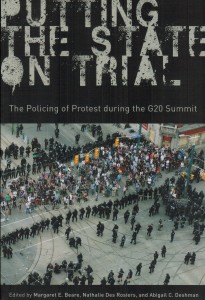
Review: 72 Hours
Fifteen years after the G20 riot in Toronto, there is little doubt protestors won the battle. The G20, Toronto Police, media and government – all were exposed as heavy-handed and paranoiac.
Putting the State on Trial is an eloquent collection of essays dissecting 72 hours in June, 2010 that smashed reputations to smithereens. Nobody – not government, not police, not media – looks good in this saga, save protestors themselves who exercised their right to dissent. “The riot gear, the verbal assaults, the seemingly irrational physical abuse on hapless citizens caught in the maze, and the initial denial by the police that any of the actions were indicative of an out-of-control policing operation, sparked outrage,” authors write.
The facts: The federal cabinet insisted on holding the summit in Canada’s largest city. Then the Ontario cabinet cordoned off five square blocks of downtown Toronto under an obscure 1939 law intended to protect power plants from Nazi saboteurs. Under Regulation 233/10 any person could be arrested for entry, or failing to provide ID. It became “a trap for those who exercised their ordinarily legal rights,” as Ontario’s ombudsman later observed.
Here for the first time Canadians learned of a police practice called “kettling,” where people were penned behind barricades for hours till they were photographed and identified by constables. That’s against the law in this country.
Toronto officialdom stumbled into the G20 fiasco even with the benefit of hindsight. At a 1999 WTO riot in Seattle, police arrested 600 people in a similar security operation gone berserk. The fallout saw the police chief resign, the mayor lose office, and the WTO suffer embarrassing scrutiny over its corporate practices. “The WTO was never the same,” wrote David Postman, a Seattle Times reporter who covered the protests. “Neither was the art of street protest or the chore of policing major political events.”
In Toronto, politicians and police were persuaded the answer was a bigger stick. Media broadcast fears that dangerous “Black Bloc” anarchists threatened public safety. I can think of worse crimes than kicking out the window at a Starbucks franchise, but that weekend in June Toronto lost its head. One State on Trial essayist, Professor Kent Roach of the University of Toronto, offers an explanation.
“If 9/11 had not happened, would over 1,100 arrests have been made?” Roach writes. “Would the use of arrests as a form of disruption and incapacitation with low levels of subsequent prosecutions have been tolerated? Would $1 billion have been spent and over twenty thousand police and military been deployed in a time of global economic recession?”
“The idea that protestors could become terrorists influenced some police thinking and responses,” Roach concludes. Of 1,105 people arrested during the summit only 321 were later summoned to court. Of those, 204 saw the charges stayed or dismissed including Courtney Winkels, 20, famously arrested after blowing soap bubbles at police in an incident captured on YouTube video.
Canadians were told the G20 protestors were “the violent dregs of nihilism” (Toronto Star), “thugs” (Barrie Examiner), “brick throwers” who were “hoping to get bopped on the head by a policeman and make the nightly news” (Globe & Mail), “hooligans,” “malcontents,” “losers” and “ne’er do wells.”
How could so many people get this so wrong? “Media adopted a communication strategy that emphasized danger and engineered fear,” State on Trial concludes. “Clearly newspapers – and in fact all media – should adopt a far more skeptical stance toward such warnings in future.”
Putting the State on Trial is a crisp, probing analysis of mayhem. Anyone is better for reading it.
By Holly Doan
Putting the State on Trial: The Policing of Protest during the G20 Summit; edited by Margaret E. Beare, Nathalie Des Rosiers and Abigail C. Deshman; University of British Columbia Press; 396 pages; ISBN 9780-7748-28307; $32.95
Vote Chief Faces Questioning
Chief Electoral Officer Stéphane Perrault will be called by the House affairs committee to explain irregularities in the April 28 election. Perrault has apologized for unexplained poll closures in one riding and faces a lawsuit over irregularities in another: “The public could also testify.”
No Comment On Investments
Housing Minister Gregor Robertson would not answer repeated questions in the Commons on whether he personally speculates in real estate. Robertson’s office yesterday did not comment: “I am here to answer questions on behalf of my department.”
Must Release Files On Charity
The Jewish National Fund has won a Court order compelling federal auditors to disclose confidential records concerning the longtime charity’s loss of tax status last August 10. The National Fund, a registered charity since 1967, has accused the Canada Revenue Agency of bias: “I find the Jewish National Fund’s allegation of bias is a tenable ground of appeal.”
MPs Like $6B Income Tax Cut
The Commons yesterday by a 335-0 vote gave unanimous Second Reading to a cabinet proposal for a $5.8 billion income tax cut. Passage came on a warning from seven New Democrat MPs that they would seek amendments once the bill lands at finance committee hearings: “More troubling are the unintended consequences of this tax measure.”
Sales Crash Without Rebates
New electric car sales crashed without taxpayers’ rebates, Statistics Canada data showed yesterday. Dealers saw their steepest decline in sales since pandemic lockdowns: “We are certainly looking at monitoring.”
Senator Hired By Beer Vendor
Senator Daryl Fridhandler (Alta.), a longtime Liberal Party organizer, yesterday had no comment after accepting a directorship with a federal contractor. Fridhandler would not say why he took the post with a beer vending company or what he was pocketing in fees in addition to his $184,800-a year Senate salary.
Housing Far Short Of Target
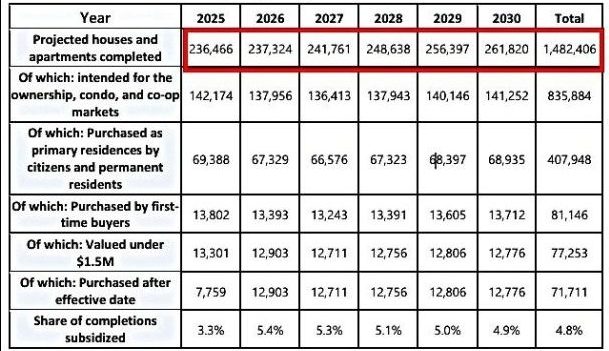
The Budget Office yesterday forecast housing starts will remain far short of cabinet’s affordability target for years to come. New home construction was predicted to remain below record levels set in 1976: “We are focused on building big.”
Praised Unlawful Bank Freeze
Michael Sabia, a former deputy finance minister instrumental in the unlawful use of n anti-terror law to freeze Freedom Convoy bank accounts, yesterday was promoted as head of the federal public service. Sabia told a 2022 judicial inquiry he was undecided on whether peaceful protestors were terrorists: “Who takes responsibility for that?”
NDP Is Out For Years: Angus
The federal New Democratic Party will take years to rebuild after the disastrous April 28 election, former MP Charlie Angus said yesterday. “This is going to be a rough four years,” he told reporters: “I have not spoken to Jagmeet Singh since the election.”
Bill Honours Cattle Branding
A ranchers’ livestock brand would join Parliament’s inventory of all-Canadian symbols under a private bill introduced yesterday in the Commons. The sponsor called it an enduring symbol of the frontier: “It tells a story.”



