
A Senate panel yesterday approved passage of a bill prompted by an international incident along the Canada-U.S. border. The bill curbs zealous Customs enforcement against boaters, fishermen and whale-watchers who unwittingly drift into Canadian waters: ‘This happens thousands of times.’
Cabinet Weighs Post Pension
Cabinet will take steps this year to deal with a multi-billion dollar Canada Post pension shortfall, says a Department of Finance memo. A 2014 order allowing management to defer pension solvency payments ends December 31: “Existing funding relief will expire.”
Predicts Carbon Tax Layoffs
A national carbon tax will cost production and jobs, say Canadian cement makers. Executives testifying at the Senate energy committee blamed British Columbia’s 2008 carbon tax for layoffs at three plants: “Climate change is not for the faint of heart.”
Builders Face Flood Standard
Home builders and buyers will face new national standards on flood prevention, says a University of Waterloo researcher. Waterloo and the Standards Council of Canada will develop guidelines on floodplain construction: “Are there some developers who will push back?”
Captive Whales Not Worth It
Whales in captivity have little scientific or educational value, say researchers. Two scientists appealed to the Senate fisheries committee to approve a bill banning the practice: “Their contribution to the conservation of Canadian species has been virtually zero.”
Find RCMP Jobs A Hard Sell
Few young Canadians, about 24 percent, would take a job with the RCMP despite millions spent on recruitment campaigns, says in-house research. The RCMP is short more than 1,000 constables, by official estimate: ‘There is a general lack of interest followed by the feeling it is dangerous.’
Gov’t Sues Over Shipwreck
The Department of Fisheries is suing British Columbia to recover $145,000 spent on clean-up of a derelict vessel. Cabinet has promised a national program to clear harbours of abandoned boats deemed an environmental hazard: “Canadian taxpayers can’t fund every single one of these.”
Review: The Press
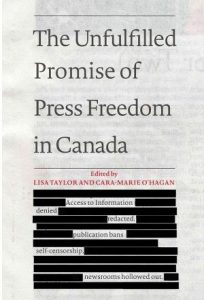
A new book from University of Toronto Press suggests press freedom in Canada is weakening as news media decline, and reporters genuflect to power in the face of growing job pressures. In The Unfulfilled Promise of Press Freedom, Prov. Ivor Shapiro of Ryerson University notes Canadian journalists could campaign to protect their rights, but don’t for a variety of self-serving reasons.
“The press could use its freedom more assertively,” writes Shapiro; “The argument for press freedom today is harder to make than before, because it rests on a greater burden of responsibility. The press could work harder to make this case.”
The point reflects our experience at Blacklock’s Reporter. The other day a Commons committee clerk threatened one of our reporters with an RCMP background check and lifetime banishment from Parliament Hill. The grievance involved alleged requirements in obtaining a public document at a public meeting by a member of the public, us. We told the clerk to put the complaint in writing and get ready to fight like hell.
The incident illustrates Shapiro’s lament. In Ottawa we see a steady push to control journalists and keep information from citizens on a day-to-day basis. Blacklock’s has spent hundreds of thousands of dollars and countless hours asserting our statutory rights. It’s pretty much a part-time job.
“To explain why news media sometimes hesitate to investigate and critique widely admired figures and institutions (including one another), it is sometimes suggested that Canada is a smaller world, a place where bridges can be so easily burned, leading to career obstacles and lost jobs,” writes Shapiro. “But surely journalists, who tend to be so dismissive of cowardice when it’s exhibited by senior civil servants or judges or politicians, should be shocked, rather than tolerant, when it is exhibited by peers.”
Media are the only for-profit corporations granted constitutional freedom from government regulation. Having won a reprieve from costly rules that vex other businesses, it’s not too much to expect that media managers spend a bit of those savings on something other than party hats and dividends for shareholders.
“The press could campaign for a freer press,” as Prof. Shapiro puts it. The fact many don’t is noteworthy but not profound. Canada has never had a golden age of press freedom, and our business like yours has its share of lightweights and poseurs.
The book’s observations are brought to life at the Parliamentary Press Gallery. Many shrink from confrontations with officialdom for fear of offending a future employer. Many others have no emotional investment in their trade whatsoever. Some just want to have fun.
The Gallery has $235,000 in the bank but could not be bothered spending a penny on submissions to Commons committees examining Access To Information and the state of dailies. When the RCMP in 2016 admitted to unwarranted surveillance of two Ottawa reporters, the Gallery did not utter a whimper. Minutes of board meetings indicate the Gallery was preoccupied at the time with hustling corporate sponsors for its annual banquet.
The Unfulfilled Promise of Press Freedom is candid and thoughtful. It belongs in every journalism school library. It casts a wide net in asking why media fight, and more interestingly, why some don’t. “No one is better positioned to educate the public about these issues than journalists themselves,” writes Prof. Bruce Gillespie of Wilfrid Laurier University. “If they fail to do so, they risk perpetuating the government’s framing of the issue as one of self-interested whining.”
Authors recount famous stories of CBC court challenges of government secrets and censorship, though the effect for readers is uneven. Accounts of Goliath versus Goliath are not telling. Doggedness is no virtue in a billion-dollar news corporation with a roomful of taxpayer-subsidized attorneys.
More compelling is the account of Robert Koopmans, former courthouse reporter with the now-defunct Kamloops Daily News. Koopman’s newspaper had a legal war chest of $300. “I was covering the first appearance in provincial court of a woman charged with murdering her husband,” he recalls, when a defence lawyer told Court that detectives were badgering his client for a confession. The Crown Prosecutor suddenly piped up and requested a convenient publication ban.
“For the first time, I stood in response and sought standing from the court to address the Crown’s application,” writes Koopmans. “I argued the Crown’s request for a ban was unwarranted in the circumstances and did not meet the legal test put forth by the Supreme Court of Canada. The judge agreed, and refused to impose a ban. As a result, I was able to report on the concerns of a lawyer about the treatment of his client at the hands of investigators.”
Press freedom is won and lost at the bail hearing, on the picket line, at the school board meeting, in confrontations with every petty clerk, meddlesome cop or bad-tempered judge. As Alan Borovoy of the Canadian Civil Liberties Association once put it, “If you want to change policies, you have got to be ready to have some trouble, to make a fuss, to point the finger, to name some names. You’ve got to be able to do that, or nothing changes.”
By Holly Doan
The Unfulfilled Promise of Press Freedom in Canada, edited by Lisa Taylor and Cara-Marie O’Hagan; University of Toronto Press; 296 pages; ISBN 9781-4875-20243; $29.95

Gov’t Eyes First Carbon Tariff
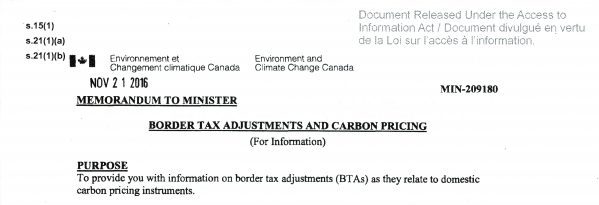
Cabinet is researching the world’s first carbon tariff on imports to protect Canadian industry, says an Access To Information memo. The Department of Environment admitted its national carbon tax will impact the ability of Canadian employers to compete: “Border carbon adjustments ‘level the playing field’.”
Auditors Lose Key Tax Ruling
Federal auditors have lost a key court ruling that strikes down Canada Revenue Agency’s access to taxpayers’ confidential records. The case is expected to go to the Supreme Court: “It can be seen as a question of national importance, no doubt.”
Fed Mercury Regs To Tighten
Cabinet has issued an order to ratify a United Nations treaty on mercury emissions. Canada signed the Minamata Convention in 2013 but had yet to bring the anti-pollution pact into force: “Nobody is regulating logging as a source of mercury.”
Fined $1,300 For Canned Paté
A tribunal has upheld a $1,300 fine against an Alberta woman for a “very serious violation” of federal law, carrying four small cans of chicken paté in her luggage. Adjudicators have no power to waive Canada Border Services Agency penalties on humanitarian grounds, the tribunal said: “Officers must protect Canadians.”
Won’t Disclose Cannabis Cost
Cabinet has no estimated cost of the impact of legalized cannabis on police budgets, hospital visits, border enforcement, insurance claims or traffic injuries, say records. Ministers in documents tabled in the Senate acknowledged a lack of research, but noted Health Canada spent $174,396 on polling: “Our question to the government is simple.”
Feds Urged To Disclose Tax Scheme; Must “Come Clean”
Environment Canada must disclose the full scope of its carbon tax plan, say legislators. A secret memo published yesterday by Blacklock’s indicated a tax of $300 per tonne – six times the rate claimed by cabinet – is required to meet greenhouse gas emission targets: “It will bankrupt many families in my riding.”
Claims 100% Like Carbon Tax
Environment Canada reports 100 percent of businesses it consulted support a national carbon tax. Steelmakers said nobody asked them: “Do you want to continue to manufacture steel in Canada?”