
Cabinet is deleting part of its own budget bill that would shield banks from provincial consumer protection laws. The concession averts a Senate showdown on protests the bill would void class action lawsuits against the nation’s largest financial institutions: “I think consumers won today.”
First Carbon Tax Report Due
A parliamentary report on the impact of cabinet’s carbon tax is due in February, says the chair of the Senate energy committee. The study, the first of five, will weigh the impact on electricity rates of a $50 per tonne tax on carbon emissions: “Nobody talks about the costs.”
Bank Feared Scrutiny In Deal
The Bank of Canada knowingly purchased banknotes from an Australian supplier implicated in a corruption scandal, according to an Access To Information memo. Management feared questions in the press or Parliament “as to why the Bank of Canada would be in business with such a firm.”
No Mandatory GMO Labels
Genetically modified fish should not require mandatory labeling despite findings of federal consumer surveys, says the Commons agriculture committee. MPs yesterday rejected labels on engineered Atlantic salmon to be sold in Canadian supermarkets within two years: “This is very worrying.”
Says Drug-Impaired Bill Vital
The Senate last night took up Third Reading debate of a bill sanctioning first-ever roadside tests of drug-impaired drivers. A federal task force today will detail its recommendations to cabinet on legalizing marijuana: “Victims are counting on us.”
Subsidize “Next Generation Of Publishers”, Says Memo
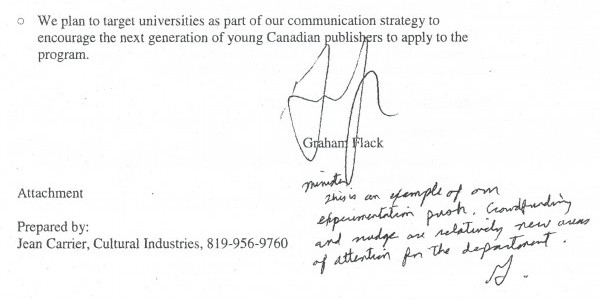
The Department of Canadian Heritage is introducing a new media subsidy – for university students. The department, after warning of the bankruptcy of the nation’s largest newspaper chain, said it must “encourage the next generation of young Canadian publishers.”
“We plan to target universities as part of our communications strategy,” Deputy Minister Graham Flack wrote in a memo. The March 10 document was obtained through Access To Information. “This is an example of an experimental push,” wrote Flack.
The department in an earlier report contemplated the bankruptcy of Postmedia Network Canada Corp. and its Sun tabloid subsidiary. Collapse of the chain would leave 28 cities without a daily newspaper, authorities noted.
Postmedia last year reported $263.4 million in losses with corporate debts totaling $671 million. “Public and industry concerns will probably grow in light of future closures, and the number of voices requesting government actions could become significant,” said the report Newspapers In Canada: The New Reality Of a Traditional Industry.
“Postmedia is burdened with high annual interest payments which restrict cash flow and place it in a difficult financial position,” Newspapers said. “This has raised fears among experts that it may not be able to repay its substantial debts, the bulk of which come due in 2017 and 2018, and that this could result in further restructuring or even bankruptcy.”
Thirty-seven print dailies have folded in Canada since 2008 including the Guelph Mercury, Halifax Daily News, Kamloops Daily News, Nanaimo Daily News and Prince Rupert Daily News.
In the newly-disclosed memo to Heritage Minister Mélanie Joly, staff said an existing subsidy program for other media – including magazines and weeklies – should be expanded in 2017 to include campus website start-ups that use crowd-source funding. “The changes will increase the number of new applicants by opening the program to digital periodical start-ups; recognize the emergence of crowdfunding by prioritizing applicants who seek to generate revenues through this platform; encourage different applicant behaviour to collect more accurate information by employing behavioural science; and reduce entry barriers to the program by applying more flexible criteria and reducing eligibility thresholds within the current terms and conditions.”
The current Canada Periodical Fund pays out $74.5 million annually in grants to periodicals like Maclean’s ($1.5 million), Chatelaine ($1.5 million) , Reader’s Digest ($1.5 million) and TV Week ($1.04 million).
The department proposed a new subsidy “targeting youth by encouraging university students to participate in the next field of digital periodical publishing and contributing to the next generation of Canadian publishers,” said the memo Canada Periodical Fund Business Innovation Component. The memo did not disclose the costs of new subsidies.
Dailies’ paid circulation as a percentage of Canadian households has declined by more than half, from 49 percent of homes to 20 percent, in the period from 1995 to 2014, by official estimate. Employment in the industry has fallen 23 percent since 2006. A total 66 percent of Canadian dailies are owned by three publicly-traded corporations: Postmedia, Torstar and Transcontinental.
By Tom Korski 
Want ‘Pay Now’ Act In 2017
A bill mandating prompt payment for federal contractors could become law in 2017, says its Senate sponsor. Cabinet has said it’s reviewing the legislation guaranteeing prompt payments to all trades and contractors on public works: “People are going bankrupt.”
MPs Target Executive Salaries
MPs seek to amend a cabinet bill on management of large private corporations. The bill should target “out-of-control executive compensation,” said one legislator: “The Government of Canada can and should address this problem.”
Career Criminals Cost $1.4M
Career criminals typically cost taxpayers $1.4 million by age 30, says the Department of Public Safety. Federal researchers based the estimate on demographic data drawn from federal inmates: “I’ve come across individuals who’ve spent 20 or 30 years behind bars, so you can add up the costs.”
Soap Additive An Eco Toxin
Cabinet proposes to list a common soap additive as environmentally toxic. Manufacturers import 100,000 kilograms of triclosan annually, by official estimate. Environmental groups and the Canadian Medical Association have sought a triclosan ban since 2009: “Triclosan meets the environmental criterion for a toxic substance.”
Gov’t Offers Deal On Budget Bill Amid Anti-Bank Protests
Cabinet in an unusual concession is offering to delay full enactment of a budget bill amid Senate protests. Lawmakers yesterday threatened to remove a clause exempting banks from provincial consumer protection laws. The Senate hasn’t defeated a budget bill since 1993: “We are trying to find a way forward.”
MPs Okay Nt’l Porn Review
The Commons last night unanimously passed a motion to investigate pornography, the first federal initiative of its kind since 1985. Proponents said Parliament should be prepared to regulate the internet: “It has to stop.”
GMO Report Due Next Week
MPs have completed a report on whether to mandate labeling of Canada’s first genetically-modified animal protein. A final decision will rest with Health Canada, said the chair of the Commons agriculture committee: “My personal opinion is eventually it will be.”
Pension Bill Closer To Law
A bill to raise Canada Pension Plan premiums is closer to law following endorsement yesterday by the Senate social affairs committee. Union executives and the National Pensioners Federation support the bill; a small business group called it a “bulldozer” that will hurt employers: “Nothing is perfect.”
Says Fisheries Law Still Weak
Cabinet continues to ignore the Fisheries Act by licensing new pipelines and advocating hydroelectric dams to meet climate change targets, says a leading Canadian researcher. The remarks came on the last day of Commons fisheries committee hearings on a new Act to be introduced in 2017: ‘It’s business as usual.’