
Cabinet is again examining Australian-style limits on foreign real estate buyers. A Department of Finance memo noted both countries have seen large increases in urban home prices due in part to non-resident buyers: ‘We are tasking Statistics Canada to develop a set of options for gathering data on foreign homebuyers’.
Gov’t ‘Will Take Care Of Me’
Few Canadians say they can afford flood insurance and expect federal agencies to pay for climate change-related disasters, says a federal report. The Public Safety Canada research followed $200 million in five-year funding for a National Disaster Mitigation Program: “Most Canadians wouldn’t understand the difference between overland flooding and a sewer backup”.
Air Rights Act “Eventually”
Cabinet will “eventually” introduce an air passenger rights bill but can set no deadline, says Transport Minister Marc Garneau. The Minister three weeks ago had promised legislation would be introduced in Parliament: “There were no specifics”.
Legal Pot Bad For Road Safety
Police will see more drug-impaired drivers if cabinet legalizes marijuana, says a secret Department of Justice memo. Cabinet has promised a bill within a year to decriminalize cannabis for the first time since 1923: “There is no legal limit for drugs”.
$3.5M For Crown “Branding”
CMHC is budgeting $3.5 million on a “branding” campaign after 70 years in business as a Crown insurer. The spending appeared a waste of money amid ongoing shortages in affordable housing, said one MP: “I see firsthand the way CMHC has let down communities”.
Cabinet “Guts” Genetics Bill
Cabinet opposes passage of Canada’s first DNA anti-discrimination bill despite all-party support in the House and Senate. Attorney General Jody Wilson-Raybould yesterday said the bill as written is probably unconstitutional: ‘We have some concerns’.
Carbon Tax Is Unpredictable
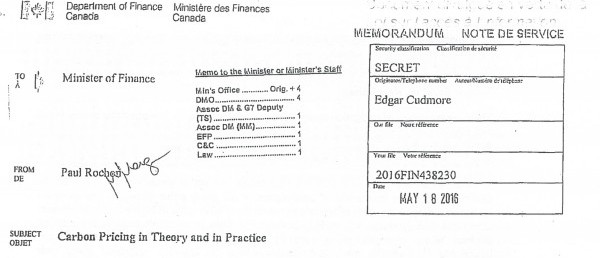
The finance department in a secret memo says information is lacking on how a federal carbon tax will impact Canadians, but cautions the “tax would cascade throughout the economy.” Cabinet proposes to tax greenhouse gas emissions beginning in 2018.
“Information is lacking,” said the May 18 staff memo to Finance Minister Bill Morneau. “Without sufficient information on energy consumption or carbon alternatives, emitting sectors and consumers may not be able to respond to price incentives.” The May 18 memo was obtained through Access To Information.
The memo Carbon Pricing In Theory And In Practice said that, while the tax should encourage consumers and industry to economize, “measurement is difficult”. “While taxing fuels is a relatively simple way to price combustion emissions, other emissions like those related to livestock are difficult to measure and may therefore be impractical to price,” it said.
Cabinet has proposed a tax of $10 per tonne of carbon emissions in two years, rising to $50 per tonne by 2022. Individual Canadians account for about 23 tonnes a year through home heating and commuting.
The carbon tax “would generally operate like current excise taxes on gasoline and diesel fuel, although it would be applied to a greater number of fuels,” said Carbon Pricing; “A manufacturing firm would pay a higher price for energy derived from burning fossil fuels. In turn, this firm would increase the price of its goods to reflect higher input costs for energy obtained from carbon.”
“The tax would cascade throughout the economy and prices would increase most for goods that make intensive use of carbon-based energy,” said the memo. “There would be a broad incentive to substitute away from carbon in the whole economy. It would also stimulate technological innovation.”
‘Not Simple Economic Theory’
However the memo acknowledged cabinet has little data on the practical effect of the tax. “Carbon pricing and energy use are disconnected,” the memo said. “For example, increased electricity prices may not lead a landlord to invest in energy efficiency improvements in a rental property if the tenant pays the heating and power bills. Alternatively, tenants may overuse energy if the landlord pays the heating and power bills.”
Environment Canada has proposed a 30 percent reduction in 2005 greenhouse gas emission levels by 2030. The Parliamentary Budget Office in an April 21 report Greenhouse Gas Emissions calculated a tax of $100 per tonne was more likely to meet emission cuts.
Carbon Pricing noted that comparisons to provincial climate change programs are imprecise, though cabinet has frequently cited British Columbia’s 2008 carbon tax as a model. “Provincial actions are difficult to compare since they are sometimes complicated and differ across multiple metrics,” it said.
The B.C. tax of $30 per tonne is levied on all fuels at the equivalent of 7 cents a litre but exempts industrial emissions and exports, First Nations, farmers, trucking companies and marine shippers. Tax revenues of $1.2 billion a year are used to finance a 1 to 2 percent tax cut for B.C. corporations and small business, and a 5 percent cut for low-income earners, Carbon Pricing noted.
“In practice, markets do not function as predicted by simple economic theory,” the memo said.
By Staff 
$1B Aqua Output Rebounds
Aquaculture sales rebounded 23 percent last year, new federal data show. The figures followed Senate committee complaints of cumbersome regulations on fish farm operators: “We are so far behind”.
Rare Bird Versus Energy Co’s
Cabinet has issued a protective order for nesting grounds of an endangered seabird near an offshore oil and gas field. Environment Canada said the federal order should not affect industry: “I do worry”.
Coast Guard Asks For Help
The cash-strapped Canadian Coast Guard is appealing for private icebreakers to aid its aging fleet. The notice followed cabinet complaints of breakdowns that compromised service: “That is not the way to run a billion-dollar corporation”.
“Climate Refugees” Welcome
Canada could become a preferred destination for climate change refugees, says a government think-tank. Officials in a policy statement described the prospect as an economic opportunity for the nation: “It’s pretty bizarre, really”.
‘Hear Rumours’ On DNA Bill
MPs fear cabinet will amend a DNA anti-discrimination bill despite unanimous support on Second Reading in the Commons. Supporters expressed alarm the bill would be rewritten to protect insurers: “We have started to hear rumours the government may have reservations about this bill”.
Anthem Fuels Senate Protest
A bill to rewrite the national anthem faces serious opposition in the Senate after speeding through the House of Commons. Revising the anthem with gender neutral lyrics is “tinkering with history”, said Senator Nicole Eaton (Conservative-Ont.): “Let’s not tamper with iconic pieces of our historic past”.
Cabinet Pressed On Pensions
Cabinet is promising answers on whether it contemplates cuts to Crown pension plans. The finance department in 2014 began drafting proposals to strip retirees’ benefits to save costs: “You see a trend to moving away from defined contributions to targeted benefits as a cost-cutting measure”.
Didn’t Pay The Bills On Time
Federal agencies in the past year have charged taxpayers nearly a quarter-million dollars in penalties for failing to pay their phone and cable bills on time. Late fees at the CBC cost nearly $12,000. The government’s IT department billed more than ten times as much.