
Canada must improve methods of estimating the amount of particles and soot from diesel engines and other sources of black carbon, says an agency. The Commission for Environmental Cooperation warned better monitoring is needed: “Soot is what causes winter smog”.
Protest Prompts Pesticide Reg
Cabinet after years of protest will halt conditional licensing of pesticides. Critics including a Senate committee alleged misuse of “temporary” licenses that for decades permitted the sale of chemicals without full study of health and environmental risks: “10 to 20 years — that’s not temporary”.
Board Hires U.S. Forecaster
The National Energy Board is hiring a U.S. consultant for oil price forecasting on a $163,000 sole-sourced contract. It follows inaccurate price predictions by the Department of Finance and Privy Council Office economists: “There are always people who come up with theories that oil will keep moving up and up”.
Feds Quiet On Railway Rule
Transport Canada says it has not decided whether to renew regulations upheld by the Supreme Court aimed at limiting “near-monopoly” powers of the country’s largest railways. Rules expanding competition for Prairie shippers are to expire August 30: ‘We have long seen the challenges of monopolistic control’.
Worst Debt Bubble In The G7
The nation’s debt bubble, already the largest in the G7, will see Canadian households pay an average of nearly $18,000 a year to service mortgages by 2020, the Parliamentary Budget Office warns. In a cautionary report federal analysts said a generation of homeowners is carrying debt “beyond historical experience”.
Regulatory Mea Culpa: Public Does Not Trust Energy Board
The National Energy Board in a mea culpa to cabinet says “controversial changes” by the last government compromised its work, and that it must regain public trust. “Status quo in Board operations will no longer suffice,” CEO Peter Watson wrote the Minister of Natural Resources: “The fault lies with us”.
Six Weeks To Pass Union Bill
Parliament has only six working weeks to pass a landmark bill permitting the RCMP to unionize. Authorities had asked for a six months’ extension of a Supreme Court deadline: “We’re hoping to have input”.
Just Mild About Tax E-Filing
Ten years after launching a “fast, easy” electronic service for taxpayers, Canada Revenue Agency research shows few people have heard of it or trust the Agency to protect their privacy. The data is cited in focus groups commissioned by the tax department: “The main concern was about possible breaches”.
GST Gold “Scheme” Unravels
Federal auditors used vehicle registration records in uncovering what they described as a scheme to claim nearly a million dollars in GST credits. The case detailed in Tax Court involved alleged sales of scrap gold: ‘It was a sophisticated false invoicing scheme’.
Judges Hear Wrongful Firing
The Supreme Court tomorrow hears an appeal on workplace firing that’s expected to impact some one million Canadians in federally-regulated industries. It follows the dismissal of an Atomic Energy of Canada Ltd. staffer who complained of being sacked after uncovering improper contracting at the agency: “We are looking for some direction”.
Fish Farm Bill Getting Closer
The fisheries department is preparing to draft industry-friendly aquaculture regulations this year following appeals from fish farmers. The department in a notice suggested a long-sought Aquaculture Act is under review: ‘The question of reform has been raised for 20 years’.
Late Is Late, Regulator Rules
Airline passengers denied boarding despite rushing to the airport 54 minutes before their flight have lost a federal appeal for compensation. The Canadian Transportation Agency said a 60-minute check in-rule stands fast: “Scheduled reliability is important to the travelling public”.
‘Pollution’ Clause Upheld By Court: Insurer Need Not Pay
A dispute over “pollution” exemptions in commercial insurance policies will not be heard by the Supreme Court. Justices declined to hear an appeal by a British Columbia company denied coverage following a disastrous fire: “This is a super important issue”.
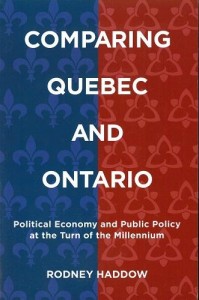
Review: Globaliz… — Yeah, Whatever
Globalization, phooey.
If our century is a march to international corporatism and conformity, why do such vastly different societies thrive on opposite banks of the Ottawa River? In this book of dissent, political scientist Rodney Haddow of the University of Toronto documents the striking absence of anything resembling globalization in our own neighbourhood. It’s a neat proposition.
First, the facts. Ontario and Québec combined have a population of 22 million, only slightly less than Australia and twice the size of Greece.
All provinces now control a majority of government revenues nationwide, about 57 percent. Premiers, not Parliament, pretty much run the country under terms of Confederation that were never appreciated at the time. Haddow explains, “The Constitution Act 1867 grants the federal government almost unlimited fiscal authority while requiring the provinces to rely primarily on direct taxes. The provinces were assigned most social responsibilities, but these were considered to be modest in nineteenth-century Canada.”
In John A. Macdonald’s day most revenues came from tariffs – income tax was considered revolutionary – and the only welfare program per se was the voting of annuities to widows of federal judges. “Social responsibilities became much more important in Canada as it constructed a modern welfare state after 1945,” Haddow writes. “The provinces’ capacity to raise funds from their own resources grew substantially and was complemented by rapid program expansion.”
Here the trail takes a winding course.
Comparing Quebec And Ontario documents widely different postwar societies built by neighbours. You’d struggle to find two states within the European Union that have more diverse governments.
Québec has a higher rate of union membership; less foreign trade; an older population; fewer immigrants; more debt; a similar jobless rate; higher taxes but better benefits for families. The last point is spectacular. In 2011 a single mother received $4,078 in benefits in Québec but only $1,860 in Ontario.
Childcare in 2002 cost $3,600 in Ontario, but only $1,400 in Québec. True, one province received more federal transfers than the other, Haddow notes, but that does not explain the contrasting values in where they spent the money.
In a single year, 1986, more than 10 percent of the entire province of Québec received social assistance. Ontario by comparison in the 1992-93 recession cut operational spending by one-tenth and fired 5,000 public servants.
Why? Haddow attributes the gulf to “dissimilar party systems”; there is comparatively little daylight between most Québec politicians on issues of taxing and spending, while Ontarians can still argue over the minimum wage.
“These results are resilient in the face of controls for globalization and post-industrialism,” Haddow concludes; “Differences between Ontario and Québec do not disappear when we control for the impact of globalization and post-industrialism, separately or together. These forces are not causing our provinces to converge.”
In Geneva and Brussels and Tokyo globalization is all the rage. Yet it dies on the right lane of the Champlain Bridge as you cross the Ottawa River.
By Holly Doan
Comparing Quebec And Ontario: Political Economy and Public Policy at the Turn of the Millennium, by Rodney Haddow; University of Toronto Press; 392 pages; ISBN 9781-4426-27017

CP Rail Loses Landmark Case
One of the country’s largest railways has lost a landmark challenge of federal law restricting a “near-monopoly” of service to commercial shippers. The Supreme Court rejected an appeal by Canadian Pacific Railway Co. of regulations expanding competition for Prairie shippers: “You really need to play hard ball with the railroads”.