
Indigenous rights do not include driving without insurance or auto registration, a Court has ruled. The judgment came in a lawsuit by a member of Ontario’s Mohawks of Grand River fined $6,170 for motoring outside the Highway Traffic Act: ‘It is a fool’s errand’.
Fracking Case In High Court
The Supreme Court tomorrow hears a landmark challenge on fracking. An Alberta rancher claimed Encana Corp. poisoned her well with toxic groundwater chemicals, then refused to answer complaints unless she stopped talking to reporters: “It is incredibly problematic”.
Facebook Creeping Expanded
The defence department is assigning up to 40 employees to monitor social media in a bid to “identify trends” deemed a threat to national security. The program follows expansion of Facebook creeping by domestic media monitors in the Department of Public Works: “Insidious”.
Feds Quiet On Project Delays
The public works department is refusing comment on delays in its multi-billion-dollar renovations to Parliament Hill. Completion of one project ran six months late, and contractors have been told all scaffolding and other work must be off the grounds for 2017 celebrations of Canada’s 150th birthday: ‘It’s just a few weeks’.
Warning On Home Chemicals
Chemical flame retardants cited for possible health risks are more commonly used in Canada than the U.S. or Mexico, says new research. The Commission for Environmental Cooperation also warned of limited data on chemical use in imported products: ‘Should we be using them in the first place?’
Review: Just People
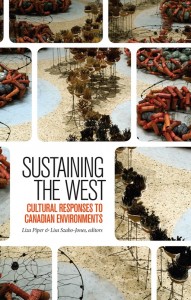
What happens when you put a group of artists and historians in a room and ask them to write about science? The result is Sustaining The West, a fresh and eclectic collection of essays on the environment. “If we are going to be honest about the environmental crises we face, the problems before us lie with people,” note editors Liza Piper and Lisa Szabo-Jones of the University of Alberta.
The people behind Sustaining The West are poets and naturalists, authors and filmmakers. “The role of humans in twenty-first century environmental change is clear,” editors write. “Framed as such, who better to grapple with the cultural issues at the core of our environmental crises than artists, writers and scholars in the humanities?”
Cabinet points to climate change as one of the nation’s foremost worries, though the impact is uneven. If farm production is at historic levels, Regina naturalist Trevor Herriot notes 80 percent of prairie grasslands have been ploughed up as cropland – a loss rate four times greater than the vanishing Amazonian rainforest: “What this means, of course, is that native biodiversity of the prairies is in rapid retreat.”
Sustaining The West is an eloquent collection of vignettes that cite astonishing fact, odd tales and compelling human stories woven together on an environmental theme.
Readers learn the Douglas fir is named for a hapless 19th century English botanist who misidentified the tree as a sugar pine and later perished under peculiar circumstances in 1834: “His body was found, lifeless and trampled, at the bottom of an open pit dug to trap wild bulls near Mauna Kea in Hawaii,” write Zac Robinson and Stephen Slemon of the University of Alberta. The circumstances “fueled speculation of foul play, even suicide.”
Contributor Nancy Holmes, of the University of British Columbia Okanagan, recounts the tale of the 22-acre Woodhaven Nature Conservancy of Kelowna established in 1973 by a couple determined to save groves of red cedar, cottonwood and ponderosa pine from local developers. Disaster struck when city planners diverted a creek to prevent basement flooding in nearby subdivisions: “Rare groves of western red cedar in the park began to die,” Holmes writes. In a surprising epilogue, managers worked out a compromise that sees trees watered a few months a year.
Sustaining The West even honours Ontario’s original fruit baron Ernest D’Israeli Smith, a son of pioneers who kept meticulous weather records documenting the micro-climate of the Niagara Escarpment from 1853. The number of frost-free days varies 10 percent or more depending on the location of orchards within the same county: “Smith recognized that to succeed as a fruit grower he would have to move to a more suitable location,” write the U of A’s Shannon Studen Bower and Sean Gouglas. The peach farmer grew to glory as founder of E.D. Smith Foods Ltd., still in business after 130 years.
Environmental issues at their core are human stories. The challenge of “how to equitably support ever-growing populations is just one part of a much larger canvas of catastrophe with fingerprints strewn across,” editors conclude.
Sustaining The West traces the prints.
By Holly Doan
Sustaining the West: Cultural Responses to Canadian Environments, edited by Liza Piper and Lisa Szabo-Jones; Wilfrid Laurier University Press; 380 pages; ISBN 9781-5545-89234; $32.24

Sport Betting Bill’s In Trouble
Another bill to sanction Vegas-style sports betting appears dead on arrival in Parliament. The measure earlier lapsed in the Senate on protests from the Toronto Blue Jays. One Liberal senator said the new bill preys on problem gamblers: ‘It makes no sense whatsoever’.
Frugal Hermit Leaves Fortune
In an estate settlement legal analysts describe as unusual, a frugal hermit who spent his life in a tumble-down Prairie cabin without indoor plumbing left $2 million at his death. Details of the Dickensian case emerged in Court of Queen’s Bench documents: “It’s kind of sad”.
20-Month Delay In TV Code
Millions of cable and satellite TV customers will see little first-hand impact from a new federal consumer code to take effect in 20 months, say telecom firms. Rogers Communications and Bell said they already meet most requirements of the code to mandate plain-language contracts and greater fee disclosure: “This was a key area of frustration”.
Seventy Years A Fishery Pest
Regulators claim a breakthrough in combating the sea lamprey, bane of the Great Lakes for 70 years. Health Canada’s Pest Management Regulatory Agency is expected to sanction use of chemical pheromones to kill the invasive species blamed for destroying an entire trout fishery: “The sky is the limit”.
MP Keeps Post Despite Rights Complaint: “Set An Example”
A 28-year old Liberal MP remains parliamentary secretary for international development despite filing a human rights complaint against Mexican diplomats, says the Prime Minister’s Office. Cabinet yesterday issued a new Guide For Parliamentary Secretaries urging appointees to show “appropriate judgment”.
MP Karina Gould of Burlington, Ont. in 2014 was fired after nine months as a consultant at the Toronto office of ProMexico, a foreign trade commission. Gould subsequently filed a human rights complaint alleging a “toxic” workplace. Her claim was dismissed last September as Gould campaigned for Parliament.
Gould has not commented, and the Prime Minister’s Office declined repeated requests for details on whether authorities checked her resumé. Officials would not say if they had concerns the MP’s employment history would compromise official contacts with Mexican diplomats. Gould made no mention of her ProMexico posting in her campaign literature.
“As a representative of the Government you should exercise appropriate judgment in your words and actions,” cautioned the Guide For Parliamentary Secretaries; “You are subject to increased public scrutiny and your actions reflect on your reputation of your Minister and of the Government as a whole. You must therefore set an example by satisfying the highest standards of personal conduct in fulfilling your duties as parliamentary secretary and as a Member of Parliament.”
Gould was hired by ProMexico in January 2014 to “generate business opportunities” for Mexican exporters and fired the following September, according to Ontario Human Rights Tribunal records. Gould subsequently alleged she suffered discrimination because of gender, age and other complaints.
“The allegations describe the applicant’s employment up until the termination of her employment, which she says was a forced resignation due to a toxic work environment,” a Tribunal adjudicator wrote in dismissing Gould’s allegations. “She describes a series of incidents which she believes show that she was targeted by her employer, treated unfairly and falsely accused of inadequate performance of her duties. She alleges that the reason for this treatment was her sex and age. Many of the allegations related to the applicant’s involvement in various trade shows and related events, and reports she prepared relating to trade issues.”
Gould also complained of “inter-office conflicts about job roles and alleged preferential treatment of other employees as compared to her treatment,” the Tribunal wrote. The complaints were dismissed under the State Immunity Act.
The Tribunal made its ruling September 2 as Gould campaigned for Parliament in Burlington. Gould won the riding by 2,400 over incumbent Conservative MP Mike Wallace, and was appointed parliamentary secretary December 2.
The Mexican Embassy in Ottawa earlier declined an interview on the MP’s employment as a trade consultant. “We have no comment on Ms. Gould,” a diplomat said.
By Tom Korski
We Won’t Pay For Emissions
Canadians will not pay for climate change programs and remain sceptical of any scheme that relies on corporations to voluntarily cut emissions, says government research. An in-house study by Natural Resources Canada also cited public worries any carbon tax would punish Canadians as they confront job losses and a feared housing collapse: ‘The economy is not doing very well’.

Emails A Mystery Says Gov’t
Transport Canada says it’s at a loss to account for warnings from a whistleblower that it allowed an insolvent airline to keep flying. A passengers’ advocate described the department response as evasive: “I don’t think these people are stupid”.
Pact Vetoes Dairy Export Aid
A new trade agreement to eliminate dairy export subsidies should have little direct impact but compounds far-reaching concessions affecting the industry, say Dairy Farmers of Canada. Cabinet has five years to comply: “The most recent subsidy issue was hard-fought”.
Gov’t Report Cites Uproar On Spam Regs ‘Hurting’ Vendors
Federal anti-spam rules have “significantly” damaged digital publishers, says a confidential Department of Canadian Heritage report. The study released through Access To Information concluded rules are so onerous they impact companies’ daily business: ‘Laws restrict interaction with consumers’.