
Federal regulators have cited a national chain of houseware stores for breach of the Textile Labeling Act for the second time in two years. JYSK Canada was not fined, but ordered to pull items and post a “correction notice” for customers: ‘If it occurs again penalties will be severe’.
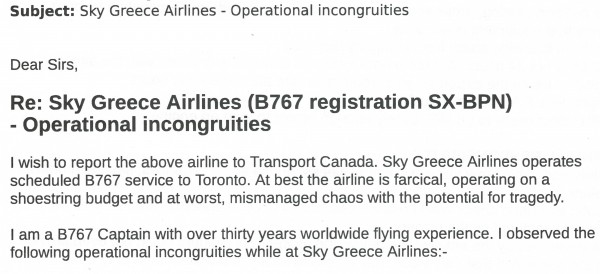
Whistleblower Warned Gov’t On Insolvent Airline: Emails
Regulators knowingly allowed an insolvent Canadian airline to continue selling tickets for months before it collapsed, says an advocacy group. Air Passenger Rights released whistleblower emails to Transport Canada that warned of financial difficulties at SkyGreece Airlines two months before the company abruptly cancelled pre-paid flights.
“It was a warning to Transport Canada about serious shortcomings, both in terms of safety and finances, yet is seems no action was taken,” said Dr. Gábor Lukács, Passenger Rights advocate. “To my knowledge Transport Canada did not respond.”
The department did not comment. Lukács published correspondence from an accredited SkyGreece pilot, complete with company identification, that was sent to seven civil aviation inspectors and enforcement investigators at Transport Canada on June 16. “At best the airline is farcical, operating on a shoestring budget, and at worst mismanaged chaos with the potential for tragedy,” the whistleblower wrote.
The airline grounded flights on August 17 and applied for bankruptcy protection from creditors on September 3. Travellers are still owed hundreds of thousands in refunds for pre-paid tickets, and compensation after being stranded by SkyGreece’s collapse.
In the whistleblower email, Transport Canada inspectors were told the company had trouble paying its fuel bills; that crew had quit over unpaid wages dating from as early as May; that replacement crew were inadequately trained; and that SkyGreece has “the worst onboard storage of charts, approach plates and documents I have witnessed in over thirty years’ flying.”
“SkyGreece requires further and more detailed examination by your authority,” wrote the Boeing 747 pilot, who provided his name and contact information. “Please contact me if you require additional information.”
Lukács said the whistleblower provided Air Passenger Rights with records of correspondence following the airline’s bankruptcy. “This email was sent two and-a-half months before SkyGreece became insolvent,” said Lukács.
“I am working to find out if any actions were taken to investigate his very serious complaints,” he said. “One is left wondering whether the financial aspects of the information was transmitted to the Canadian Transportation Agency – and if not, why not.”
The Agency’s initial response to the SkyGreece grounding was to publish a terse website notice advising stranded customers to contact their travel agents. The airline had offered service from Montréal and Toronto to Athens, Thessaloniki, Budapest and Zagreb.
Regulators yesterday concluded SkyGreece violated Air Transportation Regulations in failing to compensate travellers, but concluded further investigation was moot since the airline was bankrupt. The Agency only initiated its investigation September 2, more than two weeks after flights were grounded, when it was petitioned by Lukács to enforce regulations.
“The real issue is how this situation was created,” he said. “I maintain the Agency was too slow to act when I filed my complaint; moreover, it is quite possible that they could have acted months earlier.”
SkyGreece was launched in 2014 by Montréal-area investors with Air Omega Holidays Inc. Lukács earlier criticized the Agency as “useless”, noting regulators might have acted to secure the airline’s main asset – a Boeing 767 grounded in Toronto – to finance compensation for clients.
By Dale Smith 
Bill 377 Gutted At 11th Hour
Cabinet has gutted provisions of Bill C-377 only ten days before unions and labour trusts nationwide saw a legal requirement to compile confidential financial records for publication on a government website. The Canada Revenue Agency refused to say how much it spent in preparing to enforce the law: “We’re talking real money”.
Hockey Helmet Fine “Weak”
Another sporting good supplier faces a five-figure federal penalty for misleading claims its hockey helmets may protect players for concussions. Consumers’ advocates described the Competition Bureau settlement as weak: “It lets the company spend on brand remediation”.
Feud Cost $5M In Legal Fees
Trade groups say they spent some $5 million on lawyers’ fees in waging a seven-year battle to repeal U.S. restrictions on Canadian meat exports. Authorities yesterday marked the formal end to the 2008 dispute over so-called country of origin labeling: ‘It was a long and expensive fight’.
Census Not Like Selling Beer
Statistics Canada is appealing to “civic duty” in promoting a new, improved census in 2016, cautioning its TV promotions won’t be as entertaining as beer ads. Patriotic appeals must also avoid imagery like dead maple leaves that suggest the nation “is in decline”, focus groups said: “Graphic treatment of such a prominent national symbol was disturbing”.
Hazardous Goods By Rail Is Shipper’s Cost, Court Orders
Rail shippers can be required to pay for liability on hazardous goods, a federal court has ruled. Canadian Pacific Railway Co. successfully challenged a regulator’s decision that billing customers on liability for cargo it freighted was unreasonable: “There has to be a way to move those goods”.
Feds OK Herbicide Banned In Europe Union: ‘No Concerns’
Health Canada is endorsing the continued sale of a herbicide banned in the European Union, concluding it poses no threat to Canadians’ health or the environment. The public has till January 29 to comment: ‘The substance affects people the same way regardless of where they live’.
Marketing Board Loses Case
One of the country’s largest provincial marketing boards has lost a crucial legal battle. The Supreme Court declined to hear a bid by Québec’s maple syrup producers to block the off-board sale of goods: “Each province has their own rules”.
A Sunday Poem — “CHEO”
Ice-skating falls
send thousands each year
to emergency rooms.
Children are the most vulnerable.
The grand prize of this year’s
Children Hospital of Eastern Ontario’s lottery:
A fully furnished, 1.5 million dollar home, featuring
an 18-feet high, freestanding fireplace,
oak cabinets,
and three-dimensional, hexagon marble tiles in the
kitchen and the master bathroom.
In the basement,
a private rink.
(Editor’s note: poet Shai Ben-Shalom, an Israeli-born biologist, examines current events in the Blacklock’s tradition each and every Sunday)
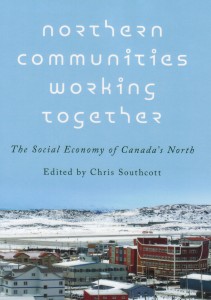
Review: The 60- Year Experiment
The territories are a 60-year experiment in state planning. The result is a succession of little victories and big defeats. Ottawa spends $64 million a year on food subsidies, yet chicken costs $45. The jobless rate in Nunavut is 18 percent. Homeless shelters in Yellowknife face periodic outbreaks of tuberculosis. Yukon’s GDP has shrunk three years in a row.
“Canada’s North has always been a colony to southern interests, a fact that has profoundly marked its historical development,” writes editor Chris Southcott in Northern Communities Working Together. “Despite current trends towards increased self-government, the territorial North is still heavily dependent on the federal government for the provision of services and decision making.”
This happened once before, in Newfoundland & Labrador in 1949, when state planners tried and failed to impose an industrial economy on a society of poor fishermen. The result was costly and disastrous. “Anyone familiar with administering public services in Newfoundland is well aware of the naiveté with which Newfoundlanders – especially the very dependent ones, and they are legion – look to government to supply most every need,” Herbert Pottle, the province’s first welfare minister, wrote in his 1997 memoirs Newfoundland: Dawn Without Light.
“Their age-long isolation had encouraged it, and the glad tidings of additional government benefits have tended to institutionalize it,” Pottle wrote. “It was the old and easy way out: ‘Get the government to do it.’”
Northern Communities examines the grassroots alternative. The verdict is uneven. The territories remain underpopulated – Whitehorse, the biggest city, has only 23,000 people – and many residents have no intention of spending the rest of their lives in the region. There are few community clubs organized by unions, charities or local improvement groups, and those that exist are dominated by government. “It’s not surprising that people who live in the territorial North rely upon publicly-funded education, health care and social welfare,” writes Southcott, a professor of sociologist at Lakehead University.
“Paternalistic state policies, no matter how well intentioned, have had an impact, sometimes positive but often negative, on the development of social economy organizations in the North,” says Southcott.
Northern Communities is not an exposé; it’s an honest account of community life in a region governed by faraway federal regulators and mining corporations. Accounts are candid. The effect is unsettling.
“In the North, state-society relations bear the marks of their undemocratic history of power imbalance,” writes Prof. Frances Abele, of Carleton University’s School of Public Policy. “Sustained and sometimes massive federal interventions have affected, for example, how people make their living (wildlife harvesting regulations); their living arrangements (settlement of people in communities); and the organization of child rearing (compulsory education) to name just a few.”
Even attempts to document success stories are mitigated by unrealized potential, if not outright failure. Prof. Thierry Rodon of Laval cites Pangnirtung Fisheries Ltd., a Nunavut processor. Is a fish plant part of the social economy? “Yes,” says a resident. “The fish plant here provides money for us and it also provides economy for the families who are out working together as a group. That’s an example of social economy.”
Pangnirtung Fisheries Ltd. has never turned a profit. It has operated as a Crown corporation for 23 years. It employs 80 people. Its net loss after subsidies is $41,000 annually, and that was before Parliament chipped in $40.5 million to improve the village harbour.
Is this the best Canada can do?
By Holly Doan
Northern Communities Working Together: The Social Economy of Canada’s North; edited by Chris Southcott; University of Toronto Press; 304 pages; ISBN 9781-4426-14185; $24.95
No More Secret Files Says MP
Health Canada faces demands it table thousands of documents in Parliament involving a regulatory decision that drove a Manitoba company out of business. MP James Bezan said he suspected regulators were “over-zealous” and may have skirted federal law: “The department tried to wear them down in the hope they would go away”.
Old Landfills Prompt Study
Thousands of municipal landfills nationwide are being studied by Environment Canada to ensure they’re safely capped. The department said its concerned material used to cover current and decommissioned dumps is safe and effective: “Historically we don’t know”.
Puzzling Data Show Rate Of Women At Work Has Peaked
Women’s rate of participation in the workforce is stagnating after strong postwar gains, according to new federal research. Statistics Canada said the rate of women at work has slowed markedly since the 1990s: “Further analysis is warranted”.
No Court Date For Sad Client
The Supreme Court is declining to hear an appeal from a British Columbia man who alleged he got bad advice from a lawyer in purported conflict of interest. The barrister had taken the case without charge: “Clients frequently complain”.