Vow No China-Made Flags

The public works department is buying only Canadian-made flags to celebrate the nation’s 150th birthday in 2017. Authorities disqualified bids to manufacture more than four million flags from companies without Canadian printing and assembly plants: ‘ I love to see this’.

This content is for Blacklock’s Reporter members only. Please login to view this content. (Register here.)

Public Fears Housing Bubble

Canadians have told the finance department they fear a housing bubble. The in-house research preceded a federal notice that banks must set aside more cash for “severe but plausible losses” on residential mortgages: “Buying a new home is becoming difficult due to the high cost”.

This content is for Blacklock’s Reporter members only. Please login to view this content. (Register here.)

Review: The What Might Have Been

They say cemeteries are full of indispensable people, but some deaths are more far-reaching than others.

On October 19, 1984 a Piper Navajo commuter plane operated by Wapiti Airlines Ltd. crashed in a freezing rainstorm near Lesser Slave Lake, Alta. An inquiry would cite human error. The pilot, 24, suffered from “cumulative fatigue” and had 11 hours’ sleep in the past two days. Six perished in the crash including New Democrat MLA Grant Notley, Alberta’s Opposition Leader, flying home for the weekend.

He died in anticipation of an election “in which he sensed the party would finally make the breakthrough,” a reporter wrote at the time. For years afterward the words were heard at the Alberta legislature: “If only Notley had lived….” If.

A grinding recession drove then-Premier Peter Lougheed into retirement months later. A subsequent 1986 election saw Conservatives lose 14 seats yet still win the legislature – or more properly steal it. Ridings were so crudely gerrymandered that rural voters controlled the balance of power in the assembly, though two-thirds of Albertans lived in Edmonton and Calgary. The average Edmonton riding had 23,000 electors; one country seat called Little Bow had barely 6,000.

If only Notley had lived…

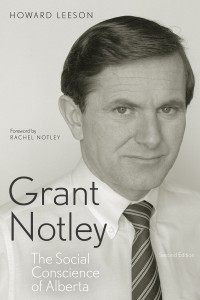
The University of Alberta Press has printed a second edition of this 1992 biography now more arresting given recent events. Author Howard Leeson, professor emeritus of political science at the University of Regina, recalls the man who might have smashed a Prairie political machine a generation before his daughter did.

Notley was a 4-H farmboy whose grandparents had been prairie sodbusters, and worked all his life to elect New Democrats in Alberta. Curiously Leeson does not dwell on Notley’s spectacular death; it is relegated to a single paragraph on the 311th page. Instead he recounts the struggles of a populist whose singular achievement was to keep the hard-luck NDP alive.

“The NDP was a socialist party in a province where the people had continually rejected the socialist alternative,” writes Leeson, former executive assistant to Notley. Every marginal success was matched with failure.

The party elected its first MLA in 1966, then fell into bankruptcy in 1967. Leeson recalls the arrival at NDP headquarters of a new party secretary, Hart Horn, in 1970: “The office had been closed for months. Everything was, as he recalled, musty and dusty. There was no list of current or past members. Indeed, there was no list at all, only some old addressograph plates piled in a corner. It was a mystery to Hart that the organization functioned at all.”

New Democrats for years were caricatured as Marxists – Premier Ernest Manning once called them “the greatest threat facing this nation today” – though party policies fell short of hysteria. The 1963 platform proposed “open government”, free long-distance calls within Alberta, and state auto insurance. It was not too communistic in a province where conservatives maintained a state-run telephone company, state-run bank, state-run railway and state-run airline, Pacific Western.

Grant Notley is an affectionate tribute to a quiet, decent workaholic who might have become Alberta’s premier in 1986, and altered the whole course of his province and the Prairies. Instead he became another indispensable man in the Fairview, Alta. cemetery.

By Holly Doan

Grant Notley: The Social Conscience of Alberta, by Howard Leeson; University of Alberta Press; 392 pages; ISBN 9781-77212-12544; $29.95


Big ‘Re-Branding’ Gets A Fail

Three years into its rebranding as a “concierge” for business, executives have told the National Research Council its new motto is boring, and that dealing with the federal agency is a “hassle”. The Council would not say how much it spent on its new corporate slogan, cnrcsolutions: ‘It reminded many of a consulting firm’.

This content is for Blacklock’s Reporter members only. Please login to view this content. (Register here.)

Sally Ann Sued Over Claim

The Salvation Army will not comment on a lawsuit against its Governing Council alleging financial irregularities. An Ontario Superior Court judge declined to dismiss the suit, saying though the allegation “may seem outrageous at first blush, that does not make it untrue”.

This content is for Blacklock’s Reporter members only. Please login to view this content. (Register here.)

Lawyer, 86, Sues Law Society

The Supreme Court has agreed to hear an appeal against Law Society rules by longtime Winnipeg lawyer Sid Green, 86, a former Manitoba cabinet minister. Green was suspended for declining mandatory “professional development” training after practicing law for 60 years: “This case falls within a time-honoured tradition”.

This content is for Blacklock’s Reporter members only. Please login to view this content. (Register here.)

DNA Test Privacy Bill Is Back

A DNA privacy bill has been reintroduced in the Senate after lapsing in the last Parliament. The Liberal bill would forbid employers and insurers from demanding that Canadians take genetic tests, or divulging the results of previous testing: “The law is well behind the science”.

This content is for Blacklock’s Reporter members only. Please login to view this content. (Register here.)

Feds Probe Oil Sands Toxins

Environment Canada is mapping toxic emissions from Alberta’s oil sands including mercury, benzene and other poisons. The department commissioned the most sweeping review of new pollution data for the industry since 2006: “We really don’t have a good handle on emissions”.

This content is for Blacklock’s Reporter members only. Please login to view this content. (Register here.)

Trucker Loses Charter Claim

A trucking company has lost a Constitutional challenge of fines issued by agricultural inspectors. A federal tribunal ruled corporations with “pure economic interests” cannot cite the Charter of Rights in challenging administrative monetary penalties: “The law is clear”.

This content is for Blacklock’s Reporter members only. Please login to view this content. (Register here.)

CRTC Demands Confidential Data On Long-Promised Cap

Telecom companies must divulge wholesale roaming rates to federal regulators within 30 days ahead of a promised 2016 cap on charges. The CRTC ordered wireless providers to disclose all rates charged smaller rivals for cellphone calls and text messaging in 2014 and 2015: ‘The sooner, the better’.

This content is for Blacklock’s Reporter members only. Please login to view this content. (Register here.)

More Fish Farm Regs Planned

Authorities propose more changes to aquaculture regulations after sanctioning companies’ use of chemicals, says the fisheries department. A review of federal rules follows a 23 percent decline in sales for the industry: ‘Hurdles prevent sustainable aquaculture development’.

This content is for Blacklock’s Reporter members only. Please login to view this content. (Register here.)

Feds Cited For Lost Tax Dep’t Files: ‘This Is Embarrassing…’

Canada Revenue Agency has assigned senior managers to check documents after misplacing thousands of pages of records. Information Commissioner Suzanne Legault yesterday cited the Agency for “serious” problems in tracking tax files.

“We had a high number of missing records cases,” Legault told reporters. “More than half of those were valid complaints, leading us to ask the Agency to now certify they’ve taken all reasonable steps to search and find records.”

Under a 2015 Agency directive a senior manager – the assistant commissioner or director general – must personally certify that “all reasonable steps were taken to conduct relevant searches to identify and retrieve responsive documents” requested by taxpayers.

The policy followed a 2014 Federal Court case in which a judge cited tax authorities for concealing documents from a Sooke, B.C. taxpayer, Sandra Summers, despite three requests. Justice John O’Keefe ruled the Agency “consistently delayed disclosure of information, withheld information, destroyed information and misled the applicant as to what information was available.”

Summers had filed a 2012 Access To Information request for records after she was audited over claims of business losses the previous year. Only after Summers sued in 2013 did Canada Revenue conduct a top-to-bottom search for documents in her case and “discovered it had not destroyed records”.

Commissioner Legault in her Annual Report cited two other cases in which Canada Revenue disclosed 14,000 pages of documents after companies went to Court; and a taxpayer who received 57 pages of censored records and then received 57 more after an investigation was launched.

“Canada Revenue Agency has acknowledged to the Commissioner that it has a serious information management and document retrieval problem when it comes to identifying and retrieving records in response to Access requests,” the Report said.

In a string of unrelated incidents one official rated “embarrassing”, the tax department earlier admitted to losing tax returns, cheques, moving receipts, bank statements, audit files, permanent residency cards, marriage licenses and registered letters sent by taxpayers. Records obtained by Blacklock’s through Access To Information revealed cases in which taxpayers were charged late-filing penalties of up to $2,200 for returns the agency simply misplaced.

“I am very concerned,” one manager wrote in a July 13, 2012 email. “It is embarrassing to acknowledge that Canada Revenue Agency cannot trace their correspondence.”

“No, we have no procedures for logging correspondence,” another manager wrote in a July 9, 2013 memo.  “From what I hear from my colleagues this type of thing seems to be happening quite a bit,” another wrote in a March 1, 2013 memo; “It really doesn’t make Canada Revenue Agency look very competent when we call the client a week after they sent something by Xpress Post saying we didn’t get it.”

The Agency processes more than 25 million tax returns annually, by official estimate.

By Dale Smith

Union’s OK, But No Criticism

Legislation promised to repeal a 1920 ban on unions in the RCMP will maintain a ban on members’ political activities or public criticism of management, authorities confirm. The Mounties this year began compiling an electronic database of “problem” employees: ‘It restricts certain matters from being included in a collective agreement’.

This content is for Blacklock’s Reporter members only. Please login to view this content. (Register here.)