
A majority of Canadians, 90 percent, say genetically-modified foods should be plainly labeled. But consumers remain divided on whether they’d buy engineered fish or salmon even if approved by federal regulators: “These products need to be identified on the grocery shelf”.
Clock Runs On VIA Pensions
VIA Rail is expected to review pension costs in new contract talks with union employees. Transport Canada earlier vowed the Crown railway must ensure it is not a “burden” to taxpayers: “We’re back into bargaining”.
Demand Curbs On User Fees
Health Canada is being petitioned to restrict extra billing amid claims of a Canada Health Act crisis. Lawyers in Québec yesterday urged regulators to halt collection of user fees in the province, with a similar challenge due in a British Columbia court this autumn: “It is a much bigger issue”.
Recruitment Drive Hits Snag
Focus groups testing RCMP recruiting ads found surprising reaction to a TV pitch to women. Researchers said the ad narrated by a female announcer was unexpected and lacked authority: ‘Not one male preferred the female voice’.
Gov’t Sees Home Fix-It Boom
The Department of Finance in a staff outlook has spotted at least one growth industry in the Canadian economy: home renovation. Fix-ups worth $44.8 billion a year are projected to grow as more Canadians move into older homes, says a department memo: “More homes will eventually be in need of renovations”.
Feds Close Sale Of Crown Lab
Cabinet has finalized the sale of Canadian Nuclear Laboratories, the country’s leading producer of medical isotopes. The Atomic Energy of Canada Ltd. plant went to a consortium including SNC-Lavalin Inc. and Rolls-Royce Civil Nuclear Canada Ltd.: “When it is in the best interests of Canadians, they will be sold”.
Execs Plead Don’t Jack Tariffs
Canada’s best known retailers privately warned the finance department that higher tariffs, phased in this year, will cost consumers and kill jobs. Panasonic, Clover Leaf Seafoods, Walmart and others petitioned the department not to raise customs duties on popular imports: ‘It’s the most significant increase in tariffs since the 1930s’.
Four In Ten Short Of Workers
More than 4 in 10 food services companies are short of workers since cabinet tightened permits under its Temporary Foreign Worker Program, says an industry group. The Restaurants Canada survey found thousands of jobs can’t be filled: “How is the economy being helped?”
DNA Tracks Invasive Species
Scientists propose DNA tests to keep Canadian waters free of invasive species. The initiative follows new cabinet regulations outlawing the import of aquatic pests: ‘We are 3 to 5 years away’.
Kids Costing $216,000 Apiece
It costs about a quarter-million dollars to raise a child in Canada and likely more if they play hockey or plan to go to college, says the Department of Finance. In a confidential cabinet memo, the department says it’s grappled with the “affordability of children”.
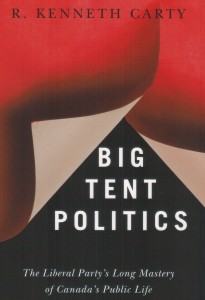
Review: Tenting Only Looks Easy
If Liberals stumble October 19 it would be the party’s longest losing streak since the death of John A. Macdonald. The fact underscores impressive success and unalterable failure. No party replaces the Liberal machine, with apologies to the Globe & Mail and certain pollsters. It’s a stretch to claim a new era of Conservative dominance when Conservatives lose Alberta and have difficulty scraping up 38% of the national vote.
It speaks instead to the impact of tinkering with political machinery, and changes in the country itself. Big Tent Politics is a subtle and revealing analysis of what went right, and wrong.
Political scientist R. Kenneth Carty, professor emeritus at the University of British Columbia, first dispels the mythology of Liberal dominance. Lots of democracies have long-winning parties, he notes: the Congress Party of India; Social Democrats of Sweden; Christian Democrats of Italy and Germany; and Ireland’s Fianna Fáil, which dominated Dublin politics from 1932 to 2011. All were winners that practiced “brokerage politics”, Carty explains.
“Rather than articulating different ideas and representing specific interests so that citizens can make electoral choices among them, a brokerage party actively aims to obscure differences and to muffle conflicting claims, generally in the name of social accommodation and always in the interest of its own internal unity,” Carty writes. “Brokerage parties are therefore a kind of unnatural anti-party, seeking to deny, or at least to suppress, the reality of competition among the community’s distinctive political parts. As one might expect, a brokerage party instinctively eschews ideological agendas and programmatic politics in the pursuit of large, volatile and heterogeneous support bases.”
In other words, build a big tent with room enough for everyone to get out of the rain. If Liberals have not won 50 percent of the popular vote since 1953, they won enough votes in enough provinces to score win after win.
So, what went wrong? Big Tent conducts the post-mortem with a scalpel. Brokerage parties by definition are “unprincipled and opaque”, Carty writes. It is their virtue and vulnerability: “Able to incorporate and to represent all also meant that the party was inherently shapeless”; “The lack of any single definition of what the Liberal Party represented was reflected in the real ambiguity regarding who constituted it.”
Big Tent examines the disastrous fiddling by Liberal HQ that weakened the machinery. The fact it took so long for Liberals to sputter is a credit to how skillfully the machine was forged in the first place: the Party, like Eaton’s, was so well-built it took hapless managers years to drive it into the ground.
The Liberal caucus lost direct control of the Party’s leadership; then managers failed to absorb new parties, with the result of splitting the ballot. Then riding associations were weakened to the point they no longer select candidates.
In 2008 then-leader Stephane Dion personally blocked the nomination of David Orchard in a Saskatchewan byelection, Desnethé-Missinippi-Churchill River. Orchard was a genuine and popular figure who’d endorsed Dion and signed up hundreds of new members. Dion Plays To Win, read the headline in the National Post. Well, not exactly: Liberals lost the byelection by 1,700 votes.
“Changes to the election law in the 1970s gave the leader the power to veto locally chosen candidates; then in the 1990s, the party altered its constitution to allow the leader to actively intervene to designate a specific local candidate,” writes Carty. “Both threatened the party’s long-standing internal dynamics.” Local organizers were alienated, and one-issue lobbyists were motivated to push managers into planting candidates.
Oddly, all major parties have made the same mistakes, ensuring Canada no longer sees any Big Tent politics. The ballot is fractured; voters are cynical and indifferent; parties bicker pointlessly over contrived and divisive issues like whether Muslim women should wear niqabs; and organizers are reduced to Twitter blitzes to reach electors who left the tent some time ago.
By Holly Doan
Big Tent Politics by R. Kenneth Carty; University of British Columbia Press; 176 pages; ISBN 9780-7748-29991; $29.95

Energy Board Swamped With Insider Tips On Wrongdoing
A “significant increase” in whistleblower reports from oil insiders is prompting the National Energy Board to hire consultants for advice on how to process complaints. The Board yesterday reported receiving 17 whistleblower complaints in the past two years. There were none in 2013: ‘These are reports from external parties’.
Feds Lose Prisoner’s Lawsuit
In a ruling affecting thousands of prison inmates, a federal judge has struck down a longstanding Correctional Service risk assessment test as biased and “unreliable”. Court heard that management knew for years their standard psychological tests were flawed: “It doesn’t mean inmates will be flooding the streets; it means they will be given a fair shake”.
Foreign Affairs Gets A Shrug
Only 1 percent of Canadians rate foreign affairs a top government priority, according to in-house research by the Privy Council Office. Voters were three times more likely to name the trade deficit than terrorism as a “threat” to the economy. The data was released just before last evening’s French-language leaders’ election debate on foreign policy: “It was the lack of good jobs that made them worry”.
Pick ‘N Pay TV Code Drafted
Canada’s telecom regulator has released a new code governing wholesale broadcasting that sets out rules between broadcasters and programmers. The code attracted an unusually large number of submissions ahead of the CRTC’s requirements for simplified pick-and-pay cable and satellite packages of $25 a month: “It is not clear”.