
The Government of Canada in a blistering judgment has been cited for breaching the Canadian Human Rights Act. A federal adjudicator ruled Employment Canada hounded a disabled employee out of his job after 20 years’ service: “The story ended sadly”.
Spill Scenarios Troubling: MP
Federal research on oil spill scenarios off the British Columbia coast raises questions over cabinet’s 2014 approval of the Northern Gateway project, says an advocate of a tanker ban. The fisheries department is contracting $50,000 worth of “oceanographic monitoring” of the Douglas Channel near Kitimat, B.C., future site of an Enbridge Inc. tanker terminal: ‘They gave the green light’.
Gov’t Cut Billions; No Sign Of Balanced Budget Legislation
Federal spending cuts mushroomed from $3.8 billion to $14.6 billion in the first half of the fiscal year, says the Parliamentary Budget Office. The fiscal watchdog reported direct program spending fell 2.3% compared to the same period last year: ‘There is a problem’.
Court Targets 1920 Union Ban
The Supreme Court will rule Friday on whether to lift a 95-year union ban in the Royal Canadian Mounted Police. The judgment follows adoption of new RCMP Regulations that forbid police from criticizing management: “Now is the time to bring them into the 21st century”.
See No Chance Of Arctic Spill
There is virtually no chance of a toxic spill at sea in the Canadian Arctic, though any fuel leak would devastate pristine wilderness areas, says a confidential Transport Canada report. The 2014 assessment rated the odds of a fuel spill at once every 778 years: “A spill of refined cargo products is predicted to occur close to every 3000 years”.
Shipping’s Up 7% On Seaway
The St. Lawrence Seaway saw a 7% rebound in year-over-year traffic this season, its best year since the 2008 recession, by official estimate. The Seaway Management Corporation said actual traffic of 39.6 million tonnes was just short of its target: “The Seaway proved its value”.
Gov’t Should Reclaim John A. Home, Says Cabinet Minister
Canada should reclaim John A. Macdonald’s Ottawa home as a bicentennial memorial to the Founding Father, says a Conservative cabinet member. Earnscliffe, a 19th century manor where Macdonald died in 1891, is currently the residence of the U.K. ambassador to Canada: “Wouldn’t it be great?”
Most Irritating Airport Is…
Toronto’s Pearson International is the most irritating airport in the country, according to complaints logged by Canada Border Services Agency. Documents cite hundreds of grievances a year, ranging from inadequate signage to “infrastructure”. Winnipeg and Halifax had among the fewest complaints: ‘Toronto is always going to have the most’.
$75M A Year In Loan Defaults
Defaults on government-guaranteed loans to small business average $75 million a year, records show. Industry Canada said it has no plans to lower loan limits raised five years ago: “The decision to grant a loan rests entirely with the lender”.
Feds Study Oil Shipping Lane
Federal agencies are continuing quiet research on a proposed shipping lane for oil tankers on B.C.’s northern coast. The Department of Fisheries awarded a $50,000 contract to scan the Douglas Channel using robot gliders. Environment Canada earlier initiated its own studies on the impact of a tanker spill in the region: “It would be useful information in an actual spill”.
Housing Falls In 7 Provinces
Canada saw a dismal year for housing starts in 2014 with declines in seven provinces, according to CMHC. Only Alberta saw significant gains in construction of new single-family homes, condos, apartments and townhouses: ‘It’s much weaker than expected’.
A Poem — “Maple Syrup”
If I could tune my radio
to the exact frequency
of the Royal Canadian Air Force,
I would listen to CF-18 pilots
as they debate today’s agenda:
Are we bombing ISIL out of Iraq and Syria,
kicking Putin out of Ukraine,
or heading to Ottawa
for the flag, the anthem, and the fly-by
over Parliament Hill?
(Editor’s note: poet Shai Ben-Shalom, an Israeli-born biologist, examines current events in the Blacklock’s tradition each and every Sunday) Photo: DND

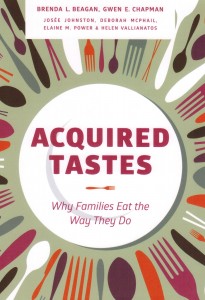
Review — Are You Going To Eat That?
Acquired Tastes is ingenious. Researchers at six universities take a bird’s-eye view of Canadian supper tables. They interview families nationwide, rich and poor, from Vancouver to Halifax, and ask: why do you eat that? Interestingly, nobody replies: “Because I’m hungry.”
Food, it turns out, is an expression of Canadians’ intimate values and ideals of self-worth. We are highly opinionated on the subject. Consider those who rate themselves “virtuous or moral individuals as they differentiated between their eating habits and those of other people,” editors note. One mother recalls the time she volunteered on a class field trip: “Kids would bring a little mini pop. I mean, it was just horrible”; “Cinnamon rolls and those Vachon cakes. I haven’t even seen them for years. One guy had an extra-big Coffee Crisp and a pop, and his dad was there on the field trip, and I remember thinking, ‘Oh my god, this is just awful!’ I couldn’t believe it.”
Acquired Tastes is not another lament over national obesity or food marketing. If McDonald’s Canada sells $260 million worth of Big Macs and Chicken McNuggets annually, nobody interviewed here volunteers the fact they are faithful customers. This research is much more compelling.
Editors discover everybody knows what “healthy eating” is. They cannot find a single family that has never heard of basic nutrition: “Everyone understood the concept that food affects health.” Second, Canadians eat what they eat for a whole variety of cultural and economic reasons that often have little to do with necessity. “What people say they know and believe about eating is not always what they do, even when a variety of foods are readily available to them,” authors conclude.
Consider the Valverde family, an East Vancouver couple with a six-figure income and a 17-year old son. They buy organic and like to experiment with recipes. “We spend more money on food than most people,” says Mrs. Valverde. Their groceries are an expression of environmental awareness and cultural diversity.
Then there’s the Austin family of rural Alberta: husband, wife, three children. They eat fish and chips, burgers and potatoes. Organic is too expensive, Mrs. Austin explains: “I rarely if ever buy anything that’s not on sale.”
Families have definite views on food. Indian fare is “really spicy”, complains one participant who has never tried it. Others are annoyed by the cliquishness of farmers’ markets, where urban shoppers are expected to browse with delight over costly produce. “I just want to go and get the food,” says one. Another boasts of shopping on Mondays, when grocers discount date-expired meat left unsold from the weekend: “We never pay full price.”
Acquired Tastes confirms what we eat is a statement of how we think of ourselves: frugal or choosey; sophisticated or practical; wealthy and urban or small-town, Kraft Dinner cheap. “Interestingly, food as gratification and as a tool for coping with stress and depression was articulated by participants of European descent, which may speak to family and cultural histories concerning the moralities of food,” editors report. “In contrast, interviewees who had recently migrated to Canada from non-European locales did not seem to speak of food in this way.”
Acquired Tastes is fresh and quirky, eloquent and very human. Eat it, you’ll like it.
Acquired Tastes: Why Families Eat The Way They Do; edited by Brenda Beagan, Gwen Chapman, Joseé Johnston, Deborah McPhail, Elaine Power and Helen Vallianatos; University of British Columbia Press; 292 pages; ISBN 9780-77482-8581; $32.95
Climate Change No Boon To Shipping: Transport Canada
Confidential Transport Canada reports predict little gain in Arctic shipping despite climate change that’s expected to see ice-free summer passage within 20 years. Two studies conclude the Northwest Passage will remain too risky and expensive to generate commercial traffic: ‘Insurance is costly’.
Bill To Ban VIA Rail Cutbacks
MPs will debate legislation to radically overhaul VIA Rail as the Crown passenger service braces for record deficits and cabinet prepares to appoint a new chair. The private bill would curb service cuts and permit employees to purchase VIA shares: “It would be a good first step”.