
A multi-million dollar charity endorsed by Canadian sports celebrities faces a federal order to surrender financial records to tax auditors. Canada Revenue Agency has been attempting to scrutinize the books of the 4Life Foundation since May, according to court records. The foundation’s “anti-bullying” motivational speakers include former NHL and CFL players: “Please don’t use my name”.
David v. Goliath – Tax Dep’t Sued Over Municipal Ruling
In a David and Goliath tax dispute, one of the nation’s smallest municipal organizations is suing Canada Revenue Agency over loss of sales tax rebates worth about one-tenth of its annual budget: “All of a sudden they get a letter”.
Feds Study Vanishing Salmon
A catastrophic decline in Atlantic salmon stocks is prompting the Department of Fisheries to appoint an expert advisory panel on the issue in 2015. The initiative follows repeated warnings that numbers of salmon are reaching the lowest levels ever recorded: “We are killing too many”.
Late Bill Rattles Farm Groups
Farm groups say were never told of a last-minute bill introduced by cabinet before Christmas to amend the Canada Grains Act. Bill C-48 expands the powers of the Canadian Grain Commission to conduct paid inspections at eastern elevators on the Great Lakes and St. Lawrence River: ‘It caught us by surprise’.
7th Province Regulates Usury
Prince Edward Island is now the seventh province to regulate payday loans under a federal cabinet order. The island is authorized to define criminal rates on term loans of 62 days or less under a 2007 Act of Parliament: “It’s high time”.
A Poem — “Indian Ocean Tsunami, Ten Years Later”
He set the earthquake
– 9.3 on the Richter scale –
to hit at precisely 7:59 am.
Triggering a Tsunami
1502 times stronger than the Hiroshima bomb.
Claiming the lives of
exactly 230,508 people
(one third children),
injuring 125,000,
displacing 1.69 million,
leaving 45,752 still missing.
This act’s accuracy
leaves me no choice but to conclude:
it was a sign
of supreme intelligent design.
(Editor’s note: poet Shai Ben-Shalom, an Israeli-born biologist, examines current events in the Blacklock’s tradition each and every Sunday)

Feds Pay $1.25M For ‘News’ Handouts To Media Editors
Public Works Canada is awarding a $1.25 million contract to a publicist to distribute government-vetted “news” to publishers and radio and TV stations. The budget for handout “news” increased 25 percent from a previous contract. The department said it wanted to “inform and educate Canadians on public issues”.
The publicist, News Canada Ltd., said it gives editors handout stories free of charge bearing a “News Canada” credit – “just like Canadian Press,” said president Shelley Middlebrook. “We help distribute content,” Middlebrook said. “Journalists either pick it up or they don’t”; “Nobody pays to publish this. We follow Canadian Press-style rules of writing, and articles have to be marked as ‘News Canada’ just like CP.”
Handouts include standard 400-word newspaper stories for dailies and weeklies, and prepackaged broadcast items downloaded from the company’s website. Recent articles scripted for the Government of Canada and other clients include, “Supersize Your Tax Refund”; “Farmers Are Interested In The Environment”; “Food & Beverage Industry Raises the Bar On Nutrition”; and “Hey New Graduate, Check Out The Insurance Industry!”
The client list for News Canada handouts is not known, though the Department of Public Works said it expects audits of actual publication and broadcast of “news” items. “This is educational, informational, lifestyle news,” said Middlebrook. “It’s not breaking news.” The profile of media users is “a real mix”, she added: “With daily newspapers we get 71 or 72 percent of dailies; in community newspapers, there have been a lot of closures but we average 60 percent.”
Middlebrook said handout stories are also carried by some 350 radio stations nationwide. “TV is smaller,” she added. “It used to be a bigger portion of our business.” Public Works said television clients were unnamed cable news broadcasters.
“It Has To Be Balanced”
Samples of pro-government TV handouts including one item lauding the Canadian Space Agency, including “interviews” with two officials; and another celebrating cabinet’s record on Aboriginal land claim settlements. The script reads: “How do you right a past wrong? Well, the Government of Canada has been working towards finding solutions to do just that.” The report continues, “Canada has made a commitment to reconciling relationships with First Nations people”; “The future looks bright. More win-win solutions are in the works to bring closure and justice for all.”
Another “news” story promotes Public Works’ own program to have Canadians surrender bank account information to the department for electronic deposit of benefits cheques. “This convenient service can help manage hectic schedules by depositing government payments directly into their bank accounts,” viewers are told; “It’s fast, secure and convenient – so there is more time for families to play together.” A similar item features an “interview” with Lorraine and Roch Beauchamp, identified only as a “retired couple”.
The public works department said, in addition to paying $1.25 million, it would edit all scripts and make officials available in Ottawa, Toronto and Montréal for “in-person interviews or testimonials”. Middlebrook, asked if the handouts were propaganda, replied: “I don’t think so”; “If it is, editors won’t pick it up. It has to be balanced. If it was too propaganda-based, editors wouldn’t use it.”
By Tom Korski
Says Air Passenger Rights Iffy
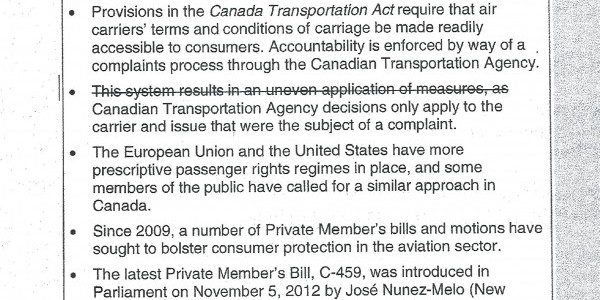
Air passenger rights are “uneven” due to a complaints-based system that fails to meet E.U. or American standards, Transport Canada admits in a departmental memo. The document cited public demands for “more prescriptive” regulations that would spell out airlines’ duties to their customers.
The 2013 memo was released through Access To Information. It was written by unnamed staff for Transport Minister Lisa Raitt, detailing Canadian Transportation Act regulations that require passengers to individually complain to regulators over lost luggage, flight delays and denial of boarding on over-booked flights.
“This system results in an uneven application of measures, as Canadian Transportation Agency decisions only apply to the carrier and issue(s) that were the subject of a complaint,” the memo states. The “uneven” reference was marked for deletion. Raitt was unavailable for comment.
The document continues, “The European Union and the United States have more prescriptive passenger rights regimes in place, and some members of the public have called for a similar approach in Canada.”
The memo follows disclosure of other confidential documents in which the Transportation Agency acknowledged it hears only a small fraction of passenger complaints, and has no estimate of airlines’ actual performance on flight delays, lost luggage and over-booking.
The agency received only 882 complaints from air passengers last year and 529 the year before, according to its Annual Report. Canadian airlines carry some 40 million passengers a year.
Weak Regulations
Regulators in a confidential Assessment Of Air Passenger Level Of Service Indicators In Canada concluded they had no “official data” on airlines’ performance since carriers refused to disclose the information. “Although air carriers do not publish data on the number of complaints they receive, the U.S. Department of Transportation estimates that for every complaint they receive, the air carriers receive around 50,” Assessment concluded.
“Although there are significant differences between the two jurisdictions, applying the same ratio to Canada results in an estimate of approximately 40,000 complaints in 2010-11.”
Assessment continued, “Agency staff report that an Air Canada representative suggested the carrier received around 20,000 complaints annually but this anecdotal report is now dated and was for a single air carrier only. Lacking firm data, a range of between 20,000 and 50,000 annual air passenger complaints to Canadian airlines is not an unreasonable estimate.”
Canada has among the weakest consumer legislation for airline passengers, the report noted, citing statutory passengers’ rights in the E.U., Argentina; Brazil; Chile; China; Colombia, Iceland; India; Israel; Nigeria; Norway; Pakistan; Peru; The Philippines; Switzerland; Thailand; Turkey; Uruguay; Venezuela and the United States, where delays of more than four hours entitle passengers to 400% compensation to a maximum US$1,300.
By Staff
Another Lac-Mégantic Legacy
Transport Canada is ordering all major railways to automatically report on traffic, employee training and maintenance worries effective April 1, 2015. The mandate is the latest to follow the Lac-Mégantic wreck that killed 47 people: “Companies are expected to follow the rules”.
Feds Nix Odd Telecom Billing
Federal regulators are citing telecom companies for an odd billing practice – charging fees to lease service poles they don’t own. The ruling followed complaints from local British Columbia cable firms that Telus tried to collect leasing fees on thousands of poles that belonged to somebody else: “They have no cost to recover”.

Irving Ltd. Hunts Web Satirist
Atlantic Canada’s largest conglomerate is suing an elusive eco-satirist over a copycat website that ridiculed the company. J.D. Irving Ltd. filed a Federal Court claim against “John Doe”, an internet prankster who replicated a corporate publicity campaign with irreverent captions: “Better put out more bird feeders. When we’re finished clear-cutting…”
M’eh: Canadians Shrug Over Pot Use, Says Gov’t Research
Federal research shows Canadian parents remain ambivalent about teenagers’ marijuana use, despite Health Canada attempts to warn of health risks including lung cancer and lower IQs: ‘It’s the least of the evils’.
5 Min. Rule At Rail Crossings
Transport Canada proposes to mandate a five-minute rule to prevent railways from blocking traffic at level crossings. The department was cheered over draft regulations that order railways not to park or switch freight cars at urban crossings for more than five minutes: ‘We can document 45-minute delays’.
Emergency Order Saves Bats; Industry Faces $1M Penalties
Industry must pay hundreds of thousands of dollars in costs with the emergency listing of three bat species as endangered. Cabinet ordered that wind turbine operators, mines, tourism firms, forestry and pest control companies operating on Crown land take steps to protect bat habitat under threat of $1 million fines.
“Are bats worth the inevitable lawsuits and cost of remedial work?” said Dr. Craig Willis, University of Winnipeg biologist and operator of a bat research lab. “It’s difficult to quantify the economic value of wild species. How do you put a dollar figure on that?”
The Environment Canada order comes two years after a federal panel, the Committee on the Status of Endangered Wildlife in Canada, issued an emergency assessment that bats are dying in record numbers. The “endangered” listing applies to the Little Brown Bat, Northern Bat and Tri-Coloured Bat, all threatened by a spreading fungus blamed for fatal “white-nose syndrome”.
“This fungus is a hibernating bat specialist,” said Prof. Willis, who likened bat mortality to the decimation of Plains bison in the 19th century: “I can’t recall any faster decline in any animal population that we’ve ever observed.”
The order under the Species At Risk Act protects bat habitat on 145,953 square kilometres of Crown land. “If critical habitat is identified on federal lands, it must be legally protected,” Environment Canada said in a regulatory notice. Violators face fines of up to $1 million for corporations and $250,000 for individuals. Commercial operations impacted by the order include:
- •Forestry, where “trees are sometimes used by the three species of bats as roosts”;
- •Mining, where bats hibernate in inactive mine shafts; 112 inactive mines have reopened on Crown lands in the past 14 years, by official estimate;
- •Transportation, where bridge repairs may interfere with “active bat maternity colonies”;
- •Wind farms, which must take steps to mitigate bat kills.
“Industry can be a huge part of the solution,” said Prof. Willis. “The wind industry in many parts of the country has led the way in trying to mitigate the loss of bats. Companies can spend a lot of money on legal costs, or do the easier mitigation actions required and come out ahead.”
Shut Turbines At Night
Cabinet did not quantify the cost of protection measures. The Canadian Wind Energy Association said it could not estimate the impact: “It is too premature to speculate,” said Tom Levy, director of technical and utility affairs. “We’re involved in these discussions.”
Environment Canada said operators could raise minimum wind speeds at which turbines operate, or change the angle of blades to reduce bat kills: “Some turbine operators may have to shut down at night and restart them in the morning to avoid bat fatalities for several weeks when the risk to bats is greatest,” the department said.
“The industry has done a lot of work to understand bat ecology,” Levy said. “We’re at the table because of white-nose syndrome; I’d like to see other industries at the table as well.”
Pest control companies and demolition firms operating on federal land are also subject to the order. Firms can apply for ministerial permits to interfere with bat habitat, though the department cautioned that permits “would be granted only where all reasonable alternatives were considered”.
Regulators suggested mining companies reopening abandoned shafts should wait till after bats end their hibernation, then erect mesh netting to prevent the animals’ return. Cave operators in national parks will be required to disinfect boots and equipment.
“There has been a significant decline in these species over a short period of time,” said Darlene Dove, an officer with the Ontario Ministry of Natural Resources’ Species At Risk branch. Ontario listed the Little Brown Bat as endangered in 2013.
Dove said the listings are needed to prevent “demise of bats in the province”, but could not say if the provincial order has been effective. “It’s too early to tell,” she said. “There hasn’t been enough data collected; it does take time to see a trend.”
“It’s Calamitous”
Environment Canada estimated the Little Brown Bat, once the most common bat in the country, has seen its population decline 94 percent in just four years. Fatal fungus has been identified in Prince Edward Island, Nova Scotia, New Brunswick, Québec and Ontario, and is spreading at the rate of 200 kilometres annually.
“It’s calamitous – that’s not an overstatement,” said the University of Winnipeg’s Dr. Willis. “This is important. It’s our fault. It’s pretty clear people brought this fungus into North America, and we ought to try and clean it up.”
The fungus is native to Europe and was first detected in the U.S. in 2006, and Canada in 2010 where it thrives in cold, damp environments. Federal regulators said even with habitat protection, it will take 70 to 100 years for bat populations to recover.
“These animals are part of the mystique of nature,” Willis said. “They eat vast amounts of insects.” A single Little Brown Bat weighing 6 grams can consume 1,200 mosquitos in an hour, and up to a kilogram of bugs including crop-killing insects over the course of a summer.
By Tom Korski
RCMP Rule: No More Talking
Mounties can be fired for a disability, ordered to undergo counselling or forbidden from speaking to media under long-awaited RCMP Regulations. Cabinet yesterday enacted the sweeping rules retroactive to November 28: “I don’t think that’s healthy”.