
One of Canada’s largest moving companies has lost a federal appeal over a five-figure settlement owed a truck driver fired without severance pay. Tippet-Richardson Ltd. pursued the case alleging a federal adjudicator showed bias at a Canada Labour Code hearing: “He is not a quitter”.
19 Prosecutions On Fish Kills
Environment Canada in the past year has seen 19 prosecutions under a section of the Fisheries Act now being amended for aquaculture operators. The department collected $2.2 million in fines and penalties to date: “We are very, very concerned”.
Sees Modest Insurance Rules
A long-awaited Commons investigation on rail safety may see “more stringent” insurance requirements but no radical changes, says the transport committee chair. Insurance rules have been under review since the 2013 Lac-Mégantic disaster: “We can’t expect CN and CP to do it for nothing”.
Mountie Veteran Wins Ruling On Discrimination Allegation
A Mountie has won the right to take a discrimination claim to the Canadian Human Rights Commission, bypassing an RCMP grievance system deemed dysfunctional. A federal judge agreed there was no reason the police veteran could not seek help outside the force.
“If you are in the RCMP and have a grievance against your employer, there is no third-party adjudication,” said Louise Morel, attorney with Forget Smith Morel Barristers of Ottawa who represented the Mountie; “The RCMP grievance system is ineffective.”
The latest Federal Court ruling against RCMP management comes as members of the force attempt to overturn a ban on unionizing the force. A Supreme Court judgment on the union application is pending.
“It can take anywhere from five to ten years to get a decision under the grievance system, which gives members no choice but to go back to their employer who is the same one they are grieving against in the first place,” said Morel, a former RCMP Chief Superintendent. Asked if she supported unionization of the force, Morel replied: “When I was a member I didn’t; I am not pro-union. But the system we have doesn’t work. There has got to be a better system.”
The case involved an RCMP sergeant recalled from an overseas post as medically unfit and denied any chance of promotion. Sgt. Antonio D’Angelo was assigned to the Mounties’ Rome desk as a liaison officer in 2009, two years after he recovered from a spinal injury. “He can’t run,” said Morel; “It never impaired his ability to do his job.”
In 2012 the RCMP recalled D’Angelo to Canada citing his “disability and medical profile”, according to court documents, and was told he had no chance of gaining a promotion. D’Angelo served 29 years with the force.
Union Banned Since 1920
“They approved his transfer; two-and-a-half years later when he was doing a great job, they cited his disability and brought him back prematurely,” Morel said. D’Angelo filed a complaint with the Canadian Human Rights Commission alleging discrimination on the basis of disability after his grievances with the RCMP went nowhere.
“A member will give up five, six, seven years to this grievance system,” said Morel; “It happens a lot.” The attorney noted under recent Bill C-42 amendments to the RCMP Act members may also be suspended without pay while their appeals wind through the lengthy grievance system.
“If somebody gets suspended without pay, they will starve them out under this grievance system,” Morel said. “They still have a mortgage, they still have kids to feed, and they will go five years without a paycheque.”
Federal Court Justice Robert Hughes ruled in the D’Angelo case the policeman had a right to appeal his treatment to the Human Rights Commission, noting that “matters did not seem to move very quickly in the RCMP grievance process”.
The RCMP is the only major Canadian police force without a union under a 1920 cabinet ban. The order followed post-WWI police strikes in Winnipeg, Boston and Liverpool that provoked public outrage.
By Tom Korski 
Claims Senators Sped Up Bill
A Senate committee is accused of speeding passage of a private Conservative bill over objections of critics including the Government of Vietnam. The Senate’s human rights committee acknowledged it refused to hear from opponents of the measure to honour victims of Communism: “What was the rush?”
A Warning Over Drug Costs
Canada’s patchwork of private drug plans will leave Canadians with less coverage and more regional disparities, cautions a new study. A report by the Institute for Research On Public Policy said provincial drug plans are inconsistent and vary widely by cost: ‘These may not be the improvements people are looking for’.
Deputy Gov’t House Leader Questions Migrant Program
A senior Conservative MP says federal management of the Temporary Foreign Worker Program has been questionable, and lamented the “abysmal history” of authorities in picking “business winners”. The deputy government House leader wrote his complaints in a letter to cabinet, released through Access To Information: ‘I question how bureaucrats determine a business need’.
MPs Okay Alexander Day Act
Parliament last evening agreed to proclaim a national commemoration day for an individual for only the third time in Canadian history. MPs voted to declare Lincoln Alexander Day to honour a former labour minister. The two previous honourees were John A. Macdonald and Wilfrid Laurier: ‘He was mystical, magical’.
Judge Slams RCMP “Gossip”
A federal judge has cited RCMP Commissioner Bob Paulson for pandering to “gossip” in disciplining a longtime member of the force. The ruling comes as cabinet enacts new legislation granting the commissioner greater powers to discipline members: ‘The RCMP does not like to be challenged’.
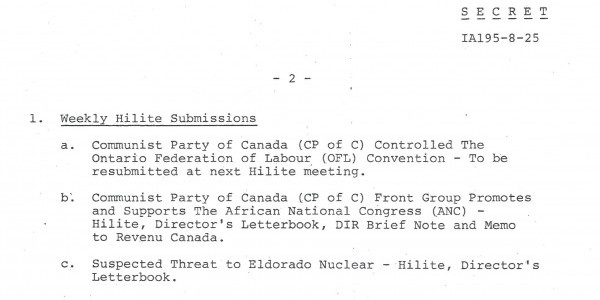
Can’t Recall 1980s Spying On Unions, Says Former Minister
A Mulroney-era solicitor general says he can’t remember ordering a federal spy agency to put political opponents under surveillance. Secret files indicate cabinet had agents spy on unions, peace groups and critics including the Council of Canadians in the 1980s: “What business is it of the state?”
Gov’t Reviews Weather Data
Environment Canada is hiring consultants to standardize weather data under a long-term plan to compile more accurate measures of snow and rainfall dating back nearly two centuries. The department noted the “high impact” of even tiny variables due to climate change: “Snowfall is ludicrous; we still use a ruler to measure the snowpack”.
MPs See Bill To Ban Tankers
The Commons is to take up debate on a private bill to ban oil tanker traffic off the northern coast of British Columbia. The proposal follows disclosures that Environment Canada is quietly conducting “legally defensible” research on the impact of an oil spill in the region: ‘The process is dysfunctional’.
Urge Tax Credits On Radon
Canada lacks clear regulations on radioactive radon gas and fails to take the health threat as seriously as other nations, says the Canadian Environmental Law Association. Researchers urged that cabinet promote a $3,000 tax credit to refit homes subject to poisoning: “We don’t need to be arguing on the science”.
Court Sees Falling Stock Case
The Supreme Court yesterday heard appeals in a case of misleading media reports blamed for a dramatic plunge in a drug company’s stock values. Canada remains the only G8 country without federal securities regulation: “It’s pretty new”.
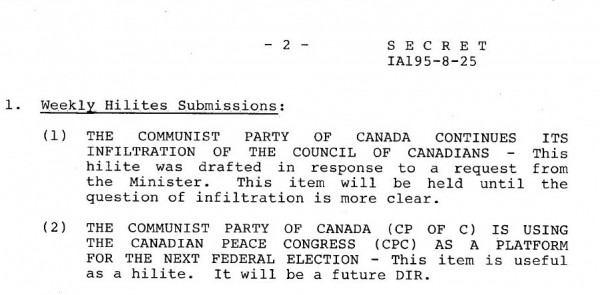
’86 Cabinet Put Trade Critics Under Surveillance: ‘Creepy’
Cabinet secretly ordered spy surveillance of political opponents in 1985 on suspicions that Communists infiltrated an anti-free trade group, newly-released records show. The Council of Canadians, founded by publisher Mel Hurtig, was placed under subversion watch. Council members included MPs and author Pierre Berton. Other groups blacklisted included CUPE, the United Food & Commercial Workers, and labour federations in two provinces: “It’s unbelievable”.