
Nearly 100,000 cartons containing millions of federal records have been warehoused by the Government of Canada without even being opened, auditors say. Investigators discovered the mystery boxes, some dating from 1890, in a routine audit of the federal agency mandated to keep records: “It’s as puzzling to us as it is to you”.
Protest Surveillance At Work
Unions are protesting a plan by railway management to install video cameras and voice recorders in locomotives nationwide. The Teamsters Canada Rail Conference said the proposal goes beyond legitimate safety concerns and aims for surveillance of employees at work: “Our members work in this 8 by 12-foot box”.
Say Holiday Act Not Law Yet
Conservative MPs opposing a bill to make Remembrance Day a legal holiday caution there is little chance the measure will become law by a 2015 election. Caucus members said the bill that overwhelmingly passed Second Reading in the House will now face slow, deliberative hearings and debate: “The bill will die”.
Just What We’re Looking For
English-speaking men account for more than two-thirds of federal appointees in the past eight years, according to records tabled in the Senate. Data also show three provinces – Québec, Ontario and Manitoba – have been proportionately under-represented in federal appointments: ‘We will work for diversity’.
Fears Sneak Vote On Pensions
Cabinet is quiet on proposed cuts to Crown employees’ pensions on fears it would manipulate a ratification scheme to strip benefits. The dispute comes amid word another federal pension plan, this one for the armed forces, is short of required funding: “We have no idea”.
Statistics Do Matter, MPs Say
A Commons committee is urging that Statistics Canada stay “up to date” in gathering vital data following past controversy over changes to the census. MPs on the public accounts committee rated the agency’s work as crucial for lawmakers and the public: ‘We need data to see who’s missing out’.
Firm Gets A $7M Federal Fine
A Canadian company faces $7 million in penalties from the anti-trust Competition Bureau over illegal door-to-door marketing. The agency says its investigation is still ongoing into the sale of water heaters to homeowners: “The bureau is getting somewhat activist”.
‘Slow Down’ On Holiday Act
Business is appealing to MPs to “slow down” a bid to make Remembrance Day a legal holiday. And one cabinet minister’s online poll found a majority of respondents opposed to it. The Commons earlier endorsed the measure in a vote held just days after a lone gunman killed a reservist at the National War Memorial and stormed Parliament Hill: “We shouldn’t let emotions carry the day”.
Fees Are So High Employers Don’t ‘Bother’ With Migrants
Fees charged to hire foreign workers are now so high many Canadian employers are “not bothering” to get migrants, says a government official. Cabinet nearly quadrupled the fees last summer, from $275 to $1,000 for every foreigner hired: “$1,000 is a lot of money”.
Bill Is Unlawful, Senate Told
Attorneys warn an internet search law already passed by the Commons is unconstitutional, and sanctions “wide-sale government intrusion” on Canadians’ privacy. Bill C-13 would see warrantless searches on telecom providers though the Supreme Court banned the practice five months ago: “Computers are fastidious record-keepers”.
Court Won’t Hear ATV Case
A Québec man injured for life after drinking and driving a friend’s all-terrain vehicle has lost a bid to claim damages in the Supreme Court of Canada. Justices declined to hear the case that left the man a quadriplegic: “He was responsible for his own misfortune”.
Couldn’t Count Phone Poles
A telecom dispute over the number of telephone poles in Atlantic Canada has gone to mediation by federal regulators. Two companies, Eastlink and Bell Aliant Inc., could not agree on a pole count for billing purposes between the firms: ‘We were shocked’.
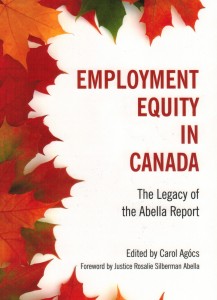
Review: A Long Trail A-Winding
When Parliament passed the Employment Equity Act in 1986 the Globe & Mail celebrated it as an initiative “aimed at making the workplace fairer for women, the disabled and visible minorities.”
And yet –
In 170 years the Globe has never hired an editor-in-chief who was not a white male. Such ironies abound in Employment Equity In Canada, a snappy account of the nation’s struggle with jobsite discrimination. Officialdom never called it affirmative action – “It proved to be a polarizing term”, Equity notes – nor did the program ever approach the scope and intensity of its U.S. cousin. The fact the Act is now in its third decade with little comment from Parliament says plenty.
Equity is both celebratory and despairing. If the Canadian law became a template for legislators in Australia, South Africa and Northern Ireland, it did little good for 95 percent of Canadians exempt from it in the first place. Even for employers subject to the Act improvements have been spotty.
“The group that lags behind most is persons with disabilities,” Equity says; “Representation has always been significantly below availability.” In the first year the Act advocates calculated the disabled comprised less than 1 percent of new hires at Canada’s largest employers: Canada Post; CBC; Bell Canada; Canadian National Railway Co. and the Big Five banks. “We Canadians like to think of ourselves as very tolerant and socially progressive, but on employment equity we need to be wary of arrogance,” Equity concludes.
The Act was born from a one-woman 1983 royal commission led by Rosalie Abella, then a family court judge from Toronto. Abella travelled with a staff of one, conducting interviews with a tape recorder rather than holding formal hearings: “Participants were told they would not be quoted without their approval, but were free to discuss their issues with the media if they wished.”
Abella met with advocates, business and labour in the kind of consensus-building initiative now disregarded in Ottawa as “red tape”. The resulting Act had much promise and is credited with inspiring a string of Supreme Court judgments that made working life fairer for minorities.
And yet –
Companies with fewer than 100 employees were exempted, representing most worksites. The Act tended to benefit workers who were covered by collective agreements anyway. It did no good for the fastest-growing segments of the workforce – part-timers and the self-employed – and a provision that it apply to federal contractors awarded tenders worth $200,000 or more was rolled back to $1 million in 2013.
“Complaint-based enforcement is not suitable for people in precarious work: not only might they lack the knowledge and skills to make a complaint, they may be particularly fearful of losing their job,” writes contributor Patricia Hughes, executive director of the Law Commission of Ontario. “They may be concerned about immigration authorities and repatriation.”
The minimum wage clerk, the migrant farmworker, the nanny – all could accurately say the Act did not improve their lot. Perhaps it was asking too much, Hughes writes: “No single policy remedy will fully address discrimination in the workplace, nor will one approach address the situation of vulnerable workers.”
Readers are left to wonder: in its 171st year, might the Globe find a candidate clever enough to edit the newspaper who is not white, and not male.
By Holly Doan
Employment Equity In Canada: The Legacy Of The Abella Report, edited by Carol Agocs; University of Toronto Press; 352 pages; ISBN #9781-4426-15625; $21.91

Arctic Junket Costs $786,000
Taxpayers were billed more than $130,000 a day for the Prime Minister’s last Arctic tour, including thousands spent by the cash-strapped Coast Guard to put two icebreakers at his disposal. Overtime by the Prime Minister’s security detail cost more than a quarter-million dollars, records show: “It’s just become a great photo-op.”
Gov’t Short Of Rail Inspectors
Transport Canada says it does not have the rail inspectors it needs to enforce safety rules. A senior official said the department has to date been unable to hire inspectors promised by cabinet a month ago: “It’s a bit of a challenge to attract people”.