
Canada’s marine industry is expressing growing alarm over confidential terms of a European trade pact that claims to “ensure a level playing field” in the sector. Shipowners and union executives alike questioned cabinet assurances that no harm will come from treaty negotiations to formally conclude Friday: “It just confirms our fears”.
MPs Reject Energy Subsidies
The Commons has rejected a motion to revive a subsidy program for home energy refits. MPs on a voice vote dismissed a New Democrat motion to restore a program cancelled by cabinet as an austerity measure in 2012: “This is disappointing”.
Canada Over-Policed: Report
The size of police departments varies as much as 45% in cities nationwide, says research by the think-tank Fraser Institute. The calculation follows a Commons report warning of unsustainable policing costs: “We have to take action to fix it”.
Feds Silent On Mystery Fine
Canadian National Rail Co. says it has received “no notice” of a mysterious fine, the first of its kind, for missing a federal grain quota. The Department of Transport claims it levied the fine after CN failed to meet minimum requirements to ship 536,250 tonnes of grain a week: ‘No notice here’.
Lawsuit Puts Focus On National Coal Emissions
A federal lawsuit over the environmental impact of a new B.C. coal terminal highlights increased scrutiny of emissions, say analysts. Attorneys for the group Ecojustice filed the lawsuit to review a decision by the Vancouver Fraser Port Authority to license a $15 million terminal: ‘It’s outrageous’.
‘Frankenstein’ Tax Informant Scheme Will Bypass The Law
Canada Revenue Agency faces questions over a “security state” scheme to bypass federal law in compiling a database of suspected fraud within the tax department. An MP and the union for senior staff questioned the ethics and legality of the program.
“This is startling; it’s Frankenstein-esque,” said Peter Bleyer, special advisor to the president of the Professional Institute of the Public Service of Canada; “Once you go down this crazy path you don’t know what you’re going to wind up with.”
The Revenue Agency is contracting private consultants to build an “internal fraud” surveillance system to track anonymous tips from its 40,000 employees on suspected wrongdoing by co-workers. In a contract notice, the agency said existing methods to investigate “fraudulent activity and inappropriate conduct by employees” are too restricted by the Access To Information Act and Privacy Act.
“Any information gathered during the course of an investigation into wrongdoing becomes accessible under these Acts; therefore, employees may be reluctant to come forward,” the agency noted; “An anonymous reporting channel, more commonly known as a tip line or hotline, provides employees with an anonymous means to report concerns such as allegations of fraudulent activity or misuse engaged in by fellow employees or management.”
Blacklock’s review of thousands of in-house Summary Discipline Reports on tax officials over a six-year period found only 3 suspected cases of criminal activity: an employee who improperly accessed 162 tax returns; another who falsified a $14,000 reassessment payment; and a third worker who altered family members’ tax returns and directed refund cheques to a personal bank account.
Bleyer said the new informants’ surveillance system appeared to be a disproportionate response: “Canada Revenue Agency is creating a problem where there is none,” he said.
“This turns the public service into a security state,” Bleyer continued. “It creates an atmosphere of secrecy and fear, and I’d point out the context in which this agency is operating. The government is so obviously interested in secrecy: that is the message coming from that centre.”
Revenue Minister Kerry-Lynne Findlay did not comment.
Evidence Will Be ‘Permanently Deleted’
The tax department in its notice to contractors stressed the informants’ database must not be shared with any third-parties – a blanket exemption that would include parliamentarians – and allow management to destroy records at will: “All information collected on behalf of the Canada Revenue Agency belongs to the CRA,” the agency wrote; contractors are to “maintain all allegations within the database until Canada Revenue Agency authorized reviewers or a CRA project authority request to have them permanently deleted from the database.”
MP Murray Rankin, New Democrat revenue critic, described the scheme as unsettling. “It is disturbing,” said Rankin, MP for Victoria. “The Access To Information Act has been held by the Supreme Court to be a ‘quasi-constitutional’ right. To see Canada Revenue doing an end run around that Act is very disturbing.”
The Access Act was introduced in 1983. Supreme Court Chief Justice Beverley McLachlin in a 2009 speech described the legislation as having “quasi-constitutional status”, calling it a “check on abuse of powers”: “The need for information is compounded by the inevitable tendency of governments and those exercising powers on behalf of the government to disclose only as much as they deem necessary,” Justice McLachlin said.
Canada Revenue would not explain the need for the surveillance system, and did not comment on what assurances it could offer that incriminating material embarrassing to government officials would not be destroyed. “That cuts both ways,” said the Professional Institute’s Bleyer. “They want to protect this information from who? Does it protect the informants or does it protect the government?”
“We need to talk to Canada Revenue Agency,” Bleyer added. “What is the intention of this? Is it really as crazy as it sounds? We’re going to take a close look at this.”
By Tom Korski 
Tea Pesticides Harmless: Feds
Imported tea that violates federal standards on pesticide content is probably harmless, says Health Canada. The department’s Canadian Food Inspection Agency calculated a consumer would have to guzzle litres of tea daily to “elicit an adverse health effect” from trace chemicals: “75 cups a day”.
One Job With A Future
Opposition MPs propose that cabinet appoint a national Seniors’ Advocate. The suggestion follows federal research that half of Canadians now age 20 will live to see their 90th birthday: “It is intelligent planning”.
Would See A Summit On Rail
Railways, port authorities and shippers are being asked to a national summit to avoid a repeat of a transport snarl last winter that prompted federal quotas on grain shipments. The Canada Grains Council invited delegates to the November 25 conference in Ottawa: ‘We need planning’.
Big Oil’s Tax Bill Down 63%
Oil and gas companies pay two-thirds less federal income tax today than they did in 2006, according to records tabled in Parliament. Tax figures show collections from the whole energy sector including mining and refining declined by more than half in six years: ‘It’s hard to believe till you see the numbers’.
“Keeping Parents Informed”
The teacher’s union
promises
to keep parents informed
during the strike.
The Education Minister declares
24/7 negotiation.
The Board of Education says
schools will remain open,
but no instruction
and no guarantees
for students’ safety.
I remember a joke…
An establishment
offers entertainment
for men.
Customers are greeted
with champagne, caviar,
discretely asked
their preferences:
blondes, or brunettes,
full bodied, or slim built.
The place opened last week
– no girls yet –
but everyone agrees
the management
is superb.
(Editor’s note: poet Shai Ben-Shalom, an Israeli-born biologist, examines current events in the Blacklock’s tradition each and every Sunday)
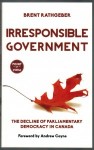
Review: How To Succeed In Politics
“Being a backbench MP in a majority government caucus is, without a doubt, the worst job in Canadian politics,” writes MP Brent Rathgeber. Irresponsible Government documents the misery.
MPs vote on bills they haven’t read, and deliver speeches they didn’t write. They are paid not to think, Rathgeber concludes; even behind closed doors the Conservative caucus is forbidden from casting free votes on any bill or motion: “The people’s elected representatives have failed miserably.”
Rathgeber’s writing is clear and compelling; he damns the 41st Parliament with a methodical narrative you’d expect of a former trial attorney. Committee hearings are a “sham”; speeches are “canned”; MPs are “automatons”; votes on crucial legislation are mere rituals: “Too many times I have heard a disengaged member inquire of his or her neighbour, ‘Which vote are we on? We’re voting ‘yeah’, right?’”
The author is no greenhorn; Rathgeber served in the Alberta legislature, a one-party state with its own brand of brawling politics, and two terms in the Commons. Yet confronted with the mindless partisanship of Parliament, Rathgeber decided – enough. His account of political life is unsettling.
Irresponsible Government begs the question, why do MPs put up with it? The answer is pathetic and merely human: compliant MPs are no worse than reporters who grovel for cabinet interviews, or Department of Justice lawyers who write unconstitutional bills, or RCMP officers who act as bouncers at Conservative Party rallies: the path of expediency is easy and never troublesome, even if it runs along the ditches.
Rathgeber credits a crude system of favours and punishments. Pliable MPs win plum committee assignments, perhaps a junket to Singapore, and a cushy office to impress out-of-town visitors. Dissenters are berated by apparatchiks, stripped of perks and reminded daily of who’s boss. “I was not a team player,” he notes.
Irresponsible Government settles no scores; Rathgeber does not name the worst culprits in Hill shenanigans, though he could. He merely presents the case to the jury of electors: this is what you voted for.
Rathgeber resigned from caucus in 2013 when Conservative friends gutted his private bill on salary disclosure. This was no radical measure; Ontario pioneered its so-called Sunshine List in 1996 with a Public Sector Salary Disclosure Act that required publication of names and benefits of all public officials paid more than $100,000 a year. To date Alberta, Manitoba, Nova Scotia and New Brunswick have enacted similar measures.
In committee a small drama played out as Conservative staff directed MPs to cut up Rathgeber’s bill; one member, Brad Butt of Mississauga-Streetsville, Ont., did the chore by introducing an amendment he hadn’t written: “I want to be able to read it just so people back home think I really work here,” he quipped. Butt questioned the bill; he had to say something. it was embarrassing:
- •BUTT: “I’m trying to wrap my head around what the real public benefit value is of average citizens filing these Access To Information requests all the time, to find out what someone’s salary is at a medium level within the public service. What is the ultimate overall benefit of that?…Did you do any financial analysis of what the costs might be to administer a program like this?”
- •RATHGEBER: “No, because I don’t know how many there will be…”
- •BUTT: “Do we know how many individuals there are at the $160,000-a year or higher?…”
- •RATHGEBER: “We can’t know, Mr. Butt, because currently the government will only disclose ranges of salaries.”
Disclosure was quashed; Rathgeber quit. And the MP from Streetsville? Butt last February 24 admitted to the Commons he’d lied about witnessing a felony in the last election, but was defended by Conservative officials as a good fellow. “Commendable,” the Prime Minister called him.
In one memorable speech MP Tom Lukiwski, parliamentary secretary to the Government House Leader, explained you couldn’t censure Mr. Butt as a liar since Canadians can’t believe a word MPs say anyway: “All members tend to torque their language a bit, perhaps to embellish or to exaggerate”; “Is it distasteful from time to time? It certainly is. Is it personal? Many times it is. Do the members on our side do the same? Yes, we do.”
By Tom Korski
Irresponsible Government: The Decline Of Parliamentary Democracy In Canada, by Brent Rathgeber, MP; Dundurn Press; 168 pages; ISBN 9781-4597-28370; $19.99
Fed Agency Targeted Private Data Weeks Before Court Ban
Federal anti-trust investigators working without warrants filed scores of requests for confidential data from internet service providers in the weeks before the Supreme Court banned the practice, records show. Canadians who had their information surrendered to agents were never told of the incidents. The disclosures came as the Commissioner of Competition pledged “transparency” was his watchword: “This is the guiding vision for the bureau”.
Bill To Police Illegal Fishing Follows Cuts To Surveillance
MPs have given second reading to a bill promising new enforcement on illegal fishing. The legislation follows cuts to surveillance of unlicensed trawlers by the Department of Fisheries & Oceans: “We have to have the clout”.
No Full Compliance On Code
Canada’s telecom firms report compliance with a consumers’ Wireless Code albeit with “delays” by the largest service providers, say regulators. The CRTC issued its first compliance report since enacting the code last December: ‘They had months to get their act together’.



