
The Treasury Board faces far-reaching effects of a Federal Court case for army, navy and air force members forced to move from base to base, say advocates. An Afghan War veteran won $73,000 in compensation for real estate losses: “We support our troops”.
Senate Sues Former Staffer
The Senate is suing to quash a human rights complaint by a former employee who said she was driven to tears by an abusive Senator. Authorities refused comment on the lawsuit filed in Federal Court. Parliamentary attorneys have acted in the past to exempt Senators and MPs from workplace regulations: “A political staffer working in the office of a Senator has no legal entitlement…”
Health Bill Was A ‘Struggle’
Health Minister Rona Ambrose says she “struggled” with exempting natural health products from new legislation on unsafe medicines. Ambrose said homeopathic products should be regulated like pharmaceuticals: “I thought everyone should be under the same legislation”.
P.E.I. Joins Loan Regulators
Prince Edward Island has become the seventh province to regulate payday loans under a 2007 Act of Parliament. The Island cabinet gained authority to set rates on short-term loans under the Criminal Code: “The criminal interest rate is too high”.
Claims ‘Misinformation’ On Internet Harms Fish Farmers
Unnamed “influencers” and media critics are undermining Canadian aquaculture, a Senate panel has been told. Nova Scotia fish farmers claimed misinformation over the sector’s eco-impact has hurt growth and sales: “They’re very skilled at using the internet”.
More Boondoggle Claims
A new report dismisses cabinet claims the RCAF can get by with the single-engine F-35 jetfighter. The analysis cautioned that twin-engine planes, the kind currently flown by the air force, appear more reliable than single-engine replacements: “The math is very simple”.
Transport Canada Falsifies Safety Data, Staff Tell MPs
In testimony MPs described as shocking, current and former Transport Canada staff accuse the department of misleading Parliament on the scope and effectiveness of commercial airlines’ safety inspections. Authorities were accused of falsifying data to conceal a decline in random inspections: ‘It’s a simple sleight of hand’.
Claims “Gross Negligence”
The Department of Fisheries has committed “gross negligence” in failing to protect wild stocks from aquaculture, a Senate panel has been told. The Newfoundland & Labrador Outfitters Association blamed federally-regulated fish farms for threatening ocean life: “The Department of Fisheries is in a severe conflict of interest”.
Fifty MPs File Post Petitions
Fifty MPs have petitioned Parliament to suspend Canada Post cuts and rate hikes in the largest petition drive of the Commons’ spring sitting: ‘It should be debated if the public wants it to be’.
A Long Reach At Tax Court
Tax Court has upheld Canada Revenue’s right to reach back nearly 30 years to collect unpaid debts despite a statue of limitations. The judgment came in the case of a widow denied pension benefits till she pays old taxes dating from 1986: “Tax debts are payable”.
Single Bank Ombudsman ‘Obvious’, Said Minister
Finance Minister Joe Oliver is being pressed for adoption of a single bank ombudsman he’d advocated as a Bay Street executive. Oliver’s past remarks were uncovered by a New Democrat MP. The finance minister would not comment: “Will he actually follow what he said?”
“Portrait Of A Leader”
George W. Bush
presents a collection of portraits:
heads of state
met in person.
The sharp eye
of the former president
captures revealing views
of these individuals:
Two dimensional,
no deeper than oil on canvas.
Remind them of the latest scandal,
or throw the truth in their face,
and they look through you –
unmoving,
unblinking.
Oh, there’s a self-portrait too.
(Editor’s note: poet Shai Ben-Shalom, an Israeli-born biologist, examines current events in the Blacklock’s tradition each and every Sunday) 
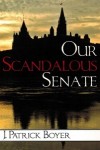
Review: Scandal, Ridicule, But No Poisonings So Far
“We can learn a lot about a place from the kind of scandal it generates,” writes J. Patrick Boyer. On that count the Senate fares not too badly. Its disgraced members are cited for cheating on expenses and lying to their colleagues. There have been no kickback schemes; no influence-peddling; no secret contracts, poisonings or manslaughter. The Senate merely embarrassed itself in the comic manner of a self-satisfied and slightly pompous aristocrat made to look ridiculous.
Our Scandalous Senate is a lively recounting of the famous troubles by a former two-term MP. Boyer is a delightful writer who dissects the problem plainly: the Senate suffers from a near-absence of leadership. Speaker Noël Kinsella warrants only cursory mention in Boyer’s account, and only then to be mocked for his ineffectual news conferences.
“The absence of administration was camouflaged by hallowed pretense of the Senate’s ‘honour system’”, Boyer writes. “The mythical ‘system’ – it was actually an absence of a system – continued to be the Senate’s operating cultural norm, even after the 1960s when the rules were changed so that senators could no longer hang around past age seventy-five, simply because it was embedded in the very fabric of the place”.
To win appointment to the Senate, he writes, is to join a kind of priesthood and face “the intimidating power and dumb inertia that had lumbered along for centuries.”
Our Scandalous Senate correctly notes the misconduct of senators has moved talk of abolition from the lunatic fringe to mainstream discourse of Canadian politics. Boyer also neatly dispenses with the mythology of Senate reform – the long, tiresome campaign by reformers who convinced themselves the Upper House was somehow malformed by patronage, and that highly technical changes in the rules would return the Senate to its pure Confederation roots.
In truth the Senate is exactly what it was supposed to be: the invention of political fixers who were trying to build a country. “By creating two houses for Parliament, it was possible to persuade Quebecers to agree to ‘representation by population’ in the Commons, where they knew they would be outnumbered, since they would be guaranteed the condition of equality in the Senate. Quebec and Ontario got twenty-four senators each,” Boyer notes. “‘On no other condition,’ said George Brown, one of the Fathers of Confederation, ‘could we have advanced a step.’”
These are the worst days for the Senate: Three members are suspended; one resigned under investigation; five others quit in apparent dismay.
These are also the best days for the Senate. Members killed a union-busting Bill C-377 that was almost certainly unconstitutional. They exposed a mean-spirited clause in an omnibus budget bill to give police warrant-free access to tax returns. Senators have convened landmark hearings on bitcoin; public broadcasting; credit fees; cross-border pricing; Official Languages communities; aquaculture and the collapse of the Atlantic lobster fishery.
“Senators are good people,” Boyer notes; “Many have rich contributions to make to public affairs, and try gamely through the muted channels of the Senate to do so.”
The contributors will be the salvation of the Senate in the end.
By Holly Doan
Our Scandalous Senate by J. Patrick Boyer; Dundurn Press; 392 pages; ISBN 9781-4597-23665; $24.99
‘No Comment’ On Whether Farm Bill’s Made In Brussels
Changes to patent rules for plant breeders came amid pressure from Europe, suggests a confidential memo. Agriculture officials refused comment on the document released through Access to Information. The memo indicates Canada was pressed to tighten patent rules while negotiating free trade with the E.U.: “Who’s making policy?”
Audits Cut By $10 Million
MPs are expressing concern over budget cuts for federal auditors, describing their work as “indispensable”. Funding for the Office of the Auditor General is to be cut by more than $10 million this year compared to 2012: “It’s not a good thing”.