
Railways may insert vague “surcharges” into shipping contracts that go to final arbitration, a federal judge has ruled. The decision came in the case of a Nova Scotia shipper overcharged by Canadian National Railway Co.: “We lost”.
Calls Road Salt Rules Useless
Environment Canada’s refusal to target road salt as toxic will see wider use of the substance despite evidence of ecological damage, says a green manufacturer. Canadians use five to seven million tonnes of road salt each winter, primarily in provinces west of Manitoba: “There is nothing here”.
Chemical Ban After 60 Years
The first fungicide ever registered in Canada now faces a federal ban after sixty years of use. Health Canada proposes to begin phasing-out quintozene this year amid concerns it is environmentally toxic: “Even if you have it on the shelf in your garage you can’t use it”.
No ‘Sense’ At Transport Panel
A federal rail and air regulator, the Canadian Transportation Agency, has been cited as “rigid”, “inflexible” and lacking common sense by a federal court. The stinging judgment came in an uncomplicated case involving a dog aboard an airplane: “Form took over substance”.
Senate To Scrutinize DNA Bill
A Senate committee next month will take up clause-by-clause scrutiny of a bill to enact Canada’s first federal privacy protection for genetic testing. The proposal still faces “exaggerated” complaints from insurers, says its Liberal sponsor: ‘Everybody else says we need it’.
Gov’t Bills $10K To Pull Files
A Nova Scotia government department is charging $37 an hour to photocopy public documents under its Access To Information law. The charges come as MPs propose raising fees on all Canadians who ask to see federal records: “It’s just outrageous”.
Gov’t Claims Security Threat In Media Blacklist: ‘Nonsense’
Shared Services Canada claims it imposed a national blackout on all government employees’ access to Blacklock’s website as a “potential threat” to federal internet usage. The department invoked security in justifying its media ban, confirmed through Access To Information files.
“A potential threat to Government of Canada infrastructure was detected,” Ted Francis, Shared Services spokesperson, said in a statement; “The threat was subsequently rectified. Access to Blacklocks.ca was restored.”
The department manages telecom services for 43 federal departments with some 200,000 employees. Access records show IT staffers were specifically directed to block access to the website last August 22. The source of the request is censored in 218 pages of newly-released Access documents. The department also redacted all references to claimed cyber threats.
Blacklock’s publisher Holly Doan described the department claim as “nonsense”, saying the website at no time posed any threat to the integrity of government internet systems. “There were no viruses, no malware, no danger of any kind,” Doan said.
“To cast an accredited Canadian media website as some kind of voodoo security peril in the same league as industrial saboteurs and foreign hackers is ridiculous,” Doan said. “We report the news. Shared Services’ statement is at odds with the facts.”
Government IT security staff did not reply to repeated interview requests. Documents indicate the Blacklock’s ban was lifted the same day the publication filed an Access request for information on why the website was blocked.
“It Seems Odd”
The Canadian Association of Journalists urged cabinet to release details of the alleged threat used to justify the website blacklisting. “We’re concerned that a government department would block access to any media website at all,” said Hugo Rodrigues, association president.
“It seems odd that a publicly-funded department would restrict access to media,” Rodrigues said. “We do have freedom of the press and freedom of expression in Canada. There needs to be transparency and accountability. They need to supply some credible information to justify their action – and we don’t see that.”
Access files indicate Shared Services Canada repeatedly cited Blacklock’s in Cyber Brief bulletins distributed to IT staff. All the references were censored. Department officials had refused to say how many other websites it blocks, or why, or how many are published by Canadian media organizations.
“We do not comment on the specifics of methods used to protect the Government of Canada’s IT infrastructure,” said Marie-Helene Rouillard, a department spokesperson; “The Government of Canada is continuously working to enhance cyber security”.
The blacklisting appeared to violate the government’s own handbook on permitted use of federal computers. Government employees are permitted to “keep up-to-date with news and current events,” according to cabinet’s 2013 Policy On Acceptable Network & Device Use.
By Staff 
$2 Here, $2 There: Gov’t Ends Small Benefit Cheques In 2015
Two years after abolishing the penny, cabinet proposes to eliminate small benefits payments as an austerity measure. Authorities would not disclose the minimum value of payments that aren’t worth the trouble. It costs the treasury 82¢ to cut a cheque: ‘It’s a common-sense measure’.
Feds Cite Media Pressure On ‘Ethical’ Offshore Contracting
Media disclosures of overseas sweatshops prompted a Department of Public Works inquiry on whether to require “ethical procurement” in federal contracting, records show. Department memos indicate news accounts of the fatal 2013 collapse of a Bangladeshi garment factory led regulators to examine the sourcing of apparel: “Protections do not exist in some offshore countries”
Dep’t To Target Drug Tweets
Health Canada will spend $590,000 sponsoring Tweets and Facebook postings on narcotics and other issues following research showing many Canadians are ambivalent about marijuana use. Parliament has regulated pot since 1921: ‘It’s no longer seen as a substance that only the ‘druggies’ use’.
No Curbs On This Eco Peril
Environment Canada proposes only voluntary targets for curbing winter use of tonnes of road salt cited for damaging property and poisoning vegetation and waterways. The recommendation follows decades of study: “These chemicals are toxic”.
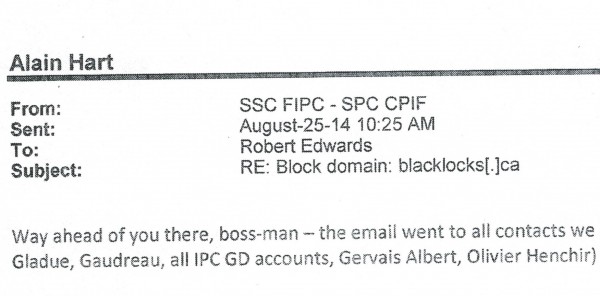
Feds Run News Blacklist, Ban Employee Access To Website
A federal agency banned public employees from accessing news stories at Blacklock’s Reporter via government internet servers, documents confirm. Confidential records show Shared Services Canada imposed the government-wide blackout on website access by hundreds of thousands of staff. Files on the blacklisting were obtained through Access To Information.
Shared Services Canada offered no explanation. A 218-page file detailing the ban is heavily censored and conceals email messages in which Shared Services staff discuss the action in messages headed, “Block Domain: Blacklocks.ca”.
“This is outrageous conduct,” said Blacklock’s publisher Holly Doan, who noted the newsroom first learned of the blacklisting from individual subscribers in federal departments who were unable to access news content. Shared Services Canada manages telecom services for 43 departments.
No reason is given for the blacklisting. Blacklock’s is an accredited member of the Parliamentary Press Gallery covering bills, regulations, Access to Information and federal courts.
“It’s astonishing to see Canada join the short list of countries that forbid public employees from accessing internet news sites,” Doan said. “This is not only Orwellian, it appears to breach the government’s own guidelines on workplace internet use.”
Cabinet’s official Policy On Acceptable Network & Device Use adopted in 2013 permits federal employees to “search for information online” and “share links to professional activities and events or interesting and relevant articles”. The Policy also details “unacceptable use” of government computers including access to “hate propaganda”; “pornography”; “obscenity”; and “illegal gambling”.
Doan said, “Surely Shared Services Canada can tell the difference between Blacklock’s and a jihadist website or crime syndicate”; “No rational agency would blacklist an accredited news site in the name of security or crime prevention”. Doan noted the Blacklock’s ban appeared to be revoked September 9, the same day the publication filed a formal request for records from Shared Services Canada.
‘Way Ahead There, Boss Man’
Documents indicate the government’s central internet provider blocks numerous domain sites. Shared Services Canada would not explain how many sites it has blacklisted, what their names are, or how many others are accredited news sites. “We do not comment on the specifics of methods used to protect the Government of Canada’s IT infrastructure,” said Marie-Helene Rouillard, a Shared Services spokesperson.
Access To Information records show the department’s IT security division blocked the website blacklocks.ca from last August 22, sending an email alert to numerous agencies including the Department of Industry, Correctional Service of Canada, tax department and others. “The email went to all contacts we have on record,” Dave Tough, a Shared Services security analyst, writes in one August 25 email; “Way ahead of you there, boss-man.”
Tough rated the alert of “high importance”, and indicated several IT staff monitored the news site. Blacklock’s was also cited in an August 27 Cyber Brief distributed to telecom staff across all government agencies; “Cyber Briefs are publications released by the Government of Canada with the goal of preventing widespread incidents,” the memo reads. All references to Blacklock’s were lengthy and censored.
Tough did not reply to repeated requests for an interview. “At no time did our newsroom pose a security threat to the nation,” said Publisher Doan.
Under cabinet’s Policy on workplace computer use, more than 200,000 federal employees are permitted to “watch online broadcasts of work-related content” and “keep up-to-date with news and current events”, according to Examples Of Acceptable Use. Other permitted activities include “subscribe to web feeds”; “check the weather forecast”; “confirm bus schedule information”; “read or contribute to online forums”; and “visit social networking sites to connect with family and friends”.
Forbidden computer activities include using workplace computers to “make public comments about government policies”; “engage in political activity”; or “breach the duty of loyalty requirement for public servants”.
By Staff
Tax Auditors’ Reach Tested In A “Battleground” Court Case
The Supreme Court will rule on the right of federal auditors to examine confidential legal records in chasing the “money trail” of suspected tax evaders. The case follows Québec notaries’ refusal to surrender client files to the Canada Revenue Agency: “This is where the battleground is right now in privacy law”.
Feds Did Hells Angel Wrong, Judge Rules In Unusual Case
In a court ruling a federal judge called “extraordinary”, the Department of Public Safety has been cited for abuse of process against an admitted member of the Hells Angels. The finding came in a British Columbia immigration case: “The integrity of our justice system has been compromised”.
CMHC Plans To Sell, Sell, Sell
CMHC is hiring marketing consultants to blitz Filipino, Chinese and South Asian immigrants with ads for new “branding” of home loan insurance. Federally-insured mortgages currently average more than a quarter-million dollars for first-time buyers: “The objectives are to increase CMHC’s visibility”.