
The Department of Fisheries is drawing mixed reviews with a proposal to sanction the release of dangerous substances into waterways. The fisheries minister could approve the release of “deleterious substances” to combat invasive species, aid aquaculture or conduct research: “It would have been against the law”.
Less Smoking, More Arson
Federal prisons have been plagued with arson fires since the Correctional Service banned smoking by inmates, new data show. Authorities counted more than 600 arson fires in prisons since a smoking ban was first introduced in 2006: “There have been challenges and difficulties”.
A 2¢ Fuel Tax Promise
The Department of Finance is quiet on a lapsed promise to reduce the federal excise tax on diesel. The Minister of State for Finance, MP Kevin Sorenson declined comment on a cabinet pledge to halve the tax from 4¢ a litre to 2. “It was supposed to be great news”.
Canada’s Unsinkable Ship
A 50-year old navy ship sold as a scuba divers’ artificial reef poses an ecological risk and must not be sunk as is off the B.C. coast, warns Environment Canada. HMCS Annapolis is laced with toxic PCBs. Authorities sold it as an artificial reef in 2008 but only confirmed last week its PCB content exceeds federal law: “Environment Canada was not entirely candid”.
Feds Urged To Release Data
Cabinet is being pressed to release confidential Canada Post feasibility studies on retail banking that were mysteriously shelved by management, and now concealed from the public. Toronto City Council voted 39-2 to request that the post office divulge Banking: A Proven Diversification Strategy, a secret report that concluded postal banking “would be a win-win strategy”.
“If there are feasibility reports on diversifying Canada Post revenues, can the government not reopen that discussion?” said Councillor Kristyn Wong-Tam, sponsor of the proposal; “This issue of Canada Post services has become a lightning rod for communities.”
The existence of the report was only learned through the release of files under the Access to Information Act. The documents cited board meetings, polling results and focus group data indicating post executives spent four years researching the benefits of establishing the largest retail banking network in the country. Of 811 pages in the file 701 were censored due to commercial confidentiality, Canada Post said. The records are dated between 2009 and 2013.
Canada Post appeared to kill the program in late 2013 and opt instead for 35% rate increases this year, and the elimination of all home mail delivery to five million households nationwide. MPs and the Canadian Union of Postal Workers have speculated cabinet ordered management at the Crown corporation to abandon its banking proposal.
“There is a strong consensus that if we lose these services the effects will be detrimental,” said Councillor Wong-Tam. “What is the financial and social impact? This is a service people need. It really comes down to the impact on residents, and people are starting to become angry.”
The text of the Council amendment reads: “That City Council request the federal government and Canada Post to publicly release the report Banking: A Proven Diversification Strategy; that City Council direct the City Manager, in consultation with the appropriate City staff, to report back to Council through the Executive Committee on a) the potential cost of the reduced Canada Post service to the City including the requirement of municipal land and rights-of way, infrastructure such as paving and lighting and policing related to vandalism, graffiti and mail theft; b) which communities and neighbourhoods in the city will be affected; c) the demographics of such areas; d) what change to service will be implemented in these areas where postal boxes will be located; e) the impact of these changes on the public realm.”
Toronto joins a list of cities to protest the service cuts, from Sault Ste. Marie, Ont. to Medicine Hat, Alta., New Westminster, B.C. and Vancouver, where councillors voted unanimously to register their opposition with the Federation of Canadian Municipalities.
“The decision to eliminate door-to-door mail delivery in urban areas will affect many municipalities,” said Mayor Claude Dauphin of Lachine, Que., the federation’s president. “Canada Post must work with municipalities to make sure the concerns of cities and municipalities are addressed.”
The post office has publicly denied any interest in reviving the Postal Savings Banks it operated nationwide till 1968. “As for banking, it is not our core business,” Canada Post spokesperson Jon Hamilton told Blacklock’s January 2; “It would require a huge investment to serve a niche market.”
However confidential documents reveal that management drafted a “vision for Canada Post financial services”, noting that profit margins in domestic banking averaged 20.5 percent, and as much as 33% at online banks like ING Canada. The corporation has 6519 post offices, a wider branch network than the Royal Bank, the largest of the federally-chartered banks.
By Tom Korski 
Auction Is Rated Ho-Hum
A winter wireless auction may have raised $5.27 billion for the Government of Canada but results need to be weighted with many grains of salt, say analysts. Industry Canada saw auction proceeds rise 23% but only after doubling the length of licenses: “It may seem a lot higher than it is”.
48,500 Wanted Nationwide
Canada Border Services Agency estimates 48,500 foreigners are in the country illegally. The disclosure came as cabinet proposed to restrict permits issued to international “students” who gain entry to Canada but never attend class: “I don’t quite understand why we would tolerate this”.
B-u-t It’s Already Illegal
An obscure reference in budget documents to electronic jamming devices has analysts puzzled over what cabinet has in mind. Authorities refused comment on the initiative, except to caution that wireless signal blocking is a danger to the public: “It is not really clear what they’re looking at.”
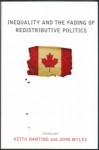
Nice While It Lasted
Imperial Oil pays less tax today than it did in 1960. Bus drivers pay more. In this statistic we see the case for Inequality and the Fading of Redistributive Politics.
Editors and contributors from leading universities document the phenomenon with scientific precision. Canada’s rich are definitely richer, the poor are not really much poorer, but recent years have put the middle class in a vise-like squeeze. In response Parliament passed a bill offering tax credits for hot tubs. “This new political landscape has sharp edges,” write editors Prof. Keith Banting of Queen’s University, and Prof. John Myles of the University of Toronto.
Inequality is neither hectoring nor conspiracy-ridden. “There is no smoking gun to be found,” the editors note. However the result is the same: “Canadians in the middle, especially those in the lower middle of the wage distribution, have been struggling in the wake of economic change and have not received their fair share of the benefits of economic growth for a generation.”
No federal cabinet in twenty years has done much to alter the trend lines. It has been a generation of cheese-paring “dominated by the Department of Finance and characterized by cost containment through technical, almost invisible program adjustments”, writes Prof. Susan Phillips of Carleton University’s School of Public Policy.
An example: the 1944 baby bonus introduced as the first truly universal family benefit, and now reduced to a non-refundable tax credit. The mangling of the bonus reads like a round of the telephone game: first they renamed it the “family allowance”, then clawed it back in 1989. It was renamed again as the Child Tax Benefit in 1993, then replaced with a Child Tax Benefit in 1998 that actually cut benefits for low-income families. This was followed by a Universal Child Care Benefit, and finally in 2007 the non-refundable Child Tax Credit.
The effect is “perverse”, writes Prof. David Good of the University of Victoria, a former assistant deputy minister: “Non-poor families receive $300 per child, including the very rich; some low-income families receive a smaller amount; and the poorest get nothing at all because they do not owe income tax.”
Inequality reflects the sunset on Canada’s postwar middle-class. It is a fact now that most people under 50 will never know a time when a high-school education could bring a good wage; or one wage-earner might support a whole family.
It was nice while it lasted.
By Holly Doan
Inequality and the Fading of Redistributive Politics, edited by Keith Banting and John Myles; UBC Press; 480 pages; ISBN 9780-7748-26006; $34.95
Cuts Yes, Consultation No
Canada Post is being flayed for its rollout of plans to suspend home mail delivery nationwide. MPs and authorities in the first communities to see service cuts complained of a lack of consultation: “It tells me they don’t give a rat’s ass”.
Court Hears Pharma Case
The Supreme Court has agreed to hear a case of stock losses triggered by misleading media reports. The appeal in a Québec class-action lawsuit followed a 2010 incident in which a pharmaceutical firm saw trading suspended based on speculative reports its latest drug was a bust.
Trade Feud Enters 6th Year
A U.S. trade practice blamed for more than $5 billion in Canadian losses is expected to drag into next year without resolution. Exporters expressed irritation with the process that’s already seen six years of protests, hearings and lawsuits: “It is taking much longer than we believe it should”.
Feds Wink At Cash To CBC
Federal regulators have approved payment of cash for news at CBC-TV, calling it a management responsibility. The CRTC dismissed a public complaint over a $97,729 payment from Parks Canada to have CBC cover an exclusive story two years ago: “Broadcasters are responsible for the content they air”.
Cabinet Tackles Pig Virus
Cabinet will enact new regulations next Wednesday in a bid to stem the spread of a pig-killing virus confirmed in three provinces to date. The virus is raising fears of the 2003 mad cow outbreak that cost the cattle industry $6.3 billion: “It’s a national event”.
A Hard Sell On Exports
Price swings in the billion-dollar lobster sector will make it very difficult to sell in new markets, says an industry group. The Fisheries Council told a Commons committee lobster marketing remains a problem due to up and down pricing: “The marketplace hates that. Retailers hate it. Food services hate it”.