
Cabinet effective next Monday will end most federal vaccine mandates for employees and travelers. Transport Minister Omar Alghabra said the decision reflected new science: “The decision is not based on something we woke up this morning and decided to do.”
Monthly Archives: June 2022
Three Parties OK Pension Bill
Three opposition parties yesterday announced a pact to speed passage of a bill to save pensions in cases of insolvency. MPs have tried and failed to pass similar amendments to bankruptcy law since 1975: “We hope to see this go to committee and beyond that to really do something.”
See Tonnes Of Illegal Plastic
Federal inspectors have intercepted tonnes of illegal plastic waste exports in the past three years, records show. MPs voted in 2021 to abolish the black market trade but saw a ban lapse in the Senate: “It is clear we cannot continue to send our plastic waste overseas.”
Mendicino Loses Crucial Vote
Public Safety Minister Marco Mendicino yesterday lost a key vote on a cellphone search bill. Nine of 12 members of the Senate national security committee rejected his proposal to designate “reasonable general concern” as justification to search electronic devices at border crossings: “We did not have one witness except the Minister and the officials say this was a good idea.”
Public Cynical About $6B Aid
Most Canadians are cynical about foreign aid, says in-house research by the Department of Foreign Affairs. Taxpayers suspect aid typically “ends up in the pockets of corrupt politicians,” said a report: “Only one in four Canadians, 26 percent, believes government spending on international aid is effective.”
Debate Gagged On Web Regs
The Commons yesterday by a vote of 174 to 146 imposed closure on the latest cabinet bill to regulate the internet. The motion was worse than anything attempted by Stephen Harper, said a Green MP: “I cannot think of a time that a motion this egregious was put forward in that era.”
Overlooked 36 Million Acres
Climate change benefits of federal tree planting will be “slow at first,” says Natural Resources Minister Jonathan Wilkinson’s department. Staff cited new data indicating Canada already has so many trees the forest cover is 36 million acres larger than originally thought: “The current estimate of forest area in Canada is an improved estimate relative to what has been reported previously.”
Bilingual Cost Was Lowballed
Estimates of a quarter-billion cost to expand official bilingualism to the private sector does not account for enforcement west of Ontario or east of New Brunswick, Budget Officer Yves Giroux said yesterday. Applying a new cabinet bill nationwide would cost much more, he said: “Do you think jobs will actually move outside of Québec as a result of this?”
$237M Contract Was Surplus
Millions’ worth of Covid ventilators purchased through a former Liberal MP’s company were immediately warehoused as medical surplus, records show. The ventilators cost the equivalent of $23,700 apiece: “We needed an advance.”
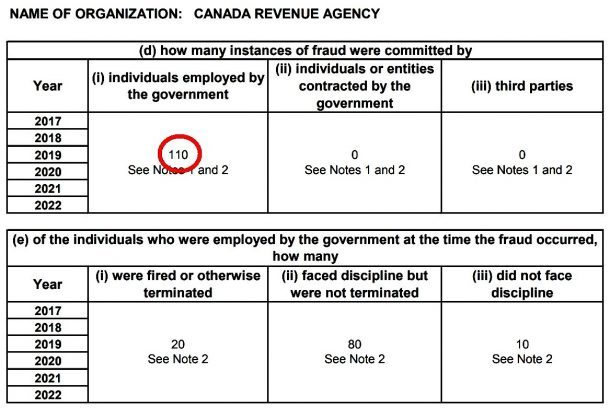
110 Frauds Inside Fed Agency
A total 110 employees of the Canada Revenue Agency have been investigated for fraud in the past five years, records show. Twenty were fired. It was the highest number of known fraud probes in any federal department or agency: “Data provided have been drawn from discipline records.”
Rate $735K Kitchen A Big Job
A $735,000 kitchen renovation at the Prime Minister’s official lake property was more elaborate than a mere cooking area, says the Department of Public Works. It also included a pantry, staff told the Commons government operations committee: “These investments are important.”
230,000 Working From Home
More than a quarter million federal employees continue to work from home, data show. Cabinet has set no deadline to have all staff return to the office: “I think it’s important to understand the magnitude.”
$98M Subsidy Is For Starters
More taxpayers’ aid is needed to meet climate change targets, says the CEO of a company that received a $27.2 million subsidy for small nuclear reactors. The Department of Industry to date has spent $97.7 million on miniature reactors though none are in actual use: “Federal support will continue to be critical.”
Poem: “For A Greener City”
Along the highway,
an excavator
is uprooting trees
for road construction.
The company’s name –
white letters on the hydraulic arm –
is visible from a distance.
Greenbelt.
(Editor’s note: poet Shai Ben-Shalom, an Israeli-born biologist, writes for Blacklock’s each and every Sunday).

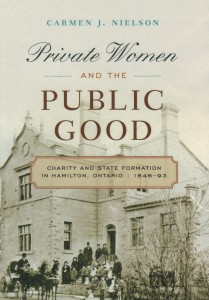
Review: Good Old Days, Unvarnished
So much Canadian literature is to history what McLobster is to shellfish, an ersatz experience in which facts are processed to the point of blandness. It fills but never satisfies, and makes you pity those who never tasted the real thing.
And then there is this gem by historian Carmen J. Nielson of Mount Royal University. Private Women documents social welfare on the frontier. The narrative turns on a specific time and place – Hamilton, Ont., circa 1850 – but it could be Anytown Canada in the age before government initiatives. This is history no TV producer could re-enact. The film set would be raided by the Children’s Aid Society.
Hamilton in 1846 was a brawling port of Protestant burghers and Catholic labourers that prided itself as the Manchester of Upper Canada. It was home to mills and factories, a steamboat landing and the Great Western Railway, three newspapers and periodic outbreaks of cholera.
The alleys were filthy and poverty was desperate. Professor Nielson notes the only public welfare institution was the local jail: “No formal state provisions had been made for coping with destitute individuals, so responsibility for poor relief most often fell to churches or private individuals and less often to magistrates and local governments.”
The result was appalling. Whole families scavenged for food. Children were apprenticed to mills at age 8. Mothers stole bread and firewood. In 1846 amid the squalor a group of 48 wives and mothers, all “white, middle-class Protestant women,” formed a Ladies’ Benevolent Society with a single purpose: “The investigation and relief of cases of distress and destitution from sickness, poverty or similar causes.”
Members paid a subscription fee of five shillings and were assigned to different wards of the city to mind the destitute. They distributed groceries and counselled orphans and runaways who wandered the streets of the city. The Ladies’ Benevolent Society was almost revolutionary, Nielson writes. For centuries charity was considered the public duty of the very rich. Benevolent societies of the Dickens era were modeled on the concept of the joint stock company.
“Western capitalists with relatively small amounts of money to invest recognized if they pooled their resources they could finance projects that required very large investments, such as building canals and bridges,” Nielson writes. So it was that charitable societies “allowed men and women of the new middle classes to subscribe relatively small sums of money to undertake significant benevolent endeavours.”
From 1848 the ladies of Hamilton operated a day school and orphanage and later an old folks’ home. Private Women is richly researched and recounts those who passed through the doors: Willie, a drunkard’s son, “totally neglected”; Harriet, a girl whose mother’s character “is not good” and was known to police – a prostitute, perhaps; and Jimmy, an incorrigible delinquent taken in by the Orphan’s Home but expelled within days for trying to “corrupt the other boys.”
Jimmy’s sins are lost to history. Was it smoking? Drinking? Playing Three-Card Monte? The boy was driven out and last seen “wandering the streets” of Hamilton.
The regimen at the orphanage was plain and purposeful: Rise at 6, prayers and breakfast, an hour of play, lessons till 5 pm, bedtime at 7. Beatings were uncommon. Children were taught useful skills in the kitchen and workshop.
In time such private charities were overtaken by government aid. Ontario passed an Industrial Schools Act in 1874 and a Children’s Aid Act in 1893. The Hamilton orphanage closed in 1914 and today is forgotten but for Private Women, a compelling account of hardship and charity too raw for textbook processing.
By Holly Doan
Private Women And The Public Good, by Carmen J. Nielson; University of British Columbia Press; 176 pages; ISBN 9780-7748-16921; $24.95