
Public Safety Minister Marco Mendicino yesterday said it’s a concern that courts have not imposed maximum sentences for gun running. Cabinet proposes to increase the maximum to 14 years but acknowledged the current 10-year sentence is not used: “Is it common at all? Has it happened quite a bit?”
Monthly Archives: April 2023
Grew Tired Writing Cheques
A federal agency issued so many corporate subsidy cheques that staff complained of overwork, says a newly-released report. “Employees’ mental health” was challenged, said an in-house audit by the National Research Council: “Unexpected work was created.”
Panel To Probe Trudeau Fund
The Commons public accounts committee yesterday ordered hearings on the Trudeau Foundation. MPs by a unanimous 10-0 vote also requested that the Canada Revenue Agency scrutinize the fund: “It is in the public interest to see an investigation into its finances, donations and in particular any possible misdealing.”
VW Subsidy Deal Top Secret
Cabinet yesterday agreed to let MPs see terms of its multi-billion subsidy to Volkswagen Canada but under extraordinary secrecy. The Commons industry committee voted that all copies of the contract shown to MPs be immediately destroyed: “It’s about protecting the integrity of the contract.”
Defend Cash For Consultants
The Treasury Board yesterday said it cannot afford to stop hiring consultants, a key demand of the striking Public Service Alliance of Canada. Suspending billions spent on consultants would “severely compromise” federal work, it said: “We have to find a balance.”
Lost Fortune In Bar Car Sales
Pandemic lockdowns on non-essential travel cost VIA Rail a fortune in lost liquor sales, data show. The Crown railway sold millions’ worth of drinks out of its bar cars until the pandemic slowed traffic to a crawl: “Demand for travel may only return to or exceed the level seen in 2019 sometime in 2024.”
Honour Tickets Or Else: Gov’t
Air passenger compensation rules to take effect by year’s end will treat paid tickets like “a contract with a customer,” Transport Minister Omar Alghabra said yesterday. “The airlines are responsible for delivering that service,” he told reporters: “There is a significant imbalance in power here.”
MPs Want The VW Fine Print
Industry Minister François-Philippe Champagne today is under committee order to surrender a copy of documents regarding his agreement to pay Volkswagen Canada more than $13 billion to build a factory in St. Thomas, Ont. Champagne ignored an earlier demand from the Commons industry committee to detail all giveaways to VW: “It is a win for the world.”
Dozen Calls With China Staff
Independent MP Han Dong (Don Valley North, Ont.) in a court filing admits to at least a dozen phone calls with Communist Chinese diplomats including Beijing’s Ambassador to Canada. Dong called it “common practice” for any MP: “They are not close friends.”
Budget Bill Targeting Airlines
Airlines must answer passenger complaints within 30 days under an omnibus budget bill. Transport Minister Omar Alghabra today meets with reporters to detail stricter consumer protection rules for carriers: “We will take action.”
Agency’s “Out To Get Theirs”
Few Indigenous people trust the Canada Revenue Agency and say auditors are “only out to get theirs,” according to in-house research. The Agency surveyed Indigenous communities to determine why people didn’t file tax returns even if it meant losing benefits: “I don’t get the sense they are looking out for people.”

Gov’t To Pass Bunny Test Ban
Cabinet has written a federal ban on animal testing by the cosmetics industry into its omnibus budget bill to guarantee passage this spring. The measure was first endorsed by Laureen Harper and the Humane Society in 2015: “Our government recognizes Canadians are concerned.”
A Poem: “One Green Leaf”
There was one green leaf left on the tree
and I just couldn’t understand
none of the others had survived
yet that one green leaf was still alive.
Then a bird came and stood right next to it
I was scared that it would pick it off or something
but it didn’t
that one green leaf was still alive
and I for some reason was happy
though I didn’t really know why.
That night I went to bed
and it rained and rained with powerful winds
I thought of that leaf wondering if it had yet given in
I went out the next morning
the sun glaring sharply in my eyes
and there it was to my faithful surprise
that one green leaf was still alive.
Days went by
I seemed to forget about that leaf
I was too caught up in my own grief
fearing my future
doubting my dreams
then one day when I walked by that tree
something hit me.
I was finally able to see
I looked up through the light
and there it was
that one green leaf was still alive
surrounded by others
the tree was now full of leaves because that
one green leaf
refused to die.
By Dahlia Kurtz

Review: A Panic
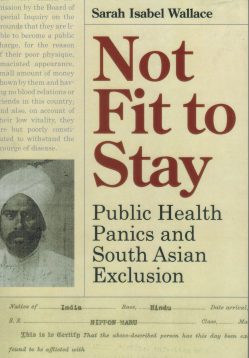
Not Fit To Stay acquaints modern readers with the “hookworm strategy” of immigration law. The facts are raw. Historian Dr. Isabel Wallace of Trent University is a skillful writer. The effect is startling. If bigotry is rooted in fear and economic despair, Wallace’s research proves even the mildest society is capable of devising something akin to the Nuremberg Laws.
More than a century ago Canada feared an influx of foreigners, especially South Asians bound for work in British Columbia’s lumber trade. A 1906 financial panic didn’t help.
The result was the “Hindu disease theory” embraced by legislators, media and trade unions, that South Asia was “a hotbed of the most virulent and loathsome” infections and its people were natural carriers of the plague, cholera, venereal disease, tuberculosis and smallpox. “From a sanitary point of view I consider them worse than the lowest class of Chinamen,” as Vancouver city health inspector Robert Marrion wrote in a 1912 report.
In everyday Canadian life fear of disease was rational and commonplace. Infant mortality rates were high. Sanitation was so rudimentary Ottawa suffered a 1912 typhoid epidemic that left 94 dead. Even the mildest infection was fatal and few diseases were curable. The doctor’s role was limited to fixing broken limbs, delivering babies and signing death certificates.
Add that to pre-Holocaust racialized views of moral fitness, and the consequence is a dark chapter of Canadiana. Author Wallace documents the incredible story with appropriate indignation and incredulity, and a reporter’s eye for detail. “India’s colonial status planted discourse on the ‘Hindu’ issue at the crossroads of medicalized nativism, eugenics and colonial theory,” writes Wallace. “In this context, charges of racial and genetic inferiority often spilled over into other, more sensational areas.”
In 1903 total South Asian immigration to British Columbia numbered 10. Within four years the number rose to 2,623. The country went berserk. South Asians “had not the faintest idea of sanitation,” wrote Pacific Monthly magazine. One daily told readers: “The average Hindu looks as though something has been gnawing at his insides.”
Frederick Blair, assistant deputy minister of immigration, described Indian immigrants as “a disgrace to any human being, that they are uncleanly in their habits, are afflicted with tuberculosis, and are addicted to drink.” It was Blair who later famously wrote of Jewish refugees in 1939: “None is too many.”
Prime Minister Wilfrid Laurier’s cabinet in 1908 enacted the “continuous journey” rule, a clever bureaucratic response to B.C. protests. It stated no foreigner could land in Canada except via non-stop travel, a regulation specifically aimed at Indians who had to disembark at Hong Kong for transpacific liners. “Laurier could not have anticipated the astounding success of the continuous journey legislation,” notes Not Fit To Stay. “Only about one hundred Indians entered Canada between 1908 and 1915.”
In 1912, false rumours that a boatload of Indians were to land in Vancouver on direct passage prompted the “hookworm strategy,” a confidential plan to test passengers for parasites as justification for immediate deportation. Author Wallace documents the secret telegraph orders from the Department of Immigration. They make compelling reading.
Not Fit To Stay is an extraordinary story, meticulously documented.
By Holly Doan
Not Fit To Stay: Public Health Panics and South Asian Exclusion, by Sarah Isabel Wallace; University of British Columbia Press; 292 pages; ISBN 9780-7748-32199; $32.95
Mortgage Claims Questioned
The Bank of Canada yesterday predicted little trouble with homeowners renewing mortgages at higher rates. Members of the Senate banking committee expressed unease with the sunny forecast: “If you talk to bankers they will always tell you Canadians will go to great lengths to make sure they can pay their mortgages.”



