Liberal MP Lori Idlout (Nunavut) remains a major shareholder in a company that received nearly $600,000 in federal contracts in the past five years, newly-released records show. The company runs Indigenous training workshops for federal employees: “This is a highly specialized training program.”
Monthly Archives: May 2026
Call RCMP On Bomb Threats
The Department of Foreign Affairs called police after bomb threats targeted a pro-democracy Chinese dance troupe, records show. An RCMP investigation is underway into threats by suspected Chinese Communist Party agents: “The department is aware of the very troubling bombing and mass shooting threats that targeted Shen Yun dance performances.”
A Poem: “Persephone”
Soft tones and the patina of civility,
A people avoiding hardness in a land,
Where the weather accommodated them.
Issues touched upon with a gentle hand,
Nothing too serious, too dark,
And always resolved by the end.
True reconciliation and a way forward,
Broadcast every week into,
The collective conscience.
To look back at it now,
With older eyes,
And knowing the lay of the land.
The lead was meant to be exemplar,
But in the end it was obvious,
That Relic was the hero.
By W.N. Branson

Book Review: The Vanished People
Mississauga, like Winnebago or Pontiac, is a vaguely colorful name popularized to describe the bland and conformist without much thought as to what it means or who it represents. Business reporters call this “branding.” In 1967 voters in a Toronto suburb chose “Mississauga” as the name of their city. Few knew then or now who the Mississauga were, or why they vanished.
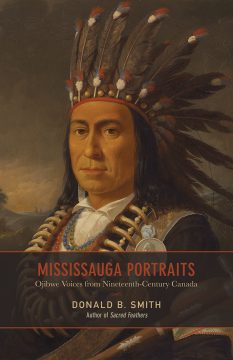
Mississauga Portraits is a rich, vibrant account of a people who thrived for generations on the north shore of Lake Ontario. Their whole history is erased from the landscape in the same way that revisionists would retouch a painting.
Historian Donald B. Smith recalls that, as a student finalizing his 1975 doctoral thesis, he looked up a 19th century portrait of the Mississauga’s Joseph Sawyer in the art collection of the Toronto Reference Library: “In the oil painting, the head chief of the Mississauga of the Credit appears strong and resolute, neither happy nor sad, without any apparent attitude.”
Years later, Smith makes a disturbing discovery. The chief’s portrait had been retouched to conceal his true expression. “The overpainting mistranslated the painter’s interpretation of his subject’s facial expression. Now, the chief’s look of dejection, deception and betrayal clearly emerged. This is the accurate image.”
The Mississauga hunted, fished and farmed on what is now Dundas Street West in Toronto, when the water was so clean you could angle for salmon. They produced maple syrup and paddled Lake Ontario by birch bark canoe. They also encountered settlers who gave these Ojibwe their mistaken Anglicized name of Mississauga, from ma-se-sau-gee, meaning “clan.”
All this ended by 1820, when the last of the Mississauga’s lands were expropriated for a keg of rum and an ox. “The Mississauga still had no idea of what buying and selling land meant, no idea of the implications of the agreement,” writes Smith, of the University of Calgary.
The epilogue is recounted in vivid detail in Mississauga Portraits. There was Chief Sawyer, who was driven to drink and became such a hopeless alcoholic he sold his own son as a farm labourer for a gallon of whiskey. The boy escaped, and father and son later reconciled.
There was Catherine Sutton, a Christian convert who travelled to London and petitioned Queen Victoria for help. “How can the poor Indian be civilized?” she asked. “As soon as he makes his land valuable then he is driven further back.”
And there was Maungwudaus, another Methodist convert. Out of work and with a family to feed, he organized a “Wild Indian” show and spent the rest of his life on tour. Maungwudaus played the Eastern U.S. where he presented President Zachary Taylor with a pair of snowshoes. He wowed London, where he dined with the Duke of Wellington, and played for royalty in Paris, the whole time jotting meticulous notes of his impressions.
French gentlemen, he said, “never shave their faces; this makes them look as if they have no mouths.” And the English? “The women cannot walk alone; they must always be assisted by their men. They make their husbands carry their babies for them when walking.”
Maungwudaus, like the Mississauga on the Credit River, vanished in the end. The people and their stories are preserved in the pages of Mississauga Portraits.
By Holly Doan
Mississauga Portraits: Ojibwe Voices from Nineteenth-Century Canada by Donald B. Smith; University of Toronto Press; 520 pages; ISBN 9780-8020-94278; $37.95
Illegalities Kept From Public
Investigators uncovered more than a dozen individuals who breached the Lobbying Act and were neither charged nor named publicly, Lobbying Commissioner Nancy Bélanger disclosed yesterday. “What am I supposed to do with that?” Bélanger asked the Commons ethics committee: “Some were former designated public office holders who should not have been lobbying.”
Rink Scheme Was “Historic”
A secretary yesterday described as “historic” an attempt by Governor General Mary Simon and her husband Whit Fraser to build a multi-million dollar skating pavilion at Rideau Hall. Corporate fundraising collapsed after Access To Information records exposed the scheme: “Cost estimates range between $4 million to $8 million.”
Question Contractors’ Waiver
The chair of the Commons government operations committee yesterday questioned why federal departments continue to do business with Lafarge Canada Inc. after former parent company executives were found guilty of financing terrorism abroad. “It seems to very clearly violate the Integrity Regime,” said Conservative MP Kelly McCauley (Edmonton West).
Skilled Trades Versus Robots
Skilled trades will survive a robotic future, says Privy Council in-house research. But federal focus group participants predicted overall unemployment will worsen by 2030, and most said cabinet was “headed in the wrong direction” on jobs.
Want Housing Costs Itemized
Costs of government fees and taxes hidden in the purchase price of new homes should be disclosed up front, builders yesterday told the Commons human resources committee. The industry has complained of exorbitant charges that typically add five to six figures to the cost of property: “Be transparent.”
Pull $3M From Homeless Vets
Housing Minister Gregor Robertson’s department transferred millions out of a program to aid homeless veterans after claiming it couldn’t find any ex-military in need. The transfer was done confidentially since it was “likely to generate negative stakeholder reactions,” said an Access To Information memo.

Spend $774,000 On Fiji Office
Cabinet spent more than $700,000 opening Canada’s first embassy in Fiji despite a pledge to “cut waste,” records disclosed yesterday. The mission was officially opened January 16 by visiting Liberal MP Randeep Sarai (Surrey Centre, B.C.), secretary of state for international development: “Understandably the establishment of a new diplomatic presence does incur costs.”
Sees Tax Dodges Everywhere
The cost of living has made tax evasion commonplace, a Liberal-appointed senator said yesterday. Senator Toni Varone (Ont.), a former contractor, told the Senate banking committee the black market is “affecting everything we do.”
Property Rights v. ‘Ideology’
Agriculture Minister Heath MacDonald yesterday expanded property rights for plant breeders with an initiative opposed by organic farmers. Only those with “longstanding ideological views” would deny patent holders more protection, said MacDonald’s department: “Property rights provide incentives for investment and innovation.”
Ownership Hits Postwar Low
Rates of home ownership for young families are at a postwar low, Statistics Canada figures showed yesterday. New data follow finance department research indicating nearly 40 percent of Canadians believe the nation’s best years are behind us: “Many had low expectations of the government.”
Federal Hack Costs Hit $8.7M
A federal judge yesterday approved an $8.7 million class action settlement over the 2020 hacking of thousands of Canadians’ tax and benefits accounts. Individual compensation ranges from $80 to $5,000: “Did these attacks not demonstrate there was a total failure?”