
Attorney General Sean Fraser yesterday said he “will occasionally” check if judicial appointees made political donations, but denied any partisan intent. “I will on occasion have a candidate’s political activities flagged before a final appointment is made,” he said.
Monthly Archives: June 2026
Warns Against Media Talks
Judges must beware of “potential danger” when discussing current events with reporters, Supreme Court nominee Glenn Joyal said yesterday. Joyal avoided reference to the Chief Justice’s criticism of the Freedom Convoy in a Québec newspaper, but said all judges must avoid editorializing: “There is a risk.”
Won’t Say Who Told Pollster
The Prime Minister’s Office yesterday would not say who gave an Ottawa pollster advance notice of an unusual proposal to finance public works through corporate donors. Pollster Bruce Anderson conducted a survey seven weeks before the announcement to gauge support for tax credits for donors who renovate 24 Sussex Drive: “My take based on these results is the approach announced by Prime Minister Carney will experience some, but pretty limited, opposition.”
Judge Faults Border Agency
An Ontario judge describes the Canada Border Services Agency as ineffectual in rounding up foreign fugitives. The remarks came in the case of an illegal immigrant repeatedly arrested, jailed, released and re-arrested for theft despite a 2022 federal warrant for deportation: “I have no confidence that the Canada Border Services Agency will actually deport.”
Deep Dive On Building Code
The Department of Natural Resources spent nearly $75,000 asking Canadians if they’d consider replacing home siding and roofing with fireproof materials. Regulators to date have stopped short of applying climate revisions in the National Building Code to existing structures: “The purpose of this project is to dive deeply into the intricate layers of Canadians’ perceptions.”
Needs Immigration “Results”
The Department of Immigration is eager to show it’s “delivering results” in a costly shelter program for illegal immigrants and refugee claimants, says an Access To Information memo to Minister Lena Diab. Managers complained of media focus and Opposition criticism of a hotel program that cost taxpayers billions: “Recent reporting and Opposition motions question overall costs.”
Immigrant Cases Jam Courts
The Federal Court says it will see a record 30,000 immigration cases this year, five times the average. Administrators served notice of long delays in paperwork affecting all plaintiffs and defendants: “This persistent surge is causing significant and sustained operational pressures on the Court.”
Feds Solicit Corporate Donors
A charity assigned to crowdfund renovations to 24 Sussex Drive will solicit donations from federally-regulated corporations, records show. Prime Minister Mark Carney, former director of the Rideau Hall Foundation, denied any conflict: “They will be raising funds.”
Not Sure About Realty Shares
Prime Minister Mark Carney faces a Commons ethics committee probe on whether he stands to personally benefit from a proposed $1.45 billion taxpayers’ bailout of distressed condos in Metro Vancouver. Carney told reporters he had no idea of whether trustees managing his stock portfolio were speculating in British Columbia real estate: “I actually don’t know whether or not I have an actual conflict, thank you.”
Museum’s Mere Propaganda
A Liberal-appointed trustee who quit the Canadian Museum for Human Rights over an anti-Israel exhibit says he was “berated by board members for my views.” Mark Berlin, former director with the federal Department of Justice, told a B’nai Brith podcast the Museum was “a tool of propaganda.”
Bank Rule For Depositors
Banks effective next year will be compelled to obtain depositors’ permission for electronic transfers. The anti-fraud measure follows legal rulings regarding bankers’ duty of care owed their customers: “The true number of fraud instances in Canada could be between 1.1 million and 2.2 million.”
Sunday Poem: Raise The Flag
Join the celebration
this Canada Day.
Do the little things
that make a difference.
A flag in hand;
a pin to the collar;
a red-and-white cap
visible from a distance.
Symbols of unity and independence;
all made in China.
By Shai Ben-Shalom

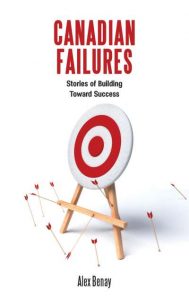
Review: Neither Fatal Nor Final
Canadians have a complex relationship with success and failure. That’s strange in a capitalist society where city life is a weekly succession of petty contests. Success is caricatured as a triumph of positive thinking that culminates in a prize, like winning on Dragon’s Den. Failure is a vaguely shameful exhibition of personal weakness: “The Morgans lost their house!”
Neither is accurate. Winners and losers strive, and even successful people fail from time to time. Billy Durant, the Michigan wagon maker who created General Motors, went bankrupt in 1936 and ended his career as manager of a bowling alley. It must have been a well-run bowling alley. Successful people like to run things.
Canadian Failures is a quirky, likeable analysis of why we so often get success and failure wrong. “Speaking only of accomplishments is taking the easy road,” writes author Alex Benay, former Chief Information Officer for the Government of Canada. “Failures define us as much as successes; they shape our national DNA, our culture and our creative spirit.”
Canadians celebrate insulin, Bell Telephone, snowmobiles, the paint roller and Robertson screw, but this misses the whole point, writes Benay: “We latch onto success and fail our nation by not engaging in a dialogue on failure.” Canadian Failures is neither a self-help book nor a celebration of plucky upstarts. It challenges our concept of failure as “a formless grey sky,” and candidly notes: “Not all failures have a silver lining.”
Contributor Dr. Frank Plummer, senior advisor to the Public Health Agency of Canada, recounts the disastrous blood scandal of the 1980s that saw more than 20,000 people contract HIV and hepatitis C from tainted transfusions improperly screened by the Red Cross. It was a “monumental Canadian failure,” writes Plummer, “one of the greatest preventable tragedies in the history of Canadian public health.”
“When the stakes are high, short cuts are risky and can result in harm to patients, to reputations and to trust in the health system at large,” writes Plummer. “Stab-in-the-dark processes drain resources away from other options, and rarely succeed.”
Canadian Failures compiles varied personal stories that underscore compelling themes. Winners are competitors who often lose. Winners share an appetite for hard work, immunity to public ridicule, and knack for self-correction. These are not extraordinary qualities. You’ll find them on any successful minor hockey team.
Unsurprisingly, the most profound contribution to Canadian Failures comes from Erica Wiebe, Olympic gold medal-winning wrestler. “In sport, failure is all but guaranteed,” writes Wiebe. “I made mistakes, failed often, and accepted that failure was never fatal or final.”
Wiebe was cut from Cadet National Team camp, went a year without scoring a point in practice, overslept for a Senior Canadian National qualifying match, and failed to qualify for the 2015 Pan American Games. A week before flying to Rio for the 2016 Summer Olympics, Wiebe suffered a panic attack that left her sobbing on a bathroom floor.
“Throughout my life, visualizing failure has been part of me,” writes Wiebe. “As a kid, I could imagine my house catching fire, and I would go through the various ways I could save myself and my dog and cat. (I guess my family members were going to be left to fend for themselves!) But, through those very early visualizations, I began working through possible outcomes. Later on, as an athlete, it was my ability to address failure and risk, and to persevere, that gave me strength to understand that failure is never final.”
By Holly Doan
Canadian Failures: Stories of Building Toward Success, by Alex Benay; Dundurn Press; 232 pages; ISBN 9781-45974-0433; $20
PM Denies Builders Lobbied
Prime Minister Mark Carney yesterday denied he was ever lobbied by developers to endorse a $1.45 billion plan to buy distressed Vancouver condos at taxpayers’ expense. Carney did not say if he personally held shares in any British Columbia development as he does in Ontario: “Mark Carney helped build this system.”
Call Ukraine ‘No Man’s Land’
The Department of National Defence in a newly-declassified report described Ukraine as a “no man’s land” of organized crime and political corruption. The confidential document was written in 1992 following the collapse of the Soviet Union: “Bribery and theft are rife.”