
A British academic book publisher is suing a Canadian librarian and his employer, McMaster University, for $3 million for alleged defamation in a blog post. McMaster in a statement said it “strongly supports the exercise of free speech.”
RCMP Sorry For Incident
The RCMP is apologizing over an “innocent” Parliament Hill encounter that provoked allegations of Muslim profiling. Majority Leader Sen. Marjory LeBreton vowed to investigate the “very alarming” incident, though police tell Blacklock’s it was an honest misunderstanding.
Legislation Ends 172-Year Practice: “I Am Suspicious”
The House has opened debate on legislation to end 172 years of practice in alerting Canadians to changes in federal regulations. Promoters of the bill have declined interviews. Critics fear the measure will permit rule-making by stealth: “I am suspicious.”

Review: A Hard Habit To Kick
A quarter-century after a federal health minister declared tobacco was socially taboo, it so happens that 5,764,843 Canadians still smoke. Industry Canada still grants patents for improved cigarette rolling machines. And for many aboriginal Canadians, cigarettes are “an important industry that helps to provide the needs of life,” writes journalist Jim Poling, Sr.
Lobster Quota Will “Tear Apart” Fisheries: Minister
Introduction of a lobster quota would “tear apart” Atlantic Canada, a Nova Scotia cabinet minister has told a Senate committee: “If you go down that road…you will see communities further deteriorate and erode.” The exchange came amid declining lobster prices, and new regulations that will cost fishermen $565,000 a year.
A $14,130 Phone Book
Telemarketers will be charged up to $14,130 for a copy of the National Do Not Call List under a fee schedule proposed by regulators: “We definitely want a commission that is able to focus on dealing with the bad apples.” Regulators will use the proceeds to pay enforcement costs.
Perhaps A Little Too Clean
An anti-bacterial ingredient used in scores of products like soap, toothpaste and cosmetics is now under federal review following nearly a decade of health warnings. Environment Canada says it must decide if triclosan is “toxic.”
Water Bill Clears House
A bill to outlaw the transboundary sale of bulk water to the United States has passed the House of Commons with all-party support. Violators who ship more than 50,000 litres a day — “no larger than a tanker truck” — face million-dollar fines and federal prison.
Rail Reforms To Correct “Power Imbalance”: MPs
Long-awaited shipping reforms affecting the movement of millions of tonnes of goods will require detailed amendments to curb the influence of large railways, say MPs: “There is no competition. The shippers are captive.”
Parents: It’s Your Fault
Parents and teachers are to blame for young Canadians’ gullibility in falling victim to predatory financial practices, say lawmakers. Senate hearings on a government bill to appoint a federal “financial literacy leader” erupted in laments over the ignorance of young credit-card holders and uselessness of educators: “Basically it is adding and subtracting.”
Mom Wins Child Care Case
The Federal Court has ruled childcare is grounds for protection under the Canadian Human Rights Act, in the case of an Alberta mother fired for refusing a work reassignment because she had to tend to her children. A federal judge called it “a prima facie case of discrimination.”
Drive-Thru Licensing?
A federal proposal to speed licensing times for vitamins and natural health products may not be the best for consumers, say advocacy groups. The Department of Health proposes that licensing be shortened to 180 days or less compared to current waits of two years.
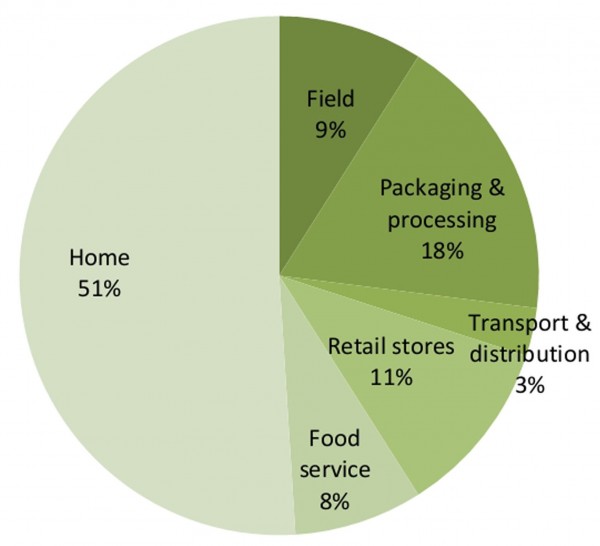
One Unappetizing Pie Chart
Canadians are urged to curb food waste following a new national study that estimates $27 billion worth of food is pointlessly spoiled each year – the equivalent of $774 for every person: “It makes no sense — ethically, economically or environmentally.”
“Who Is Responsible For What”?
Tough-on-crime legislation and other campaigns by senior levels of government have added half-a-billion dollars to the cost of municipal policing, say Canada’s cities.
The Federation of Canadian Municipalities, in a submission to the Commons’ public safety committee, said downloading has left local police departments with unsustainable costs.
“Legislative changes at the federal and provincial levels impact on the cost of providing local police services,” said Berry Vrbanovic, past-president of the federation; “Local police forces are dealing with crimes that were once the exclusive purview of the RCMP.”
The federation estimates policing costs nearly doubled between 1999 to 2009, to some $12.3 billion nationwide.
“Front-line police are seeing frustrating trends as cracks with Canada’s mental health and homelessness systems play out in our streets,” Vrbanovic told MPs. “Studies have shown the police have become society’s 24-7, de-facto front line mental health workers. Municipalities do not have the reach or resources to take on more, or to address the social and economic factors that affect crime rates.”
Vrbanovic said it is difficult “to find efficiencies and effectiveness in policing when we don’t have a clear understanding of who is responsible for what and who is paying for what.”
The Department of Public Safety last month convened a summit, Strengthening Canada’s Policing Advantage, to review crime-fighting costs.
Sixty percent of policing budgets are carried by local ratepayers, by federation estimate. 
By Staff
‘Worst Procurement Ever’
Defence analysts in Ottawa are observing “the worst procurement in history,” the refit of Canada’s fleet of search-and-rescue helicopters that is now into its third decade. Review of the purchase has dragged on through five successive prime ministers: “It is time to consider other options.”