
Federal judges have upheld a $20,000 cap on compensation for pain and suffering under the Canadian Human Rights Act. Legal commentators including now-Governor General Louise Arbour had criticized the limit set a generation ago by Parliament: “Removing the cap on damages would go a long way to increase access to justice.”
A Sunday Poem: “Imagine”
You envision a world
of perfect harmony.
Show me two individuals
able to be in one room
without a conflict –
and I’ll show you
two liars.
By Shai Ben-Shalom

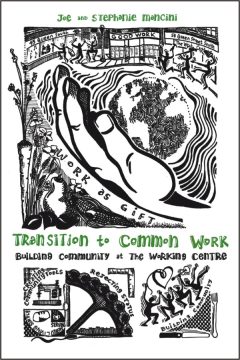
Book Review — The Welfare State
Poverty is called a trap, though millions of Canadians have escaped it using subtle methods. The Department of Employment, an anti-poverty agency, is not good at this. “The welfare state, which imposes order from above and requires specific outcomes, fails on many levels,” write Joe and Stephanie Mancini. “Access to basic necessities of life is often denied because someone does not fit into bureaucratic categories, or because they cannot navigate complex rule-based systems.”
The Mancinis’ Transition To Common Work is a crisp critique of the welfare state written by a devoutly Catholic husband and wife committed to aiding the poor. This is not a rant about the dole. It is an eloquent account of the subtle, human remedies for despair.
At the Working Centre in downtown Kitchener, Ont., founded by the Mancinis in 1982, “we became known as the place to go where there were few other options,” they explain. What do visitors say? “‘My brother died in Hamilton and I am trying to find bus fare and clothing so I can go to the funeral.’ ‘My daughter is in a hospital just outside London and I would like to visit her. Is there someone I could pay to drive me there two times a week?’ ‘I am new to Canada and I am trying to find work as an engineer.’ ‘I am living in my car but I have a dog, so I have to find a job quickly so I can find a place to live.’”
This is where the Mancini method works and Employment Canada fails. No check-off bureaucracy can resolve the small, immediate crises that are the burden of the workaday poor.
At one point the couple attend an Employment Canada workshop where managers provide a fixed answer for the jobless: “Unemployment could be beaten by an organized and meticulous job search,” Transition recounts. “The jobs are out there, the system works, and it’s up to the unemployed to work hard to find them. What else could the government say? This was the same service that was paying out Unemployment Insurance claims. The Canada Employment Centre was designed with carrots and sticks. Part of its mandate was to help the unemployed find work, but it could also suspend benefits if the job search was not up to undisclosed standards.”
Later the Mancinis count the job listings at the Kitchener unemployment office. There were 560 with nearly a quarter of the postings part-time: “The bulk of the jobs paid low wages for unskilled labour. When we published these details in our newsletter, we received a letter from the Canada Employment Centre manager demanding that we never count the jobs board again.”
Instead they created the Working Centre. It runs a thrift store and bicycle repair shop, market garden and café. It serves a no-charge lunch and rents apartments at sub-market rates. It issues a quarterly newsletter Good Work News, and draws funding from an annual Mayor’s Dinner and a golf tournament where unions sponsor foursomes and a big prize table. It is “a non-judgmental place that offered hospitality and support for the unemployed,” without bureaucracy.
Transition To Common Work is fresh and candid. It concedes failure. The Mancinis opened a recycling depot that bundled paper and metal for scrap dealers. At its peak it employed 12 and generated $20,000 a month in revenue till it collapsed in the teeth of the 1991 recession: “We started with altruistic notions about recycling and sought companies and individuals eager to recycle their waste,” they write. “We learned that paper mills had no loyalty and treated us like second-class citizens, and that equipment salespeople had their own agenda.”
“The initiative had no value in itself,” Transition concludes, a lesson lost in so many anti-poverty programs. “We concluded that private and public bureaucracies expend vast sums of money administering systems that are often second rate or unimaginative and that governments tie up tax money in highly unproductive activities.”
Transition details the subtle, human methods a Kitchener couple used to better their city. It works. They proved it. In 2014 the Mancinis received the Benemerenti Medal from the Pope for outstanding service to society.
Transition to Common Work: Building Community at The Working Centre, by Joe & Stephanie Mancini; Wilfrid Laurier University Press; 232 pages; ISBN 9781-7711-21606; $14.99
No Comment On New Lake
An international agency, the Great Lakes Commission, yesterday had no comment after U.S. President Donald Trump ordered the renaming of Lake Ontario as “Lake America.” The purported change takes effect in 30 days: “This is official.”
Fresh Air Puzzle Cost $99,927
The Department of Health paid a pollster nearly $100,000 to ask Canadians what environmental steps they took to get fresh air in the home. The most popular response: “Open a window.”
Feds Silent On Tariff Rewrite
Cabinet yesterday abruptly revised its list of American imports subject to retaliatory tariffs to remove 25 percent duties on fish and seafood products. Finance Minister François-Philippe Champagne gave no reason when asked by reporters: “What message does it send to Americans?”
Hajdu Failed Workers: Audit
An internal report is faulting Labour Minister Patty Hajdu’s department for poor service and growing backlogs of unresolved complaints under the Canada Labour Code. “Backlogs have increased significantly,” wrote auditors.
Paid $488M For 228M Trees
Taxpayers paid $487.9 million to plant 228 million trees under the now-disbanded Two Billion Trees Program, records show. Official figures counted millions of saplings scheduled for planting in national parks that were not actually planted: “The program made strong progress.”
Challenge PM On Google Tax
A newly-registered Commons petition yesterday challenged Prime Minister Mark Carney to reinstate a $3.7 billion Google tax he suspended 14 months ago as “part of a bigger negotiation” with the United States. Collapse of trade talks cleared the way to revive the tax approved by Parliament, wrote petitioners: “This tax concession has yielded no lasting benefit.”
Billable Hours Increased 24%
Costs of lawyers’ billable hours on land claims and other Indigenous litigation went up 24 percent after then-Prime Minister Justin Trudeau disbanded the old Department of Indian Affairs to create two new departments, figures show. “Roles and responsibilities are not always understood,” wrote auditors.
Proposed Nuclear War A-List
Civil defence planners in 1954 proposed drawing up a “brains and skill” A-list of gifted Canadians to be saved in case of nuclear war, newly-declassified records show. People whose intelligence was deemed essential would help rebuild a postwar world, said a secret memo: “Special facilities should be provided to preserve the lives of persons whose intelligence and experience may be essential.”
Hero’s Tribute After Park Fire
Ron Hallman, the $327,000-a year Parks Canada CEO responsible for forest management, was given a hero’s farewell in retirement with an Army band and testimonial by a former prime minister, Access To Information records show. No mention was made of the disastrous 2024 Jasper fire: “Showcase Ron’s accomplishments.”
OK Deer Cull At Historic Site
Cabinet yesterday approved a rare deer cull at a national historic site. The Department of Environment in a legal notice called it a question of public safety: “A controlled cull was determined to be the most effective approach.”
Tariff Assessments Must Wait
Taxpayers must wait until a fall budget update for details of costs to households and industry from retaliatory tariffs, Finance Minister François-Philippe Champagne said yesterday. Cabinet detailed a limited $7.5 billion aid package that business groups dismissed as cumbersome and ineffectual: “Is Canada still committed to a fiscal anchor?”
Suspect Another Bridge Story
Conservatives yesterday invoked Prime Minister Mark Carney’s misrepresentations over the Gordie Howe International Bridge in demanding he now disclose terms proposed by Canada to avert a continental trade war. Carney secretly agreed to toll concessions as “a good deal for Canada,” then denied the terms and called toll splitting proof of erratic behaviour by Americans: “Transparency is essential.”