
A Russian-owned tractor factory has won a Tax Court claim for a six-figure federal tax credit. Buhler Versatile of Winnipeg avoided blacklisting under cabinet’s Russian sanctions: “We are very aware of Russian interests in Canada.”
Poem: “Feeling Like Einstein”
In the Patent Office,
young Einstein gets bored.
His job repetitive.
His mind seeks intellectual stimuli.
He finds inspiration
in the nearby clock tower.
Without leaving his desk
he conducts thought experiments
where space and time intertwine.
Relativity is born.
Today
I haven’t left my desk.
My job repetitive.
My mind needs stimuli.
I look at the clock,
wonder if Jennifer from Accounting
is free for lunch.
By Shai Ben-Shalom

Review: Comms
Years ago a friend of mine, a defence contractor in a spot of trouble, asked: “How can I manipulate media?” It was a blunt, honest question deserving a response in kind. “You can’t,” I replied, not from any claim to newsroom virtue but in observance of Lincoln’s Law that nobody can fool all the people all the time. If public opinion was that malleable, every movie would be a blockbuster, every book a bestseller. every political candidate a winner. Focus group failure speaks for itself.
Yet the myth persists. The lure of manipulation as an expedient problem-solver is irresistible. As every gambler has a “system” so every bureaucracy has a “media strategy.” The practitioners are known as comms guys, communication directors.
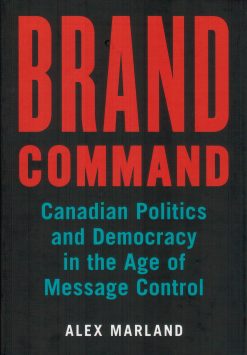
Professor Alex Marland of Memorial University is a former comms guy. Brand Command is a compilation of conventional wisdom unexpected in what purports to be a scholarly work. Here are comms guys’ essential themes.
First, digital media are now so lightning-fast it almost defies human comprehension. “There are fewer gatekeepers, less verification of claims, more gossip, more noise and less time to think,” writes Marland. He cites the “turbulence brought by social media” and “cacophony of urgent demands.”
The same could be said of the underwater cable introduced in 1858, the launch of commercial radio (1920). first teletype (1927), the first affordable fax machine (1980). In the 1870s results of the Derby were telegraphed from London to Calcutta in 12 minutes flat. Media have sped along at an industrial pace ever since.
Brand Command further asserts corporate media are all-powerful. “Television still dominates Canadians’ primary source of news and information,” Marland writes. He quotes a fellow comms guy, “You used to be able to wait for a news story to develop. Now it’s not even a matter of it happens and then you respond.” A CBC executive says, “Everything’s changed because of the internet, the timing of things; news come out 24/7.”
In fact the audience for CBC-TV’s The National has fallen 50 percent in a generation. The network’s flagship all-news cable channel draws spot ratings of 85,000, a third the listeners of the AM radio station in my hometown.
Confronted by the Kung Fu spectre of rapid electronic media, Marland concludes politicians and comms guys are able to manipulate messages and public opinion itself. “Branded communications save time for both the sender and the receiver by simplifying information for a disparate audience,” Marland writes. “Complex topics are distilled into messaged themes”; “However, branding threatens idealized notions of democratic government and party politics. It harmonizes and dumbs down. It requires strict message control and image management. Above all, public sector branding contributes to the centralization of decision making within the prime minister’s inner circle.”
This was a timely thesis in 1953 when Liberal managers transformed Louis St. Laurent from a dour corporate lawyer into a silver-haired grandfather. Staffers even had St. Laurent pose on a swing with a toddler. The strategy didn’t save St. Laurent in a1957 election. Easy come, easy go. In 1965 “branders” told Lester Pearson to lose his trademark bowtie after focus group testing suggested it made the Prime Minister appear effete.
Still Brand Command stands fast. Readers are told media manipulation is hip, now, happening. Marland has a breezy style uncluttered by contradictory research. An example: “Containment of off-message remarks in Canadian politics is now an art form,” he writes, citing a 2014 statement by an MP that legislators should use miniature video cameras to “prevent besmirchment”: “Apparently the MP was so worked up into a state of paranoia about inopportune encounters destabilizing his personal brand and the party’s brand that his anxiety and poor judgment did just that,” Brand Command states. The incident raised questions “about the state of Canadian democracy in the digital age.”
This is demonstrably misleading. I knew the MP in question, libertarian Peter Goldring. In 2011 he was falsely charged by an Edmonton constable with impaired driving. Goldring suffered public embarrassment and expulsion from the Conservative caucus till his acquittal in 2013. Goldring liked mini-cams because he didn’t trust Edmonton police. The omission of these facts by Professor Marland is striking.
By Tom Korski
Brand Command: Canadian Politics and Democracy in the Age of Message Control, by Alex Marland; University of British Columbia Press; 528 pages; ISBN 9780-7748-32038; $39.95
No Cop Probe Of Vote Claims
The RCMP yesterday said it did not conduct any criminal investigation of alleged Chinese interference in the 2019 federal election. Members of the House affairs committee said the testimony was not reassuring amid repeated claims of illegality: “I am very, very frustrated right now with the lack of information.”
‘Cannot Stand Just Transition’
Labour Minister Seamus O’Regan yesterday said Canada needs more oil and gas workers, not fewer, and cursed cabinet’s “just transition” climate retraining program. “I can’t stand the phrase ‘just transition,’” said O’Regan: “We asked workers in Saskatchewan and Alberta to figure out how to get oil out of sand and by God they did it.”
Vote To Keep Paper Balloting
Most Canadians oppose internet voting, says Elections Canada research. A Liberal Party proposal for voting by smartphone was rejected by the House affairs committee prior to the 2021 campaign: “A majority agree that voting over the internet should not be an option.”

Here Are Budget Buzzwords
Cabinet polled for popular catchphrases in anticipation of its spring budget, records show. Most Canadians surveyed in Privy Council focus groups said buzzwords were unlikely to solve economic troubles: ‘Most were of the view economic problems facing Canadians were quite complex.’
Minister Signs Ethics Pledge
Trade Minister Mary Ng has signed a “conflict of interest screen” pledging to never award another sole sourced contract to a longtime friend and CBC-TV pundit. The written pledge followed testimony at the Commons ethics committee that rated contracts for Amanda Alvaro as unusual: “The Ethics Commissioner and I have agreed.”
Feds Research Nt’l ID Scheme
Prime Minister Justin Trudeau’s Privy Council Office commissioned confidential research on a national electronic ID system. No reason was given. Parliament has repeatedly rejected any mandatory identification program as intrusive and costly: ‘Adoption may be difficult especially among Canadians already distrustful of public institutions.’

Caught Skirting Access Law
Federal Comptroller General Roch Huppé ordered managers to “be careful what you write down” to avoid creating records subject to Access To Information. The remarks were made in a teleconference with chief financial officers: “They have to be careful.”
“Slavery Was Here”: Minister
Canadians should educate themselves on slavery even if it was outlawed here decades before Confederation, Equality Minister Marci Ien yesterday told reporters. “It doesn’t matter who was in charge,” said Ien.
Bill Called Covid ‘Whitewash’
The Commons yesterday by a vote of 176 to 142 gave Second Reading to a bill critics called a bid to whitewash federal mismanagement of the pandemic. The private bill sponsored by Liberal MP Nathaniel Erskine-Smith (Beaches-East York, Ont.) proposed that cabinet appoint a committee to review itself: “Canadians will never get the answers they deserve.”
Keep Up Fight For Fee Caps
Small business yesterday appealed for a cap on billions’ worth of credit card fees charged retailers. The Department of Finance for more than a decade has permitted Visa and MasterCard to set their own rates under a voluntary Code Of Conduct: “Who do we work for?”
It’s Broken Says Budget Office
The federal government is “broken” and bungles basic tasks with little cabinet scrutiny, Budget Officer Yves Giroux said yesterday. “There needs to be a crack of the whip, big time,” he said: “Hold the government to account. I cannot do this just by myself.”
Gov’t Fails In-House Polling
Cabinet is on the wrong track and appears overwhelmed by events, Canadians tell pollsters in Privy Council in-house research. Participants in federal focus groups also gave cabinet a failing grade in tackling inflation: “Very few participants believed the Government of Canada was currently on the right track.”