
The Department of Justice yesterday acknowledged Russia had no involvement in the Freedom Convoy. False claims of large amounts of foreign funding and disinformation by Russian agents were not supported by any proof, government lawyers wrote the Public Order Emergency Commission: “There was no evidence.”
Find No Excuse For Cronyism
Trade Minister Mary Ng yesterday apologized but would not resign after admitting she directed sole-sourced contracts to a longtime friend and CBC-TV pundit. The Minister’s misconduct was an inexcusable breach of the Conflict Of Interest Act, said the Ethics Commissioner: “There is simply no excuse.”
China Election Probe Sputters
Cabinet yesterday said it did not know the names of 11 federal candidates allegedly targeted by Chinese Communist agents in the 2019 election. The House affairs committee to date has been unable to uncover any new evidence regarding claims of campaign meddling: ““I don’t have this supposed list of 11 candidates.”
Free Speech Is Okay, “But…”
Prime Minister Justin Trudeau “believes in free speech, but” is upset by social media content that is “difficult to counter,” he said. Trudeau’s remarks follow a proposal to regulate legal internet content deemed hurtful: ‘The problem arises when disagreements are built on wrong facts.’
Used Border Controls Twice
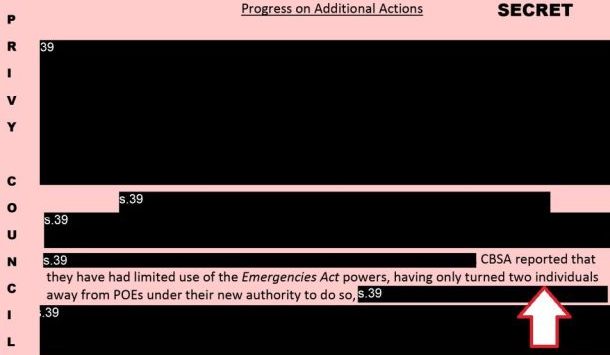
Only two Freedom Convoy sympathizers were intercepted at the border under the Emergencies Act, according to secret cabinet committee minutes. The Canada Border Services Agency claimed it needed emergency powers to keep out American neo-Nazis: “It is unclear police have these powers under common law.”
Governor’s Office Misled MPs
Governor General Mary Simon’s office and other federal staff misled the Commons government operations committee over true costs of a junket to Dubai, say MPs. One aide who claimed she dined on ordinary airplane food yesterday admitted the menu included Beef Wellington: “You got caught red-handed.”
Cynical About Budget Ritual
Canadians have “considerable cynicism” about cabinet’s annual ritual of Budget Day promises, says in-house research at the Department of Finance. Pollsters observed what they called “estrangement from the budget” for some taxpayers: “There was considerable cynicism.”
Report Zero Max Jail Terms
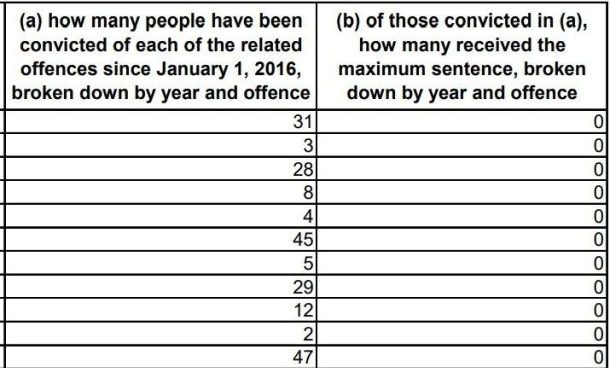
A maximum 10-year federal prison sentence for gun running has never been imposed, records show. Public Safety Minister Marco Mendicino proposed to increase the maximum to 14 years to send a message to organized crime, he said: “That measure ends up being a little bit meaningless.”
Emails Ridicule Mark Carney
RCMP privately ridiculed a claim by Mark Carney that the Freedom Convoy was seditious. Carney in a Globe & Mail column appeared to pull the definition of “sedition” from an online U.S. dictionary, not the Criminal Code: “It would be a stretch.”
Called RCMP Over Facebook
A Manitoba credit union called police on a depositor who was not “deemed illegal” but liked the Freedom Convoy in his Facebook posts, records show. And an unnamed bank reported one customer’s credit card purchase of a gas mask. The incidents are detailed in documents on the scope of an Emergencies Act account freeze: “It won’t come as a surprise.”
Chief Dodges Vax Complaints
Privacy Commissioner Philippe Dufresne in an Ottawa speech said Canadians have a “fundamental right to privacy” but made no mention of vaccine mandates. The Commissioner gave no deadline for his ruling on Privacy Act complaints that governments had no right to require disclosure of medical information as a condition of employment or use of public services: “Privacy is one of the key challenges of our time.”
Loan Stress Test Stays: Feds
The federal bank inspector is maintaining a steep “stress test” on new mortgage buyers amid a dramatic rise in loan rates. Calls to eliminate the test were understandable but risky, said Peter Routledge, Superintendent of Financial Institutions: “We see great risk in speculating on the mortgage cycle.”
Conceal “Because They Can”
Canada rates among the worst in concealing federal books from taxpayers’ scrutiny, says the Parliamentary Budget Officer. “In comparison to other G7 countries Canada was among the last to publish their financial accounts,” Yves Giroux wrote the Commons government operations committee: “Because they can, just because.”
Sunday Poem: “Kingmaker”
I open the cupboard,
reach for a mug.
My mind –
ahead of me –
sees coffee in it.
I hesitate.
In a moment of clarity
I return it to the shelf,
revoke its destiny,
choose another.
Because I can.
By Shai Ben-Shalom 
Review: Rebels
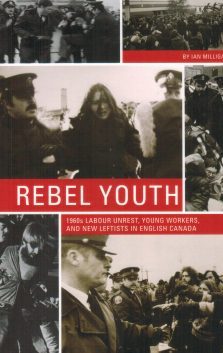
Finally, the plain truth about Canada in the 1960s. Our collective memory of this decade is so coloured by American imagery of Vietnam and Martin Luther King, the distinctive Canadian experience is forgotten even by those who lived it. Ian Milligan, professor of history at the University of Waterloo, corrects the record through meticulous research and interviews.
It was the decade of the union. “Canada’s 1960s were profoundly shaped by labour,” Milligan writes. “Skyrocketing labour unrest captivated young people, their elders, the media, and governments alike.”
Most Canadians had never had it so good: full employment in an economy geared to wartime production without any casualties. Mining and manufacturing ran red-hot. “If you could walk almost, you could get a job at Inco,” one United Steelworkers organizer recalled. Sudbury mines hired 200 men a day.
The country was overwhelmingly young – half of Canadians were under 25 – and blue collar. Only 12 percent of baby boomers went to college or university. The decade of rebellion was a generational clash between long-hairs and hard hats. One recalls a Westinghouse factory in Hamilton, Ont.: “When I started working there in ’73 every young guy in the plant, almost 99 percent, were on dope and had long hair, and had all sorts of cultural revolution attitudes, you know? They listened to the same music, Led Zeppelin.”
“Young workers spearheaded rank-and-file opposition to managers and unions alike,” Milligan notes. “A surging economy had flooded large industrial employers with new recruits who had no traditional connection to union or employer and little sense of material deprivation.”
The result was extraordinary.
In 1966 the country lost more than 5 million work days to wildcat strikes and lockouts, a record to that time. When 1,300 members of the Canadian Brotherhood of Railway, Transport & General Workers threatened to shut down the St. Lawrence Seaway, cabinet agreed to a 30 percent wage increase. Seaway workers were back in 1968 with a demand for 20 percent more, including a doubling of holiday pay. “We are trying for a social breakthrough,” one told a reporter.
The post office hadn’t seen a strike since 1924 saw one in 1965, then in 1966, 1968, 1974, 1975 and 1978. In one wildcat strike at a Chrysler plant, six thousand autoworkers downed tools in a “jurisdictional dispute over welding torches,” as Milligan puts it. “Workers expected to their torches to be lit by the previous shift; when one group arrived and found them unlit, the men refused to light them themselves and walked out.”
Union greybeards were exasperated. “Dialogue in many cases has broken down because of the ‘generation gap’,” the president of the Ontario Federation of Labour lamented in 1969.
Donald MacDonald, president of the Canadian Labour Congress, was characteristically blunt: “Advocates of workers’ control want to use union workers as shock troops to establish the dictatorship of the proletariat in Canada. What that really means is that a few intellectuals would rule by telling workers what is good for them.”
Professor Milligan puts it smartly: “The Sixties need to be understood through the prism of labour, and our contemporary labour movement in many ways is a child of that period.”
By Holly Doan
Rebel Youth: 1960s Labour Unrest, Young Workers, & New Leftists In English Canada, by Ian Milligan; University of British Columbia Press; 252 pages; ISBN 9780-7748-26884; $32.95