Ottawa Lost: “The Big Man”

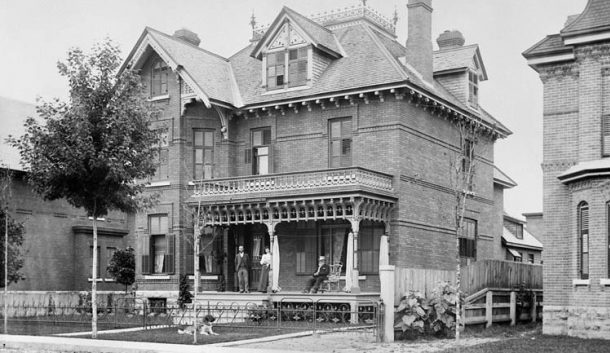
Near Ottawa City Hall at the corner of Cooper and Cartier Streets lived an unforgettable prime minister, Charles Tupper. His grand home like so much of the city’s architectural heritage is gone. Yet Tupper is oddly immortal.

His autograph lists on eBay for $4,950. In Parliament his portrait peered down over the main entrance to the Commons foyer. Across the country there are Tupper schools in Halifax and Vancouver where the basketball team is called the Tupper Tigers. There is a Tupper icebreaker in the Coast Guard, a Tupper township in Ontario, a Tupper Mountain in British Columbia.

The post office designed a Tupper stamp in 1955 and printed up 50,000,000 copies. The National Film Board once produced a Tupper movie, The Big Man. In painter Robert Harris’ famous composite portrait of the Fathers of Confederation the mutton-chopped Tupper stands as the most prominent figure in the foreground. Interestingly, he was prime minister only two months.

Tupper bought the house at 123 Cooper Street in the spring of 1896. It was an exclusive address. The home was built for the manager of the Bank of Ottawa.

Tupper became prime minister in May that year. On Cooper Street he plotted a disastrous election campaign in June that cost the Conservatives 35 seats including Tupper’s own Cape Breton riding, and here he sulked until resigning as prime minister in July.

“It was a hopeless task,” recalled Hector Charlesworth, a newspaperman who covered the ’96 campaign. Tupper assumed the premiership in the twilight days of a creaking Conservative dynasty 18 years in office. No Tory could have won that election, Charlesworth recalled: “Tupper was one of the greatest and most farseeing statesmen this continent has produced.”

Tupper was the nation’s sixth prime minister and the most fearsome. He once punched a man who interrupted his Bible reading. He was the first prime minister to speak Greek and Italian, the first to publish his memoirs, Recollections of Sixty Years in Canada, the first to use lapel buttons in an election campaign.

As a self-made millionaire he was founding president of Crown Life. As a gynecologist he was founding president of the Canadian Medical Association which annually sponsored a Charles Tupper Award for Political Action.

As public works minister Tupper oversaw construction of the Canadian Pacific Railway. It was said he accepted $100,000 in payoffs. “They were a hungry lot in Ottawa then,” as one railway promoter put it.

In Tupper’s old hometown of Amherst, N.S., the Cumberland County Museum and Archives reported 5,000 visitors a year came to see Tupper’s desk. There is no such shrine at the corner of Cooper and Cartier Streets in Ottawa. Instead they put up a Holiday Inn.

By Andrew Elliott

Book Review: A Gangster Funeral

Lost to history is the state funeral of Generalissimo Trujillo, strongman of the Dominican Republic, shot by assassins in 1961. Canadian diplomat John Graham attended the mass. “The only people in the entire church without guns were the clergy and the diplomatic corps,” he recalls.

Fearful that rebels would seize the corpse for public display, Trujillo’s henchmen hoisted it from the church by helicopter winch. “The Generalissimo’s coffin swinging in the air was a moment of unbearable, transcendent mystery for the dazed and credulous mourners below,” writes Graham. Only later did diplomats learn Trujillo wasn’t in the coffin. They’d stuffed it with an unknown corpse while preserving El Presidente in a freezer for quiet burial.

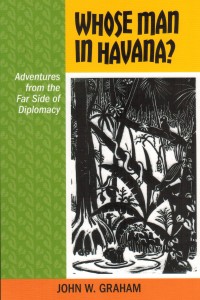
So goes Whose Man In Havana?, the memoirs of a man who served a lifetime in the foreign ministry. Graham’s writing is warm and personable with anecdotes from an era when Canada briefly walked on the world stage.

“When I first joined the foreign service in the late Fifties I caught the tail end of the much-ballyhooed Pearsonian golden age,” says Graham. “Although not always golden, it was a good time to be in External Affairs. The good times dipped a few times, but they did not come to an end with Mr. Pearson’s departure.”

Canada in the Fifties had a Nobel Peace Prize, the fourth largest air force on earth and an aircraft carrier, HMCS Magnificent. The British Empire was bankrupt, Europe was in ruins and America was desperate for Cold War friends. “In the post-war period, Canadians entered a time of prosperity that their forebears and indeed, most of the fellow inhabitants of the world had never dreamed of,” historian Craig Brown wrote in his 1987 Illustrated History of Canada.

Parliament thought nothing of buying Avro Arrow jets at $6.6 million a pop and driving defence spending to 40 percent of the federal budget. This was the heyday of Canadian diplomacy, Graham writes: “It is a term that invites abuse and is best avoided, but seen from the second decade of the twenty-first century, those years appear bathed in gilded light.”

It was an era when Canadian diplomats on the Latin beat packed pistols for safety. Graham recalls the assistant trade commissioner’s Chevrolet Impala was burned by Dominican street rioters in 1961. In Cuba, Graham spied for the CIA by sketching suspicious Soviet military installations: “When the mission was over I sometimes wondered whether I had reported anything significant in the acutely nervous Cold War context,” he writes. “I don’t know – Langley never told me – but I doubt it.”

Whose Man In Havana? is not a lament for a bygone era. It is a collection of reminiscences by a talented storyteller that leaves readers with indelible images like the massacre of black dogs in Haiti on rumours a Vodou spell had been cast over a corrupt local official named Duval. “A Priestess declared she had used her sacred Vodou powers to transform Duval into a dog, a black dog,” Graham explains; “The gardener told me no black dog is safe in all Port-au-Prince.”

By Holly Doan

Whose Man In Havana? Adventures from the Far Side of Diplomacy, by John W. Graham; University of Calgary Press; 328 pages; ISBN 9781-5523-8242; $34.95

Afraid Truckers Packed Guns

Parliament Hill police mistakenly feared Freedom Convoy truckers were armed and would try to break into federal buildings. Legislators last night questioned why MPs and senators were permitted to walk freely among protesters if the convoy was considered violent: “I don’t recall every seeing anything come out that would make me fearful.”

This content is for Blacklock’s Reporter members only. Please login to view this content. (Register here.)

Predict Prices Fall Up To 23%

An expected October interest rate hike could send average home prices down as much as a fifth this year, the Parliamentary Budget Office said yesterday. “Average income households across the country are stretching their finances,” wrote analysts: “Households that recently purchased a home have become more financially vulnerable.”

This content is for Blacklock’s Reporter members only. Please login to view this content. (Register here.)

‘This Govt’s Mismanagement’

Canadians should not blame “this government’s mismanagement” for the rising cost of living, cabinet’s representative in the Senate said yesterday. “The struggles Canadians are experiencing are real,” said Senator Marc Gold (Que.). “They are not the function of this government’s mismanagement.”

This content is for Blacklock’s Reporter members only. Please login to view this content. (Register here.)

Gov’t Probes Racist Managers

The Department of Immigration yesterday said it will investigate whether foreigners were treated unfairly by racist managers. It follows a 2021 report that found executives made crude remarks about lazy Mexicans and immigrants from “dirty” African countries: “Within our department these problems do exist.”

This content is for Blacklock’s Reporter members only. Please login to view this content. (Register here.)

Mothers Oppose Cabinet Bill

A cabinet bill to permit negotiated sentences for drunk drivers sends a terrible message, say Mothers Against Drunk Driving. The bill would abolish mandatory minimum sentences for dozens of crimes: “We do feel it’s important in terms of denunciation that a message be sent to the public.”

This content is for Blacklock’s Reporter members only. Please login to view this content. (Register here.)

Big Grocers Deny Profiteering

A grocers’ lobbyist yesterday denied allegations of profiteering. Profit margins in the retail food trade average three percent, the Commons finance committee was told: “That is a lower rate than just about any other industry, certainly lower than food manufacturers and big agriculture.”

This content is for Blacklock’s Reporter members only. Please login to view this content. (Register here.)

Home Equity Tax Is Patriotic

Homeowners who paid down mortgages and built up equity should “demonstrate allegiance” by paying more tax, says a CMHC consultant. The remark in a confidential email by Professor Paul Kershaw of the University of British Columbia was obtained by homeowners’ advocates through the Freedom Of Information Act: “You must be joking, buddy.”

This content is for Blacklock’s Reporter members only. Please login to view this content. (Register here.)

Debt Costs To Double: Giroux

Rising interest rates will see a doubling of federal debt charges within four years, Budget Officer Yves Giroux last night warned the Senate banking committee. New figures indicate interest on the federal debt will eclipse the military budget next year and keep on rising: “That is something that will have a major impact on public finances.”

This content is for Blacklock’s Reporter members only. Please login to view this content. (Register here.)

Media Face Crisis Of Mistrust

Media subsidies have provoked historic mistrust of reporters, the Commons heritage committee was told yesterday. The best-known federal subsidy, a $595 million payroll rebate and tax credit scheme for cabinet-approved publishers, expires in 2024: “People who today think media are toadying up to the Liberal government will at some point in the future believe they are toadying up to someone else. It doesn’t really matter whether they are or they aren’t. What matters is people won’t believe them.”

This content is for Blacklock’s Reporter members only. Please login to view this content. (Register here.)

Bill Mandates CBC Disclosure

The CBC faces mandatory disclosure of top salaries for announcers and executives under Broadcasting Act amendments proposed yesterday by Senator Percy Downe (P.E.I.), a Liberal appointee. It follows disclosures the CBC paid itself $30.4 million in pandemic bonuses while petitioning cabinet for more subsidies: “I do have a concern about transparency.”

This content is for Blacklock’s Reporter members only. Please login to view this content. (Register here.)