
Candy maker Mars Canada Inc. has won a $144,600 Federal Court judgment against marijuana dealers who sold cannabis-laced edibles under a copycat Skittles label. A federal judge condemned the cannabis dealers: ‘It represents a marked departure from ordinary standards of decent behaviour.’
Gov’t Knew Of Short Staffing
Transport Minister Omar Alghabra knew last spring the federal airport security workforce was short-staffed by 25 percent, according to a briefing note. Alghabra at the time blamed airport delays on Canadians eager to travel: “Does that mean we have a shortage?”
No Drugs In The Office: Feds
Naloxone kits will not be distributed in federal buildings in case of drug overdoses, says a Treasury Board report. Federal employees should not be taking drugs at the office, the Board said: “Employees are expected to report fit for work.”
Local Bylaws Can’t Veto Feds
Municipalities cannot block federally-approved projects under the guise of bylaw enforcement, an Ontario judge has ruled. The decision came in the case of the Town of Milton, population 112,000, that tried to block a railway megaproject already licensed by the federal cabinet: “Federalism may require tolerance and cooperation where people may not wish to be tolerant or to cooperate.”
Warn CRTC Power Too Broad
Cabinet must curb CRTC powers under a YouTube regulation bill, says a coalition of unions and publishers. Bill C-11 An Act To Amend The Broadcasting Act would grant the Commission too much authority without oversight, it said: “The fears are varied.”
Tam Likes Monkeypox Grants
Canadians required to self-quarantine due to monkeypox should receive federal aid, says Dr. Theresa Tam. The remarks by the chief public health officer followed estimates the virus has resulted in 28 hospitalizations in Canada: “Support people who do the right thing.”
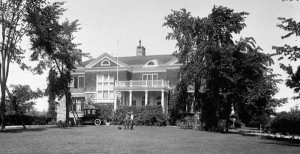
Ottawa Lost: A Hero’s Home
Why do some landmarks escape the wrecking ball, and others not? Gone forever is the Ottawa home of Robert Borden, WWI prime minister depicted on the $100 banknote. In 1962 it was pondered as a possible National Historic Site. In 1971 it was demolished by Cadillac Fairview Developments to make way for a grey complex with an unfortunate name, the Watergate Apartments.
It was “Glensmere,” a Queen Ann Revival mansion at 201 Wurtemburg Street on the Rideau River; for 31 years a place of repose and happiness for Borden and his wife Laura. Built in 1894 on park-like grounds, it was designed by the same British-born architect who designed the ornate interior of the Library of Parliament, Frederick J. Alexander. Glensmere was a generous combination of wood and stone, projecting gables and a wraparound verandah.
As prime minister Borden ended his workday by walking three kilometres from Parliament Hill home to Wurtemburg Street. Here this modest man spent contemplative moments gardening, bird-watching and practicing his golf swing. Here Borden entertained VIPs and plotted Canada’s war through two tumultuous terms.
“No Canadian prime minister faced quite the same preponderance of grave problems as proved his lot in wartime,” wrote a newspaperman in 1937. “At heart he was a man of simple tastes, unpretentious and democratic despite the wealth of high honours properly bestowed upon him.”
Maclean’s readers in 1927 voted Borden among the “greatest living Canadians.” When he died in 1937 grieving war veterans stood with heads bowed outside the Glensmere home and all along the road to Borden’s grave at Beechwood Cemetery. “Life is vain,” Borden wrote. “Life is short.”
Borden bought Glensmere in 1906. The house then was as unaffected as the man. It was so drafty a radiator froze and burst his first winter in the place. Borden complained the street was pot-holed, the grounds were a “jungle” of weeds and the city had left a derelict graveyard across the street overgrown with bushes where “undesirable characters” liked to hang out.
He spent the rest of his life improving the home and property. When the city reclaimed the neighbouring graveyard as a park Borden had it named in honour of John A. Macdonald.
In 1942 Borden’s nephew sold Glensmere to the Chinese Nationalist Government. It remained a legation until 1970, when it was lost to the wreckers.
In a cruel joke on Borden’s memory, a splendid house next door to his prized Glensmere not only stands but is now protected. Yet there is no plaque to commemorate Canada’s wartime prime minister lived on Wurtemburg Street. All that remains is an old iron fence with Gloucester limestone pillars, a silent sentinel to what once stood here.
By Andrew Elliott

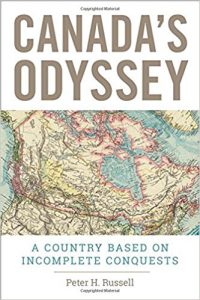
Review: Land Of Revolutionaries
The greatness of Canada is that it’s even here. We’ve had every reason to be at each other’s throats for 155 years yet kept the federation together. Anyone who doubts the achievement should ask Czechs and Slovaks, Tutsis and Hutus, Irish Catholics and Irish Protestants, Confederates and Yankees. The roll call of nations that absorbed bitter factionalism without revolt or disintegration is a very short list.
Canada’s Odyssey: A Country Based On Incomplete Conquests documents this remarkable story. In 1867 the Dominion Bureau of Statistics estimated the population was 28 percent French with few surviving Indigenous people, about 118,000. Today it is 22 percent French and the Indigenous population has grown tenfold.
“Canadians have not agreed that they belong to a single ‘people’ whose majority expresses the sovereign will of their nation. The holdouts are the French Canadians and members of the nations indigenous to North America whose historic lands are in Canada,” writes author Peter Russell, professor emeritus at the University of Toronto’s political science faculty.
Russell explains: “These Canadians do not accept that the tide of history has somehow washed away these nations of their first allegiance or diluted their constitution significance. Their enduring presence as ‘nations within’ Canada is fundamental to understanding Canada, as is the often troubled, uncomfortable accommodation of the ‘nations within’ by the country’s English-speaking majority.”
The Canadian experience is one of incremental adjustment and maddening deliberation. This remains a hard place to get things done. Professor Russell cites the example of radio.
The first Broadcasting Act was introduced in 1932 only after a Royal Commission, one Supreme Court reference – who has jurisdiction over radio waves? – and a ruling of the Judicial Committee of the Privy Council. “There was some doubt about the issue because, of course, there was no mention of radio in the British North America Act,” notes Russell.
Canada’s Odyssey chronicles the teeter-totter of the past 155 years with a warm narrative and compelling facts. By example: John A. Macdonald wanted Canada proclaimed a “kingdom.” It was the British who suggested “dominion.”
The 1864 Charlottetown Conference was the invention of Lord Stanmore, later governor of Fiji. When Stanmore died in 1912 the Globe & Mail knocked his obituary down to a single paragraph. Also, cabinet in 1914 prohibited traditional aboriginal dancing in public and in 1927 passed regulations forbidding First Nations from hiring their own lawyers.
And the most incredible fact of all: Canada in 1867 was 93 percent English and French. By 1961, the proportion of descendants of the so-called founding peoples was down to 74 percent. Today it is 66 percent. We are slightly revolutionary after all, writes Russell.
“Canada has not returned to the quest for a big bang, popular resolution of all its constitutional concerns – and let’s hope it never does,” says Russell. “That kind of constitutional politics may be appropriate for a country based on a single founding people. But Canada, a country based on incomplete conquests, is clearly not such a country.”
By Holly Doan
Canada’s Odyssey: A Country Based On Incomplete Conquests, by Pete Russell; University of Toronto Press; 544 pages; ISBN 9781-4875-02041; $39.95
New Climate Code Will Cost
Climate change rewrites to the National Building Code will have a cost impact, the National Research Council warned yesterday. The Council said it will hire consultants to calculate the additional expense for new home construction: “Until we talk real numbers we can’t talk reality.”
Claim ‘Work At Home’ Saves
The Department of Public Works says taxpayers could save a fortune on office space if federal employees continue to work from home. The department has estimated 230,000 staff are working remotely: “Infrastructure is the second largest expense to the Government of Canada after salary expenses.”
Don’t See Plastic As Problem
Canadians rate plastic a lesser environmental risk than marijuana smoke or flushing prescription drugs down the toilet, says in-house Department of Health research. Only a third of Canadians, 34 percent, said they worry about single use plastics: “Fewer are concerned.”
Marijuana Tax Topped $250M
Federal excise taxes on marijuana totaled more than a quarter billion a year prior to the pandemic, according to Canada Revenue Agency tables. Cabinet had pledged to initially limit its share of taxes to $100 million a year to aid provinces with enforcement expenses: “Organized crime does not share its data with us.”
Crash In Family-Run Business
The number of family-run small businesses crashed in Canada from pre-pandemic levels, the Department of Industry said yesterday. The figures are the latest to gauge the scope of the small business recession: “There has been a substantial decline in the percentage of small and medium sized enterprises owned by members of the same family.”

Historical Purge Targets Bell
A federal board is reviewing posthumous honours for Alexander Graham Bell due to his “controversial beliefs,” according to records. Bell died a hundred years ago. Designation of Canadian landmarks like the Halifax Citadel and Crowsnest Pass are also up for review under a cabinet policy against “colonialism, patriarchy and racism.”
Feds Do Not Drive Canadian
Most vehicles in cabinet’s multi-million dollar motor pool are American made, records show. Prime Minister Justin Trudeau had pledged to ensure “vehicles of the future are made right here in Canada.”