
The Department of Public Works yesterday said it would begin compiling a list of women-owned firms for preferential treatment in contracting. The year-long pilot project, starting with catering services in Atlantic Canada, is intended to “support socio-economic objectives”, wrote staff.
Claim Slipshod Army Probe
A senior manager is suing the Department of National Defence alleging unfair treatment on a staff complaint. The manager was cited for wrongdoing but never given a chance to face her accuser, according to a Federal Court claim: “You have a right to see a disclosure.”
Feds Test Rivers For Mercury
Environment Canada yesterday ordered years of water sampling to monitor the spread of toxic mercury in northern waterways. The program comes a year after cabinet ratified a United Nations treaty on mercury: ‘Do we have the tools in place?’
Lobbyist-Paid Interns Banned
Ethics Commissioner Mario Dion has ordered MPs to stop using lobbyist-paid interns in their Parliament Hill offices. Use of free labour sponsored by corporations is a breach of the Conflict Of Interest Code, wrote Dion: “They are not volunteers.”

Gov’t Stole Trademark: Judge
The Federal Court in an unusual ruling has cited a government agency for stealing a private company’s trademark. The Ontario Ministry of Energy ignored repeated warnings and mistakenly claimed it couldn’t be sued for adopting a 2013 slogan, “empower me”.
Grocer Gets $1.4M Eco-Grant
The Department of Natural Resources has awarded $1.4 million in climate change funding to a supermarket chain. The grant follows similar funding earlier awarded to corporations including Sears Canada and McDonald’s: “It just so happens to be located in a Liberal Minister’s riding.”
Don’t Visit For The Food
Foreign tourists don’t come here for the food though fish and game are nice, says a Department of Industry report obtained through Access To Information. “We can’t be everything to everybody,” said a research study. The department has tried since 2017 to develop an all-Canadian cuisine as a tourism draw: “It’s easy to find McDonald’s.”
Tech Superclusters Poll Badly
Most businesses don’t understand a federal “Innovation Superclusters” program and question its usefulness, says in-house research by the Department of Industry. Canadians said they’d never heard of the plan detailed in cabinet’s 2017 budget: ‘They did not understand what a supercluster was.’
OK More Sole-Source Deals
Cabinet proposes to give itself broader powers to award billions in federal contracts without competitive bidding. The Treasury Board is increasing by 60 percent the maximum value allowed on sole-source contracts, the biggest increase in 22 years: “Departments were strongly in favour.”
No SWAT Team Enforcement
A federal agency will not use SWAT team tactics to enforce a cabinet bill on accessibility complaints, says the Canadian Human Rights Commission. The bill allows for spot inspections of federally-regulated businesses to ensure they do not discriminate against the disabled: “It’s less a SWAT team and more an inspector.”
Promise To Inspect Big Co’s
Environment Canada promises to reform its chemicals inspections program, but not until 2020. Auditors cited the department for spending more time auditing small businesses like dry cleaners than large industrial polluters: ‘Priorities were not based on risks to human health.’
Seven Years Of Thanksgiving
We’re grateful this holiday to friends and subscribers for your support as Blacklock’s embarks on a seventh great year of independent, all-original Canadian journalism. On behalf of reporters and contributors, please accept our thanks.
A Poem: “Black And White”
Costly to keep the pandas
in Toronto Zoo.
$3 million shelter renovation
plus
$2.6 million annual maintenance, including
$150,000 insurance
$238,000 staffing
$550,000 food flown in from Memphis
$1 million hosting fee to China.
Now they reside in Calgary Zoo
at even greater cost.
$30 million habitat and infrastructure.
State-of-the-art enclosure
– 21,000 square feet of indoor-outdoor space –
featuring a waterfall, lush vegetation,
both heated and cooled rocks
for utmost comfort.
In the back, a nursing den
in case of pregnancy.
Fresh food from the mountains of China
– nine varieties of bamboo –
flown in twice a week
for $1.5 million annually.
Hosting fee
grows to $1.4 million.
Meanwhile at Canada-U.S. border crossings,
asylum seekers from Haiti and Nigeria.
They cause a housing crisis,
says Ontario Premier.
We should not pay for that situation,
says Ontario Social Services Minister.
We have no more room for migrants,
says Toronto Mayor.
(Editor’s note: poet Shai Ben-Shalom, an Israeli-born biologist, examines current events in the Blacklock’s tradition each and every Sunday)

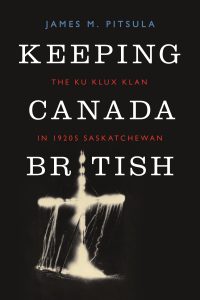
Review: The Klan On The Prairies
Of all skeletons hidden in the nation’s attic, few are as strange as the Saskatchewan Klan. For a brief period in the 1920s the KKK thrived with rallies and cross-burnings. In no other province did Ku Kluxers achieve such prominence.
Yet the organization was never as influential as mythology suggests, nor as sadistic as its U.S. namesake. Historian James Pitsula does not document a single homicide attributed to the Saskatchewan Klan, where organizers seemed satisfied to wear idiot hoods and tell Catholic jokes.
“It held public meetings and sent out charismatic lecturers, almost in the style of evangelical preachers,” writes Prof. Pitsula, of the University of Regina. “It created drama and excitement with a hint of romance and danger.” The Klan’s Saskatchewan leader was a Regina accountant. Its members included the police chief in Melville, Sask., and MP Davy Cowan, a dentist who served two terms as Conservative member for Long Lake, Sask.
Keeping Canada British is an intriguing rummage through historical memory in which Pitsula invites readers to seek and find answers: who joined the Klan and why?
Actual membership in the Saskatchewan KKK from its founding in 1926 is disputed; the Regina Leader Post has published estimates from 10,000 to 45,000. “The Klan was known to exaggerate membership figures,” notes Pitsula. In 1927 when the KKK claimed 46,500 members in the province, Pitsula calculates it was closer to 4,700, possibly peaking at 20,000 or so by 1929.
Sociologists theorize that bigotry is driven by economic failure. Was it a coincidence the KKK’s rise in Saskatchewan came amid the collapse of the wheat boom? Pitsula does not mention the possibility, though the fact remains between 1919 and 1930 wheat prices fell from an average $2.37 a bushel to 44¢.
“It was a bottom-up, grassroots version of British Canadian nationalism that empowered lower middle-class and upper working-class individuals,” Pitsula explains. They were small-town Protestants who bristled at the waves of immigrants, more than 148,000 of them, who landed in Saskatchewan in the 1920s.
Klan sympathizers, he writes, “saw themselves as being on the losing side” of the postwar era. “They thought the war had been fought to keep Canada British, but now, in the postwar period, foreign immigrants were arriving in Saskatchewan in such numbers that the country was ceasing to be British.”
It was this very upheaval that kept the Klan in check. Cross-burning went only so far in a province that was 29 percent Catholic and Greek Orthodox.
Numerous researchers insist the Klan helped defeat Saskatchewan’s Liberal government in 1929, though here the evidence is uneven. Conservative Premier James Anderson was no race-baiter. No known Klansmen were elected to the legislature, though four Catholics were; and the era was hard on incumbents anyhow. Of all Canadian premiers in office in 1928 only two – Manitoba’s John Bracken and Quebec’s Louis-Alexandre Taschereau – remained in office five years later.
Regardless of embellishment, the saga of the Saskatchewan KKK remains an odd and disturbing curiosity. It is worth a trip to the attic.
By Holly Doan
Keeping Canada British: The Ku Klux Klan in 1920s Saskatchewan by James M. Pitsula; University of British Columbia Press; 308 pages; ISBN 9780-7748-24903; $32.95
Gov’t Won’t Oppose Pot Bans
Cabinet now says it will not object if any First Nation bans legal cannabis under the Indian Act. The same would not apply to ordinary municipalities, said Border Security Minister Bill Blair. Members of the Senate aboriginal peoples committee asked cabinet to put it in writing: “Yes, of course, the ability to ban is something you may want to discuss.”