
The Commons public safety committee by unanimous vote has agreed to investigate RCMP murder-for-hire allegations against the Government of India. “A criminal is a criminal and a Canadian is a Canadian,” said Conservative MP Jasraj Singh Hallan (Calgary Forest Lawn): ‘This is something the Sikh community has been talking about for more than 40 years.’
Canada A Fentanyl Exporter
Canada is a net exporter of fentanyl, says the Department of Foreign affairs. Canada “is now a source and transit country for fentanyl to some markets,” said a department briefing note: “Domestic production is likely exceeding domestic demand.”
China Film Was Poorly Timed
Newly-declassified records show then-External Affairs Minister Joe Clark personally cancelled a showing of the film The Last Emperor at the 1989 grand opening of a new Canadian Museum of Civilization. “Too sensitive,” said Clark, noting the film was to be shown only days after the Tiananmen Square massacre: “The Prime Minister noted the shock that most Canadians had experienced.”
Sunday Poem: “Lockdown”
Stay indoors.
Shelter-in-place.
No one to enter this facility
without photo ID.
Emails
from Integrated Services;
Government Operations Centre;
the Program Manager.
Spokesperson says
the Prime Minister is safe.
Outside,
contract painters finish lunch,
apply a second coat
to the building’s exterior.
By Shai Ben-Shalom

Book Review: The Go-Getters’ Guide
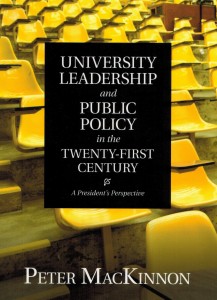
If one of the keys to happiness is learning how the world works, University Leadership would be an essential text. It is wry, self-deprecating and likable. They might have marketed it as a self-help guide on governance but that would have meant redesigning the cover, say with a thunderbolt and exclamation marks and a snappier title like Yes! You Can!
Instead readers are treated to very Canadian observations like this: “We are reluctant to declare high ambition, whether because we are unable to speak with one voice or we fear repercussions from falling short. Perhaps there is more to the amorphous cultural arguments than we care to admit: Canada is a solid, middle-of-the-pack performer because that is where Canadians are most comfortable. Even if true, however, middle-of-the-pack performance is no longer assured, if ever it was.”
Author Peter MacKinnon is former president of the University of Saskatchewan. He held the post for 13 years. MacKinnon took some shots. There were threatened strikes, and squabbles with legislators, and media accounts of how much he spent on travel. “University presidents do not have an official opposition – just an unofficial one,” he quips.
“I knew that university presidents often think their words are more influential than in fact they are,” MacKinnon writes. “In general, their audiences listen respectfully and occasionally not affirmatively; sometimes they may even applaud. It is tempting to conclude that an issue has been identified and framed and that those who are involved will follow up. The reality is that words are soon forgotten as members of the audience return to their daily tasks.”
The University of Saskatchewan is a good school. Its faculties are among the best. In postwar years its teaching staff grew fivefold. “Many of the new recruits were excellent; many were not,” MacKinnon writes. “The university’s productivity did not keep pace with its growth and its responsibilities as the only medical-doctoral university in the province.”
University Leadership naturally orients itself to campus life, though MacKinnon correctly observes this is not so different than other ventures. “Governments are large and complex, but so are universities,” he writes; “Like all human institutions, they have their peculiarities, vulnerabilities and weaknesses.”
“But their great strength lies in the fact that it is the merit of an idea that commands respect in a university – not a voice of command, a pronouncement on morality, or a threat of punishment. In a world that witnesses too many commands, pronouncements and threats, institutions that value ideas, debate and reasoned conclusions are beacons that give us confidence that we as human beings have a future and that it can be a bright one.”
Speaking of ideas: University Leadership proposes the nation’s schools like the country itself seek pre-eminence in selected fields. “Beauty exists in the eye of the beholder,” MacKinnon writes. “Pre-eminence is not. It means the best in the world”. He has no quarrel with soliciting corporate donations so long as donor agreements are public. He suggests plainer disclosure of student costs with identifiable returns, and is sharply critical of blandness. Canadian universities “tout greatness more often than it is deserved,” he says.
University Leadership is fresh and useful to anybody who yearns to know how the world works, without thunderbolts or exclamation marks.
By Holly Doan
University Leadership and Public Policy in the Twenty-First Century: A President’s Perspective, by Peter MacKinnon; University of Toronto Press; 208 pages; ISBN 9781-4426-16110; $24.95
Tait To Explain CBC Bonuses
Catherine Tait, $497,000-a year chief executive of the CBC, has been summoned Monday by the Commons heritage committee to explain why managers pocketed millions in bonuses while cutting 346 jobs and pleading financial hardship. Tait’s own bonus is worth 20 percent or about $100,000 annually, according to records: “A lot of things have made you unpopular.”
MPs Outraged By Fed Fakery
MPs yesterday expressed outrage over slipshod federal management of a program intended to set aside five percent of contracts for Indigenous businesses. The Assembly of First Nations has complained of widespread fraud: “Anybody can walk in the door and say, ‘I’m Inuit,’ ‘I’m Métis’ or ‘I’m First Nation’ without any verification.”
Freeland Missed Target 17%
Finance Minister Chrystia Freeland missed this year’s deficit target by 17 percent, the Budget Office said yesterday. Debt servicing charges are now the fastest growing budget line item: “It is not our money, it is the money of Canadians, and they quite rightly expect us to be really thoughtful.”
PM Promises To Do His Work
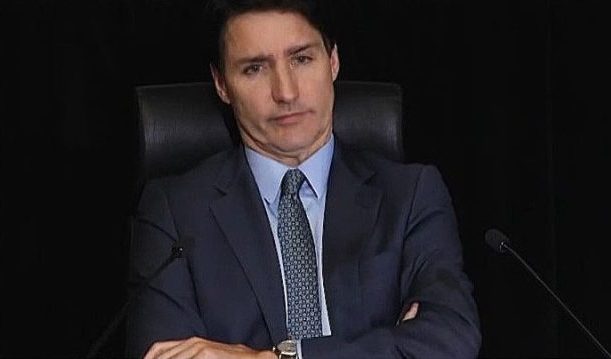
Prime Minister Justin Trudeau in a sworn statement to the Commission on Foreign Interference says he now starts his work week by reading 45 minutes’ worth of security memos every Monday morning. The statement follows criticism Trudeau ignored explicit warnings Chinese Communist Party agents posed an “existential threat to Canadian democracy.”
Wanted To Privatize VIA Rail
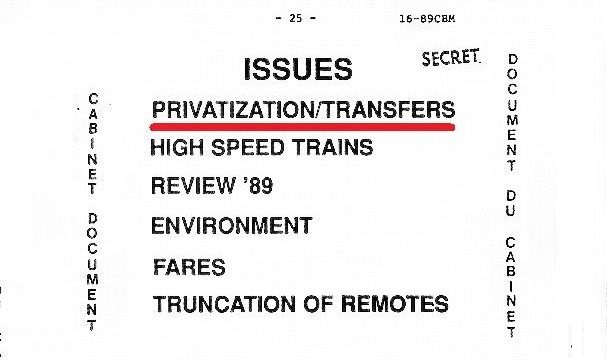
Cabinet 35 years ago called VIA Rail an “exorbitant” expense for taxpayers that should be privatized, according to newly-declassified 1989 documents. Members of then-Prime Minister Brian Mulroney’s cabinet rated the Crown railway unaffordable: “All privatization proposals will be considered.”

Blacklisted But OK’d To Run
MP Han Dong (Don Valley North, Ont.) was blacklisted from any cabinet appointment after coming under security surveillance, the Commission on Foreign Interference disclosed yesterday. Cabinet aides confirmed Dong was deemed unfit for promotion yet twice ran for office as a member of the Liberal caucus until media divulged his China contacts in 2023: “Don Valley North comes to mind.”
Name Names, Trudeau Told
Conservatives yesterday demanded Prime Minister Justin Trudeau name names after he said he had “explosive” top secret evidence Opposition members were acting for foreign agents. “Release the names,” said Opposition Leader Pierre Poilievre: “Share it with the public.”
Free Benefits For Gazans Here
Gazan refugees who arrive in Canada will receive free health care, language training, free work and study permits and other unspecified “financial assistance,” the Department of Immigration said yesterday. It would not disclose the cost: ‘This will help Gazans as they arrive across Canada.’
Didn’t See Tax Revolt Coming
Newly-declassified 1989 records show then-Finance Minister Michael Wilson assured cabinet “there was no revolt” by taxpayers over his introduction of the GST. A groundswell of opposition subsequently reduced Wilson’s Progressive Conservative Party to two seats in Parliament: “There was no ‘revolt’ building against the GST.”
Probe Is Foiled By Algorithms
Computer algorithms are bypassing a costly national rail safety measure mandated by Parliament, the Transportation Safety Board disclosed yesterday. Crash investigators cited three incidents including near misses in which key information was lost: “In all three of these occurrences the trains were operating near the border with the United States.”