
A federal judge has upheld one of the steepest fines ever levied for breach of migrant labour regulations. An Alberta contractor was fined $153,000 and banned from the Temporary Foreign Worker Program for five years after failing a spot inspection: “The process was fair.”
Guilbeault’s Dep’t Fails Audit
Federal auditors cite Environment Minister Steven Guilbeault’s department for poor oversight of millions spent on green subsidies. Management of taxpayer funds was so sloppy it represented “potential legal and reputational damage,” said a report: “We observed significant issues.”
Met Secretly With Informants
The judge leading the China inquiry has disclosed she held 22 secret meetings with immigrant communities “willing to share their experience” on intimidation by foreign agents. Commissioner Marie-Josée Hogue said she could not give public notice of her meetings for fear of endangering informants: “For security reasons these meetings took place in private at undisclosed locations.”
MPs Target Clark Testimony
The Department of Foreign Affairs faces demands to explain internal documents showing New York Consul Tom Clark was personally involved in buying an $8.8 million Manhattan penthouse at public expense. Clark repeatedly denied having anything to do with the purchase: “You would have us believe you said absolutely nothing and nobody asked?”
Fear Gangland Crime Wave
Canadians report an epidemic of gangland crime despite millions in federal grants under a Guns and Gang Violence Action Fund. In-house research by the Department of Public Safety found a fifth of people surveyed said they personally knew of gang violence: “Seven in ten agree Canada has a gang violence problem.”
Prison Vote Was Crucial: Data
More than 150,000 Canadians are eligible to cast ballots today in two federal byelections including a Manitoba riding where the prison vote once influenced the outcome. Cabinet earlier blamed “hard times” for the loss of a safe Liberal seat in a June byelection in Toronto: “Do you think the Liberals need a radical change in strategy?”
Sunday Poem: “Dear Mrs. B”
We regret to inform you
that your son has died this morning
when securing a road
south of Kandahar.
The Improvised Explosive Device
gave him no chance.
He who set the device
was in our hands
the hours before the explosion;
he refused, however, to disclose
the exact location of the bomb,
and we did not want to torture
or become uncivilized
when seeking this kind of information.
We respected his right to remain silent.
You may find comfort knowing
that he is resting now
after discussing his options
with his lawyer.
Your son died for a noble cause,
Mrs. B –– .
By Shai Ben-Shalom

Review: You’re Not In Germany
If aliens invaded, a prime minister’s first duty would be to get premiers on the phone. Airspace is clearly federalized under the Aeronautics Act. But what if invaders land on islands and travel by ferry to terrorize the populace? If it’s a British Columbia ferry, that is provincial jurisdiction. Newfoundland and Labrador ferry, federal.
The space enemy may use laser beams to make trees explode or boil mountain lakes. That is clearly provincial jurisdiction. But let one errant death ray touch a single rivet on a railway trestle and you are dealing with the Government of Canada, my friend.
This is “the incredible fragmentation we have in this country among federal, provincial and municipal governments,” as then-Senator Howard Wetston (Ont.), a former federal judge, once put it. Wetston was referring to regulation of light bulbs.
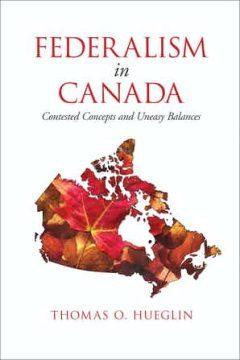
Federalism In Canada puts all the pieces together but with a striking difference. Scholar Thomas Hueglin is not from here. Hueglin is German-born. With a completely open mind, he did what every political scientist should do: jump in the car.
“One could not understand Canada nor its bewildering literature on federalism without having seen it, the vast spaces separating one region from the other,” writes Hueglin. “In southern Germany, where I grew up, one could drive to five countries within a few hours. Just to get out of Ontario took almost exponentially more time. With distance came diversity.”
“In Winnipeg I saw the railyards connecting the two halves of the country,” recalls Hueglin; “In Calgary I was shown the new PetroCan building as a sinister symbol of Trudeau’s centralist machinations.” This was 1983.
Hueglin discovered the traveler’s secret hidden from Ottawa, “a remote lumber town.” Nobody who drives from Winnipeg to Vancouver is struck by the all-seeing presence of the federal government. Hueglin spent a week reading the Saskatoon Star-Phoenix and found a single reference to Ottawa. “The physical distance between Ottawa and Saskatoon is nearly 3,000 kilometres and neither city is anywhere near the edge of the country,” he writes.
Federalism In Canada is fresh and matter of fact, a constitutional travelogue. The genius of Canada is the pride and purpose of the provinces, so different one from the other. Scholars for years have argued whether this was a happy accident or a reflection of the genius of Fathers of Confederation. Professor Hueglin falls into the “happy accident” camp, but 154 years of success speaks for itself.
“Confederation not so much constituted a universal agreement on first principles as it was a working compromise allowing for different interpretations for each of the participants,” writes Hueglin. The contrasts between participants are striking.
“I crossed from Saskatchewan into Alberta, two provinces a world of political culture apart yet indistinguishable from one dusty Prairie town to the next,” writes Hueglin. The same could be said of Nova Scotia and Prince Edward Island, Yukon and the Northwest Territories.
Our country is “an agreement cobbled together,” writes Hueglin. “Remarkable,” he concludes. “All through its history there have been and still are deep disagreements about the meaning of federalism,” and for all that here we are in Year 155.
By Holly Doan
Federalism in Canada: Contested Concepts and Uneasy Balances, by Thomas O. Hueglin; University of Toronto Press; 384 pages; ISBN 9781-4426-36453; $54.95
Warn Consul To Get Packing
Opposition MPs yesterday told New York Consul Tom Clark to “keep your bags packed” after the next election. Testifying at the Commons government operations committee, Clark denied any role in the federal purchase of his $8.8 million Manhattan penthouse despite documents to the contrary: “Why don’t we just stop the lying?”
Hands Off Pilots, Says NDP
New Democrats yesterday said they will fight any federal interference in an Air Canada strike or lockout. Failed contract talks with some 5,400 members of the Air Line Pilots Association would ground planes nationwide as early as next week: “If you want to make it a confidence vote, make it one.”
‘Were Hungry But Didn’t Eat’
Almost a tenth of Canadians surveyed in federal focus groups say they now worry about running out of food. In-house research also identified people who said they were “hungry but did not eat.”
Gov’t Censor Bill Challenged
Attorney General Arif Virani faces a direct challenge over cabinet’s signature bill to censor speech on the internet. Conservative MP Michelle Rempel Garner (Calgary Nose Hill) yesterday said an alternative Opposition bill will target online crimes without “putting a chill on Charter-protected speech.”
Prison Costs Now $428 A Day
Operating costs at federal prisons last year were the equivalent of $428 per inmate per day, according to Statistics Canada figures. The Correctional Service cautions actual expenses are much higher when including equipment, prison guards’ pensions and other costs: ‘Canada’s is among the highest resourced correctional systems in the world.’
Faith In Fed Gov’t Collapsing
A majority of voters outside Québec do not trust the Government of Canada and rate it secretive and incompetent, says in-house Privy Council research. The pre-election findings follow Prime Minister Justin Trudeau’s statement that “Canadians’ need to have faith in their government’s honesty.”
Now Sudden Death Overtime
Opposition Leader Pierre Poilievre yesterday said he will compel the Commons to vote no confidence in cabinet as soon as possible and send voters into a fall election. It is “put up or shut up time for the NDP,” Poilievre told reporters: “Which will it be?”