
Liberal MPs on the Commons health committee yesterday rejected a public inquiry into federal pandemic management. Cabinet favoured instead a closed-door review by advisors to the Minister of Health: “Canadians will never get the answers they deserve.”
Kill SNC-Lavalin Probe 7 To 3
A majority of the Commons ethics committee yesterday voted against questioning cabinet dealings with SNC-Lavalin Group Inc. “Unacceptable,” said Conservative MP Michael Barrett (Leeds-Grenville, Ont.): “We have government members looking to shut down a hearing on a very serious matter.”
Say China Tried To Bully MPs
China is likely responsible for another internet slander campaign targeting MPs, the second attack of its kind in four months, the Department of Foreign Affairs said yesterday. China swamped MPs’ social media accounts with libelous remarks, it said: “It likely seeks to discredit and denigrate the targeted MPs.”
Looking For Jill, From Regina
Environment Minister Steven Guilbeault will not release letters he claimed to receive from Canadians grateful for the carbon tax. Guilbeault said he had thank-you notes from a woman named Jill in Regina and “Bob, a teacher.”
Will Curb ‘Housing Demand’
Cabinet will take measures to curb housing demand, says Housing Minister Sean Fraser. The Minister in a letter to MPs said increasing the housing supply alone is insufficient: ‘Canada will need careful well-calibrated measures to moderate housing demand.’
Only 48% Followed The Rules
Federal agents allowed thousands of inadmissible foreigners into the country under a program that failed four previous audits, says a new Canada Border Services Agency report. Fewer than half of permits issued under a Temporary Resident Permit program followed the rules: ‘They may potentially gain access to health and social services.’
Feds Promise Registry In 2024
Cabinet in 2024 will launch a public registry naming beneficial owners of all federal corporations, says Industry Minister François-Philippe Champagne. The Senate banking committee approved a registry bill without amendment, ensuring its passage into law by Christmas: “We are serious about doing something.”
Panama Papers Worth $78M
Federal auditors have recovered about $78 million in unpaid taxes to date as a result of the Panama Papers leak. The Canada Revenue Agency said numerous audits and two criminal investigations are ongoing: “It is very important for the Agency to be perceived as aggressively pursuing tax evaders to maintain the trust in the tax system.”
Poem: “When In New York”
Visiting the restroom
in a New York restaurant.
A sign above the sink says,
“Employees must wash hands”.
Not being an employee,
I hesitate.
By Shai Ben-Shalom

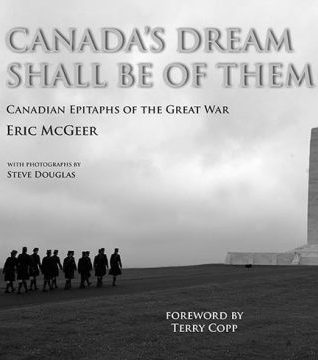
Book Review: “Jesus Calls”
In 1918 the Imperial War Graves Commission enacted two notable regulations. All dead were to be buried with their units, regardless of rank, near the spot where they fell. And all families of the dead could submit personal messages, to 66 characters, to be carved into kin’s headstones.
The effect was profound: mammoth, manicured battlefield cemeteries with indelible inscriptions. Wilfrid Laurier University Press asks, what did they write? Epitaphs were thoughtful, angry, ironic. They are collected in Canada’s Dream Shall Be Of Them. It is a beautiful, elegant book that will bring a reader to tears.
The epitaphs “were contributed not by the poets or artists we tend to associate with the Great War and modern memory, but by ordinary men and women,” writes Toronto historian Eric McGeer; “They are a window into another world, not a mirror to our own.”
The book is comprised of startling imagery by photographer Steve Douglas and McGeer’s crisp narrative. “Of the identified graves, just under half carry a personal inscription, many of which repeat formulae (‘Rest in peace’, ‘Gone but not forgotten’, ‘Son of…’) of little more than fleeting interest,” writes McGeer. “The number of inscriptions that offer insight into the minds of the bereaved, individually and collectively, comes to about 3,000,” approximately five percent of Canada’s war dead.
Headstone inscriptions were vetted – the Graves Commission reserved “absolute power of rejection or acceptance” on all submissions – though Commonwealth families were given latitude for personal expression. “Shot at dawn. One of the first to enlist. A worthy son of his father,” reads the epitaph of a British soldier executed for desertion. “Another life lost, hearts broken, for what?” says an Australian’s grave.
Canadian inscriptions expressed pride and loss. “Tell my mother I will meet her at the fountain,” reads the gravestone of Private William Rankin of the Royal Canadian Regiment, killed at age 17. “Frank! Jesus calls,” wrote the father of a private killed at 20. Other Canadian families wrote:
- • “An actor by profession. His last role. The noblest ever played”;
- • “He would give his dinner to a hungry dog and go without himself”;
- • “Last words to his comrade: ‘Go on. I’ll manage,” for a 21-year old private shot at Vimy;
- • “Just a high school boy, but a real man,” at the grave of a 19-year old;
- • “Enlisted voluntarily,” for a teenage francophone, in a curse on conscripts;
- • “It is finished,” on the headstone of a driver who died of wounds four days after the Armistice.
Most haunting is the fact few Canadian families would ever their see their hero’s grave. The epitaphs were written for posterity, not personal closure. “The only child of aged parents,” wrote the mother of a 16-year old private killed with the 58th Battalion. The family in six words described the end of the world in faraway France.
Canada’s Dream Shall Be of Them is stunning.
By Holly Doan
Canada’s Dream Shall Be of Them: Canadian Epitaphs of the Great War, by Eric McGeer; photos by Steve Douglas; Wilfrid Laurier University Press; 224 pages; ISBN 9781-77112-3105; $49.99
Drug Policy A Killer Says MP
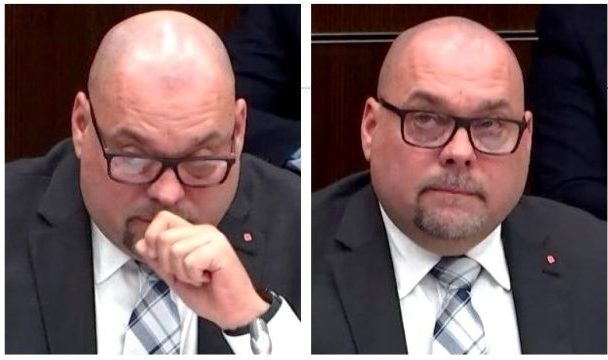
Cabinet must suspend its “safe supply” drug policy as a killer, says a member of the Commons health committee. Conservative MP Todd Doherty (Cariboo-Prince George, B.C.), choking back tears, told the committee he’d lost a brother-in-law to an accidental fentanyl overdose and was unable to save another brother “who lives on the street.”

Agency Lost 29,248 Fugitives
More than 29,000 foreign fugitives are at large nationwide, says the Canada Border Services Agency. Management in a report to MPs called it their “wanted inventory” including foreigners convicted of crimes: “I don’t quite understand why we would tolerate this.”
Committee Drops Nazi Probe
The House affairs committee yesterday dropped further public discussion into how a Waffen SS member was given a hero’s welcome on Parliament Hill. “Cover-up,” said one MP who pressed for public hearings: “What we have is the cover-up coalition at work yet again.”
Protecting MPs “Not My Job”
A former deputy minister of public safety yesterday testified it was “not my job” to warn a Conservative MP he was targeted by Chinese agents. Rob Stewart told the House affairs committee that foreign agents target “many people in Canada” that he never warned: “It was not my job to inform them.”
Calls Gov’t Hiring Worrisome
The size of the federal government’s payroll is worrisome, Budget Officer Yves Giroux said yesterday. The number of employees has increased 26 percent since 2015, by official estimate: “But we haven’t seen similar improvements when it comes to service.”