
MPs have taken another step to compel Prime Minister Mark Carney to sell millions in stock holdings. The Commons ethics committee on Friday asked that Parliament rewrite the Conflict Of Interest Act to eliminate what Conservatives have dubbed a “Carney loophole.”
OK’d $97K For “Inspiration”
Housing Minister Gregor Robertson’s department spent more than $97,000 to send managers to a two-day conference on homelessness for “inspiration,” Access To Information records show. Charges included $33,600 for hotels and $8,857 on restaurant meals: ‘It arms policymakers with inspiration.’
Labour Congress v. Minister
The Canadian Labour Congress president in a Commons petition accuses Labour Minister Patty Hajdu of misusing cabinet powers to “end a strike by simply sending an email.” The Congress seeks repeal of a federal law used by cabinet to quash eight legal strikes in the past 15 months: ‘It gives sweeping, undemocratic powers to the Minister.’
Bill Sends Message: Senators
An innocuous Senate bill to celebrate the history of immigration is actually intended to counter “xenophobic rhetoric,” say Liberal-appointed senators. Even the proposed timing of the bill was designed for lobbying purposes, the Senate social affairs committee was told: “Clearly the government is not doing it.”
Sunday Poem: “All Aboard”
Canadian politicians
love the train.
They either take Business Class
for added room and comfort,
or publicly denounce VIA executives
for failing to maintain
safety standards.
One way or the other,
it gets them to where they want to be.
(Editor’s note: poet Shai Ben-Shalom, an Israeli-born biologist, writes for Blacklock’s each and every Sunday)

Book Review — Pressman To PM
In 1895 when the Queen knighted Prime Minister Mackenzie Bowell, once a printer’s apprentice, newspapermen composed a ditty:
- When I was a boy I served my term
- As a junior imp in a printing firm
- I washed the windows and scrubbed the floor
- And daubed the ink on the office door
- I did the work so well, d’ye see
- That now I’m premier and a KCMG
Bowell quit school from Grade Four to scrub the floors at the Belleville Intelligencer and wound up owning the company. He was a drudge whose only escape was immersion in drudgery, clocking fifteen-hour days. Years later, when Bowell achieved fortune and fame, he kept a parrot trained to croak, “Wake-up.”
When Bowell died he received no state funeral. Even in life he was forgotten. Bowell spent a quarter-century languishing in the Senate to age 93. His papers in the national archives remained largely untouched.
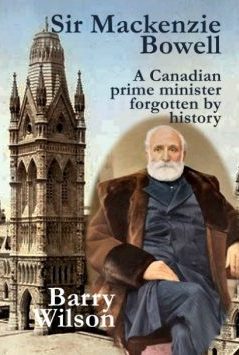
Sir Mackenzie Bowell: A Canadian Prime Minister Forgotten By History is an affectionate, candid portrait by Barry Wilson, for 35 years a reporter with the Western Producer. Bowell could have no more fitting biographer than an ex-newspaperman. “By any reasonable standard, his Canadian saga was an immigrant-makes-good success story,” writes Wilson.
Collective amnesia on Bowell’s tenure is forgiven. He was the Konstantin Chernenko of his era, a plodding apparatchik who faithfully toiled for the Party. A friend recalled Bowell was “decent and hardworking” but lacked “force,” “intelligence” and “modesty.”
Bowell did not become prime minister through caucus or grassroots support. His Conservative Party would not hold its first leadership convention until 1927. He served just sixteen months as leader before his ouster by cabinet rivals. He was “a competent workhorse,” writes Wilson.
Nor was Bowell entirely likable. He enjoyed backgammon so long as he won. “He flatters himself that he plays a pretty good game and thoroughly enjoys to win,” a reporter wrote in 1894. “If he is beaten, well, he wants another game.”
On meeting the gracious Hawaiian Queen Liliuokalani, composer of the haunting ballad Aloha Oe, Bowell considered her “ugly as a hedge fence.” Once aboard a Grand Trunk passenger train briefly held up by striking locomotive engineers, Wilson writes Bowell was so traumatized by the inconvenience even years afterward he would curse “uppity employees and their demanding unions.”
For all that Sir Mackenzie Bowell is a beautifully written and very Canadian account of an egalitarian society, then and now, without any landed gentry, where Mack the Printer’s Boy could make good. Wilson’s research is meticulous, though even he could not unearth elements of Bowell’s 1820s childhood to permit armchair psychoanalysis.
Bowell was a carpenter’s son who emigrated with his family from Suffolk at age 9. His mother died when he was 10, a family catastrophe that sent him to apprenticeship. Bowell was shop foreman by 17.
He rarely drank, never smoked, occasionally prayed at the office but was no proselytizing Methodist. He had a temper, once hurling a water glass at a Commons heckler, but a sense of humour, too. In an age of scoundrels in Ottawa, Bowell was never known to solicit a bribe or kickback. “A man must never weary,” Bowell said in an 1895 speech to the Young Conservative Club.
“If he puts his shoulder to the work, he must never hesitate but keep pushing, pushing until he attains the top,” said Bowell. “It is by plodding industry that you will be led to success.”
Mackenzie Bowell is Canadiana, warm and frank. If Canadians do not celebrate these stories, then who?
By Holly Doan
Sir Mackenzie Bowell: A Canadian Prime Minister Forgotten by History, by Barry Wilson; Loose Cannon Press; 276 pages; ISBN 9781-9886-57257; $22
PM Plan’s Same-Day Collapse
Prime Minister Mark Carney last night avoided questions amid the quick collapse of a much-touted plan to expand Alberta oil exports. Carney’s Québec lieutenant Steven Guilbeault abruptly quit cabinet as critics denounced the proposal as both reckless and ineffectual: “Stop wasting everyone’s time with this political posturing.”
Dentacare’s 50% Over Budget
A federal dental care plan has gone 50 percent over budget. The Department of Health acknowledged it underestimated the volume of claims now expected to top $4 billion this year: “All this is new.”
Post Seeks $500M More: MP
Canada Post seeks another line of credit from cabinet to cover ongoing losses, Conservative MP Jeremy Patzer (Swift Current-Grasslands, Sask.) yesterday told the Commons government operations committee. “Keep your eyes open,” said Patzer, who did not disclose the source of his information.
Feds Trying To Spare Feelings
Treasury Board President Shafqat Ali yesterday said he could not publicly detail federal job cuts to spare employees’ feelings. Cabinet has said it will cut a tenth of the payroll: “This is a real issue that impacts those public service employees and not only on them, their families.”
Question Unpaid War Claims
MPs are demanding the Department of Veterans Affairs account for millions in unpaid benefits for Métis veterans of the Second World War. A $30 million fund approved by Parliament paid only a fraction to old soldiers, sailors and air crew: ‘Detail the number of veterans who have received a payment.’
Disallows Corruption Query
Commons Speaker Francis Scarpaleggia yesterday banned MPs from Question Period enquiries concerning alleged corruption in the provincial Liberal Party in Québec. MPs questioned whether a former federal cabinet minister’s campaign paid $100 for Party votes: “I did not allow the question.”
Feds Like $25K French Fines
Federally regulated transport employers must conduct business in French as well as English under threat of $25,000 fines, Heritage Minister Steven Guilbeault said yesterday. Penalties will be initially enforced on three corporations and major airports nationwide: “French and English, anywhere, anytime.”
CN Must Compensate Client
The Federal Court in a landmark judgment has ordered Canadian National Railway to pay a customer more than $24 million in damages including lost profits due to poor service. The order followed 11 years of litigation and four trials stemming from the near-collapse of grain deliveries in the winter of 2014: “There is little precedent to guide this Court about how to assess damages.”
I’m Staying Put, Says Minister
Industry Minister Mélanie Joly, 46, yesterday said she had no interest in any patronage appointment abroad. Joly is one of three veteran Liberal MPs marking their 11th year in cabinet: “Absolutely not.”



