
The Department of Fisheries would consider any license application for ocean mining, staff wrote in a briefing note. Federal researchers have predicted little market for underwater mining in Canada since the country has ample minerals above sea level: “Seabed mining would be assessed based on the best available scientific knowledge.”
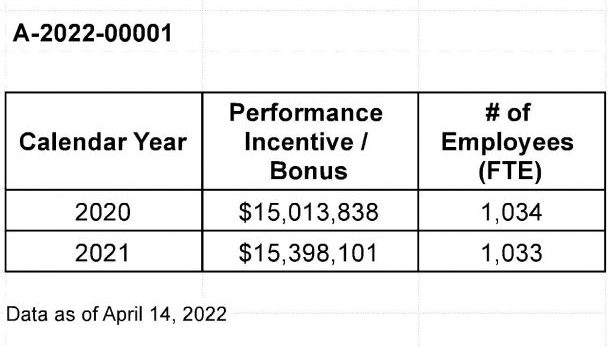
CBC Covid Bonuses At $30M
The CBC paid executives millions in Covid bonuses even as management complained of “immense pressure” with crashing ad revenue, records show. Bonuses were the equivalent of nearly $15,000 apiece: “It brings into serious question the judgment of executives in times of crisis.”
Found $10 Million For Tennis
A federal agency mandated to counter “slow economic growth” in Québec instead approved $10 million in subsidies for a Montréal tennis tournament, records show. The idea was to draw media attention to the province, said staff: “Funding for sporting events acts as a strategic lever.”
Can’t Cut Food Prices: Bibeau
Cabinet has minimal control over food prices, says Agriculture Minister Marie-Claude Bibeau’s office. However the Department of Agriculture acknowledged federal regulators raised wholesale prices for milk and butter at a rate higher than general inflation: “Federal governments deliberately have minimal direct involvement in managing food prices.”
Require A Vote To Expel MP
An MP who yesterday pleaded guilty to breach of the National Defence Act does not face automatic expulsion under Commons rules. Independent MP Kevin Vuong (Spadina-Fort York, Ont.) may only be stripped of his seat by a House vote: “I am proud to have served seven years now in our country’s largest naval reserve division.”
Paid For ‘Truth Day’ Holiday
An Ontario labour arbitrator has recognized National Day for Truth and Reconciliation as a paid holiday under a municipal union contract. Arbitrators across Canada have issued conflicting decisions on whether the federal holiday applies to others: “The matter was tried as a straightforward question of contract interpretation.”
Figures Contradict Tax Claim
Bus ridership nationwide remains below pre-pandemic rates despite record high gas prices, Statistics Canada data showed yesterday. The trend contradicts the rationale for a carbon tax that was to encourage commuters to burn less fuel, said the Canadian Taxpayers Federation: “They need to drive to support their families and the carbon tax makes that more expensive.”
Blame Slavery & Colonialism
A Department of Justice report blames Canadian slavery and colonialism for anti-Black racism though no Canadian Parliament legalized slavery and no Father of Confederation was a slaveholder. Canada remains the only G7 country never to maintain overseas colonies: “The oppressed status of Black people persisted long after slavery was abolished.”
Wore A Mask At His Trial
A Calgary judge has convicted a drunk driver though he was identified at trial while wearing a face mask in the prisoner’s box. “It was a fact known by everyone in the courtroom,” said the Court: “The person who answered the charge and entered the prisoner’s dock from the public gallery was wearing a face mask.”
Public Divided On Addiction
Canadians are divided over treatment of drug addiction, says in-house research by the Department of Health. A report summarizing new public opinion surveys was completed weeks before cabinet announced it was lifting a 1911 criminal ban on opioids and cocaine in British Columbia: “I don’t have much sympathy.”
Letter To “Dear Canadians…”
Governor General May Simon yesterday in a 1,300-word letter to Canadians said she has an important job. The letter addressed “Dear Canadians” comes ahead of Commons committee hearings into Simon’s expenses: “I think we all find it absurd.”
Find Job Claims Were Inflated
A billion-dollar program launched five years ago by then-Industry Minister Navdeep Bains did not come close to creating the 50,000 jobs it promised, says an internal audit. Even a lower estimate of 11,000 jobs was unverifiable, said auditors: “You’re claiming it. Where can we find that?”
Standing On Guard For Water
Canadians rate foreign demand for our plentiful fresh water as one of the biggest threats to sovereignty, according to Department of National Defence research. Parliament eight years ago passed a private Conservative bill banning the bulk export of Canadian water: “Fresh water could make the country a target for future conflict.”
Bill Was Hurry Up Then Wait
A cabinet bill on paid sick leave that was pushed through Parliament as a Covid emergency will not fully take effect for 17 months. Hurried passage prompted Senate grumbling that scrutiny of pandemic measures had become a “rubber stamping process.”
Convoy Hearings On Internet
Public hearings of the Freedom Convoy inquiry will be livestreamed on the internet for all Canadians to see regardless of whether TV networks broadcast proceedings. Internet publication of cabinet secrets is still under review, said the Public Order Emergency Commission: “Yes, the Commission plans to stream all its public hearings.”