Any future Conservative cabinet will again commemorate military exploits, John A. Macdonald and “our common Canadian identity,” Opposition Leader Pierre Poilievre said yesterday. Federal historical revisionism “weakened the bonds that used to tie us together,” he said: “We will be naming public monuments after Macdonald and many of our other historical figures.”
Air Security Tax Hits $832M
A mandatory security fee on all air travelers raised more than $832 million last year, a record, according to Access To Information documents. Cabinet hiked the fee 33 percent in its 2023 budget: “This is a tax on the flying public.”
Reject $2B Class Action Claim
A federal judge has dismissed a multi-billion dollar class action lawsuit alleging anti-Black hiring practices in the public service. The Federal Court cited a lack of evidence that thousands of individual hiring decisions over the past 55 years were the result of a colour bar: “No specific practice or policy is identified to substantiate this claim.”
Election Near As Gas Cut 18¢
Prime Minister Mark Carney has signaled an imminent election call with a gasoline price cut of 18¢ per litre. In a reversal of its signature climate plan, cabinet eliminated the consumer carbon tax effective April 1 after concluding it “created economic distortions.”
PM Won’t Discuss His Wealth
Prime Minister Mark Carney will not disclose stocks and other assets he and his wife hold with corporations on two continents including federal contractors. Carney told reporters he found it odd that anyone would ask: “That’s an odd question.”
Expect Costly G7 Lockdown
RCMP are preparing for a “large number of demonstrators” at a G7 summit in June, according to a briefing note. The Mounties initially budgeted more than $46 million for security at the two-day meeting, a sum expected to be a small fraction of the final cost: “The RCMP will be prepared to deal with a large number of demonstrators.”
PM Fires Or Demotes Rivals
Prime Minister Mark Carney fired or demoted two cabinet members who opposed him for the Liberal leadership. Carney praised former Deputy Prime Minister Chrystia Freeland as an “exceptional minister, exceptional public servant” but demoted her to Minister of Transport, the 11th position in cabinet’s order of precedence: “We have new ministers with new ideas.”
Hard Times Hit Book Trade
Canadian book publishers face hard times without ongoing federal aid, says a Department of Canadian Heritage report. The industry is short of money for long term investments despite 46 years of subsidies, it said: “Costs reduced profit margins, forcing booksellers to offer free or discounted shipping to compete with major e-commerce players like Amazon.”
Sunday Poem: “Illustration”
Cartoonists
taking aim at the White House
are making progress.
They figured out the
tailored suits,
facial expressions,
hair style.
Everything but the
thought bubble.
By Shai Ben-Shalom


Review: His Eyes Gave Him Away
On the job at the CBC, producer John Scully recalls a supervisor once reprimanded him for doing a crossword puzzle on company time. Scully ducked out for lunch with his wife and began to sob: “Not just a few drops, but waterfalls of howling public pain,” he writes. “People looked away in embarrassment, but I didn’t care where I was. I was grieving, grieving so passionately for the loss of my skills and the lack of understanding from my bosses. The crying lasted half an hour.”
The product of Scully’s torment is Am I Sane Yet? Clinically depressed for years – he consulted 40 doctors – Scully is also a skilled journalist with the concise eloquence you’d expect of someone who served 50 years in the newsroom. He is able to do what many other mentally ill Canadians cannot, document his own descent into self-agony.
There was the time he was speaking at a book launch when a lone heckler rattled him and Scully could barely finish his remarks: “Zip, I suddenly had a depression crash. The stress was too much. ‘Is that it? Is that all there is?’”
Trudeau’s Up For A Million
Prime Minister Justin Trudeau today leaves office with the prospect of $1 million to $2 million from the federal archives to buy his personal papers. Previous leaders also received seven-figure payments to “acquire, process, preserve and make accessible” their private records: “Documents deemed to have national importance are those that bear witness to the Canadian experience.”
‘Don’t Need Canada’: Trump
There is “not a thing that we need” from Canada, U.S. President Donald Trump said yesterday. His remarks came as a Canadian cabinet delegation met with the U.S. Department of Commerce in a bid to avert a tariff-driven recession: “We don’t need anything that they give.”
Bilingualism A Black ‘Barrier’
The Treasury Board is hiring private tutors to coach Black federal employees on how to learn French, records show. Too few Black staff are passing bilingual proficiency tests required for promotion as executives, it said: “Language training has been identified as a barrier for Black employees’ advancement.”
Careful Ruling On Wage Cut
The Federal Court has dismissed penalties against a construction company that paid foreign labour less than a posted rate. The judge cautioned the decision was narrowly based on facts in the case and must not be seen as “undermining strong worker protections.”
Says Bitcoin’s For Speculators
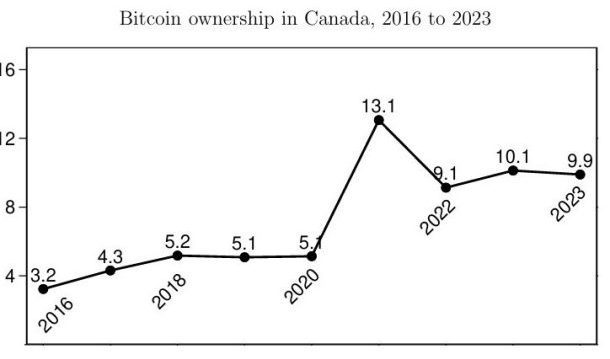
Bitcoin ownership in Canada is double pre-pandemic levels but remains low, Bank of Canada researchers said yesterday. Typical buyers were speculators under 34: “The primary reason for selling their holdings was cashing out for a profit.”