Ottawa Lost: The Old Court

It was a magnificent colonial landmark, Canada’s first Supreme Court building. Here a Laval tax lawyer, Louis St. Laurent, pleaded his first federal case in 1911. He made such a reputation in law he was later propelled to cabinet as justice minister and then the premiership in 1948.

St. Laurent was twice offered appointment to the Supreme Court but declined. “Low salary,” his secretary explained. In private practice St. Laurent earned $50,000 a year in the 1930s.

Even in politics he retained the habits of a corporate attorney. St. Laurent demanded punctuality, kept his cigarettes in a silver case and never campaigned without a black Homburg hat or a lectern, insisting that all speeches be triple-spaced so he could read a sentence at a glance.

He had little interest in “light conversation and exchanges of humour,” a friend said. The Ottawa Journal described St. Laurent as a tax lawyer who merely “played the part of prime minister.”

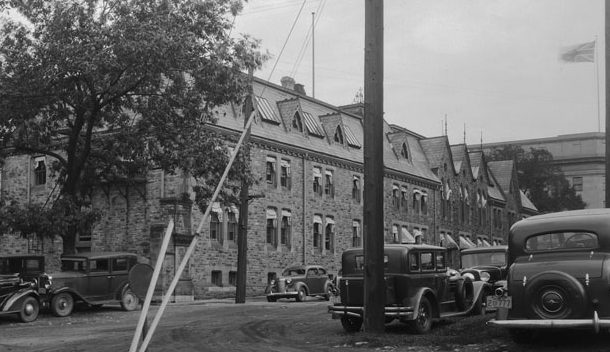
When he graduated at the top of his law class in Laval in 1905 the Supreme Court seemed the pinnacle of ambition. The court’s home from 1882 stood at the corner of Bank and Wellington Streets in Ottawa, at the foot of Parliament Hill.

Designed in a subdued Gothic Revival style, it mirrored the larger Parliamentary precinct buildings. The architect was Thomas Fuller, renowned in the Confederation era. Fuller designed Parliament itself and the Prime Minister’s Office, the Halifax Armoury and Toronto’s St. Stephen-in-the-Fields Anglican Church.

The courthouse was a witness to history. It heard pleas in the great conflicts of the era – rebellion and conscription, prohibition and the “persons” case that qualified women for federal appointments.

From his appointment to cabinet in 1941, St. Laurent passed the courthouse often. He walked to work from his apartment on Elgin Street and walked back home for lunch, “free from guards, sycophants or self-importance,” noted historian Desmond Morton.

The postwar era was not kind to architecture in the capital. Whole blocks of vintage homes and landmark buildings on Wellington Street were razed to make way for new structures including a modern Supreme Court, completed in 1945. The original court was left neglected and fell into disuse.

How much did St. Laurent care about the old courthouse where he’d made his name as a young barrister? As prime minister in 1956 he deemed the courthouse a fire trap and had it demolished to make way for a parking lot.  It remains the only Parliament Hill structure to be razed by cabinet order.

Afterwards in 1976 a statue of St. Laurent was placed on the lawn of the new Supreme Court of Canada on Wellington Street. The site of the old courthouse today is the main RCMP vehicle checkpoint on Parliament Hill.

By Andrew Elliott

Book Review: Land Fit For The Vikings

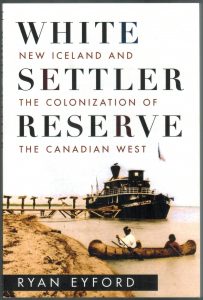
Parliament for 90 years enforced a White Canada immigration policy intended to create an all-Caucasian society, literally a Great White North. It was built on crude and false assumptions of racial characteristics. Lawmakers and educators rarely speak of it today though the painful topic has inspired excellent academic research like White Settler Reserve, an exposé of attempts to create a Nordic master race on the Prairies.

It was a “special experiment of immigrant colonization,” newspapermen wrote in 1875. Cabinet subsidized Icelandic immigrants to colonize the southwest shore of Lake Winnipeg on territorial lands of the Cree, Ojibwe and Métis. Among the 19th century settlers were the great-great-grandparents of Professor Ryan Eyford of the University of Winnipeg, who chronicles the experiment in a crisp narrative.

“Contemporary European racial theories posited that Icelanders should be part of the dominant race,” writes Eyford.  “Canadian elites typically believed that ‘northern peoples’ were ideally suited to become colonists and future citizens, and thus the Icelanders were recruited and settled in the Northwest.”

Some 285 Icelanders were the first to arrive in 1875. Governor General Lord Dufferin called them “the grand old Norse race. Wrote Dufferin: “They very much resemble the Norwegians”; “They are quiet peaceable folk, Lutheran in religion, but not fanatical.”

White Settler Reserve explains, “Iceland was a source of endless fascination to European Romanticism because of its presumed isolation from world history. Philologists claimed that the Icelandic language was the ancient Norse tongue, once common to all Scandinavia, and ethnologists argued that Icelandic people were a racial anachronism, a strand of the ancient northern race preserved on an isolated northern isle.”

The campaign worked nicely in depopulating Iceland. Between 1870 and 1914 the island lost about a quarter of its population, about 20,000 men, women and children. The majority of immigrants came to Canada.

Icelanders were offered discounted steamship tickets and 160 acres free of charge under the 1872 Dominion Lands Act providing they busted sod and grew crops. They built communities named New Iceland and Gimli and Voger, Manitoba.

They also suffered from scurvy and smallpox, fire and flood, and the snide remarks of government agents who concluded they were not the Viking supermen Ottawa was looking for. The chief medical officer in Gimli described settlers as weak and lazy, “listless,” “dejected” and “apathetic.”

“Centuries of isolation and intermarriage have had the effect of reducing their physical condition to a point below which they are likely to be successful,” wrote the Gimli doctor.

White Settler Reserve exposes one of those corners of Canadiana omitted from official records and federal observances. It is shocking and intriguing, the best kind of history.

By Holly Doan

White Settler Reserve: New Iceland and the Colonization of the Canadian West, by Ryan Eyford; University of British Columbia Press; 272 pages; ISBN 9780-7748-31598; $32.95

NDPer Targets Jewish Charity

New Democrat leadership contender MP Heather McPherson (Edmonton Strathcona) yesterday had no comment after sponsoring a Commons petition targeting a Jewish charity co-founded by Heather Reisman, CEO of Indigo Books. The petition also asked Parliament to screen all Canadians returning from Israel for complicity in alleged war crimes: “I have to feel in my heart that I’ve done what I can.”

This content is for Blacklock’s Reporter members only. Please login to view this content. (Register here.)

No Firing For Late Deliveries

A labour arbitrator has overturned Canada Post’s firing of a mail carrier who kept thousands of undelivered letters in his vehicle for months at a time. Inspectors found 6,000 pieces of mail including urgent notices: “This can only be seen as very abnormal behaviour.”

This content is for Blacklock’s Reporter members only. Please login to view this content. (Register here.)

Industry’s Set Back 15 Years

Repeal of U.S. climate mandates set the industry back “at least 15 years,” says a Department of Environment briefing note. Cabinet to date has yet to report on its review of Canada’s electric auto mandate though it was due December 31: “Why the mandate?”

This content is for Blacklock’s Reporter members only. Please login to view this content. (Register here.)

It’s Weathermen v. Machines

A federal agency is shopping for artificial intelligence software to replace a “specialized team” of bilingual employees paid to translate weather bulletins. The proposal by the Meteorological Service of Canada is the first of its kind in the federal use of AI: ‘It would rely solely on machine to machine communication.’

This content is for Blacklock’s Reporter members only. Please login to view this content. (Register here.)

Freeland Averts Ethics Probe

Liberal MP Chrystia Freeland (University-Rosedale, Ont.) will quit Parliament tomorrow in an abrupt departure that averts any Commons ethics committee questioning over conflicts of interest. Freeland’s announcement came only hours after the committee chair expressed outrage over her conduct: “When did we become a country where laws, ethics and morality don’t matter anymore?”

This content is for Blacklock’s Reporter members only. Please login to view this content. (Register here.)

Once A Threat, Now Partners

China represents a “new partnership” for growth, Prime Minister Mark Carney said yesterday in confirming a January 13 trip to Beijing to meet President Xi Jinping. It is the first conference of its kind since Carney called China our worst security threat and a federal inquiry likened Communist Party meddling in Canadian elections to a national crime: “I’ll choose my words carefully.”

This content is for Blacklock’s Reporter members only. Please login to view this content. (Register here.)

Public Budgeting For Tariffs

A majority of Canadians surveyed, 64 percent, say they changed their household spending habits because of tariffs. Federal researchers found 80 percent concluded U.S. President Donald Trump’s policy had made everyday goods more expensive: “How worried are you that tariffs might reduce your household income?”

This content is for Blacklock’s Reporter members only. Please login to view this content. (Register here.)

Ten Years And Zero Charges

The Canada Revenue Agency ten years into its investigation of tax avoidance by wealthy clients of a Panamanian law firm has not laid a single charge in the case, records show. Cabinet a decade ago said the Panama Papers case involved thousands of Canadians deemed “high risk.”

This content is for Blacklock’s Reporter members only. Please login to view this content. (Register here.)

Sought ‘Non-Binary’ Job Stats

Statistics Canada reviewed whether to add a “non-binary” gender category in its monthly jobless reports but concluded the population was too small for accurate data, says a labour department report. Less than a quarter of one percent of Canadians identify as transgender or non-binary: “Given the non-binary population is small, data aggregation to a two-category gender variable is necessary.”

This content is for Blacklock’s Reporter members only. Please login to view this content. (Register here.)

Wants Federal Rent Controls

Parliament should federalize rent controls and cover late payments for tenants “at risk of immediate homelessness,” says the only MP in the federal New Democrat leadership race. Heather McPherson (Edmonton Strathcona) yesterday said regulation must not be left to landlords and local authorities: “Affordable housing is non-negotiable.”

This content is for Blacklock’s Reporter members only. Please login to view this content. (Register here.)

Vacancy Tax Barely Worth It

A now-suspended tax on foreign-owned vacant residences cost nearly as much to collect as it raised in cash, according to Canada Revenue Agency figures. Finance Minister François-Philippe Champagne announced repeal of the tax last November 4: “The form is six pages long.”

This content is for Blacklock’s Reporter members only. Please login to view this content. (Register here.)